About
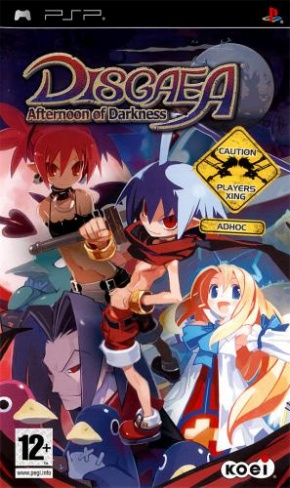
Disgaea: Afternoon of Darkness for PSP is Nippon Ichi Software’s expanded handheld edition of the tactical role-playing game that began on PlayStation 2 as Disgaea: Hour of Darkness. Released in North America by NIS America on October 30, 2007, it brings the first Disgaea adventure to Sony’s portable system under a new English title; Koei published the European and Australian editions later that year. The story opens in the Netherworld after demon prince Laharl wakes from a two-year sleep to learn that his father, King Krichevskoy, has died. With the throne suddenly contested, Laharl sets out to establish himself as Overlord alongside his sharp-tongued vassal Etna and the idealistic angel trainee Flonne.
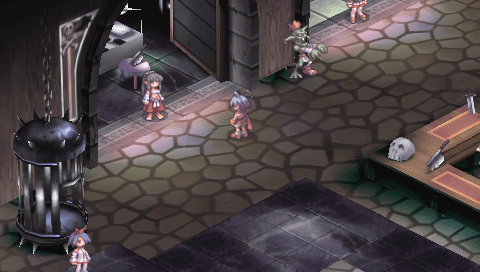
At its heart, the game is a turn-based strategy RPG built around battles on square, isometric maps. Before acting, players position a party of humanlike fighters and monsters, then select movement, attacks, spells, skills, item use, or defensive choices one unit at a time. Victory generally comes from defeating the opposing force, but the open layouts encourage players to think about distance, elevation, attack ranges, and the order of their turns. Characters can cooperate in combos and use powerful special attacks, while battles reward experience, money, mana, equipment, and access to further character development.
Disgaea’s tactical identity comes from mechanics that let a map become part of the puzzle. Humanoid units can lift and throw allies or enemies, making it possible to extend movement, remove a foe from a key position, or toss a unit toward an objective. Many stages also use colored Geo Panels and movable Geo Symbols. A symbol grants an effect to panels of its color, which might benefit or hinder units standing there. Breaking or moving symbols can trigger a sequence of color changes and explosions, so clearing a dangerous layout can become as important as a direct attack. Careful use of these systems can also build bonuses at the end of a battle.
The Overlord’s Castle functions as the central hub between story chapters. From there, Laharl’s party visits combat maps, buys weapons and armor, heals wounded allies, and speaks with the Dark Assembly. The Assembly uses proposals and votes to govern options such as improving shops, creating characters, or opening new opportunities; mana earned by individual characters supports these requests, and items can be used to influence reluctant senators. Another major diversion is the Item World, a series of randomly generated floors entered through an item itself. Surviving its battles and confronting its residents raises the item’s potential, giving the equipment system a long-term progression path beyond the main campaign.
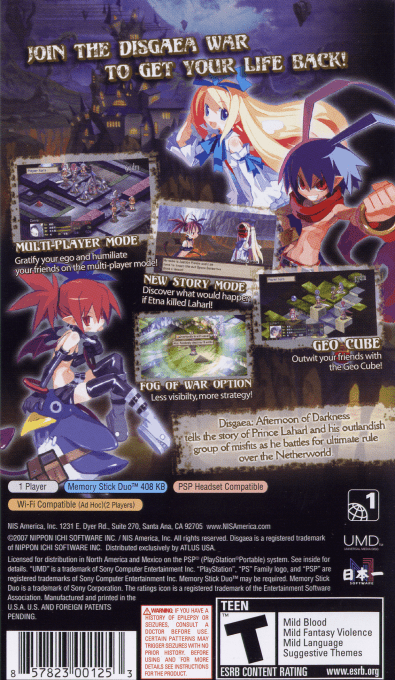
The PSP version is more than a straight conversion of the 2003 PlayStation 2 game. It supports the handheld’s widescreen presentation and adds an Etna Mode, an alternate scenario in which Etna becomes the lead character after an early change to the opening events. It also includes additional battles and guest encounters, a music shop, a record keeper, and the option to disable battle animations. Local wireless Ad Hoc multiplayer lets two players use prepared teams in modes including standard battle, Capture the Flag, and Defeat the Leader; Geo Cubes add special battlefield effects to these matches. These additions distinguish Afternoon of Darkness from the original release while preserving its campaign and systems.
The setting balances demon politics, angels, science-fiction visitors from Earth, exaggerated character comedy, and the series’ recognizable explosive Prinnies. Laharl’s pursuit of the throne gradually brings a larger cast into the conflict, including Captain Gordon, Jennifer, the robot Thursday, and the self-styled “Dark Adonis” Vyers. Multiple endings give the campaign some replay value, while optional challenges and deep character and item advancement extend play after the story. As the portable form of the first Disgaea, Disgaea: Afternoon of Darkness establishes the strategic combat, irreverent Netherworld tone, and systems-driven experimentation that became central to the series.
Gallery
Details
- Developer
- Koei
- Publisher
- Nippon Ichi Software
- Genre
- Tactical RPG
- Players
- 2
- Release Date
- October 30, 2007
- System
- PSP