About
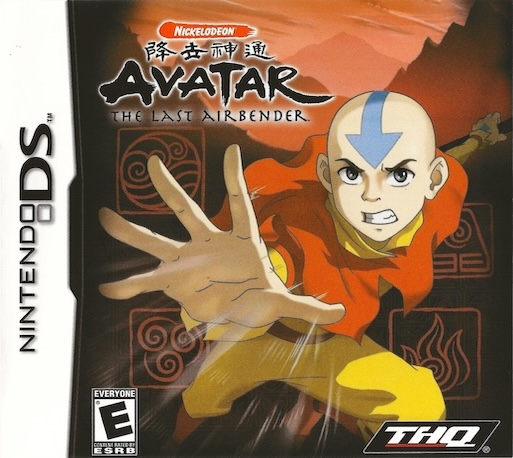
Avatar: The Last Airbender for Nintendo DS is a 2006 single-player action-adventure game based on Nickelodeon’s animated series. Developed by TOSE and published by THQ, this handheld version brings Aang’s world to the DS with an original story set between the show’s first and second books. It arrived in North America on October 10, 2006 and was released in Europe and Australia as Avatar: The Legend of Aang, making it distinct from the later games based on the same series and from the 2010 film tie-in.
The adventure follows Avatar Aang, Katara, Sokka, and the earthbender Haru as they confront a Fire Nation threat involving attacks, captured allies, and dangerous machines. Rather than retell a single television episode, the game sends the group through a self-contained quest that visits familiar corners of the Avatar setting while introducing characters and conflicts made for the game. Prince Zuko appears as a recurring pursuer, while the party’s investigation gradually leads toward the people and machinery behind the raids.
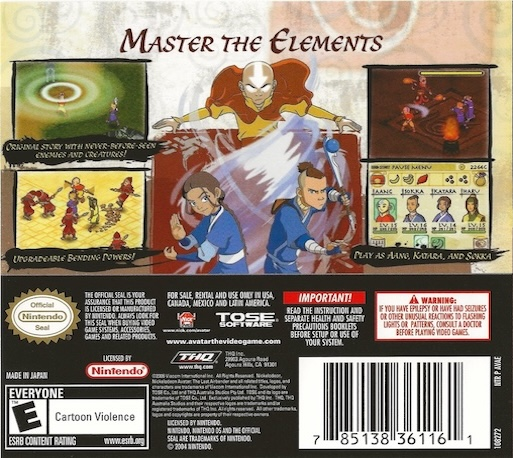
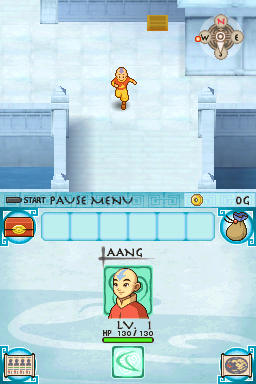
Players guide a four-character party through a succession of areas, talking to characters, taking on objectives, searching for useful supplies, and fighting enemies drawn from the Fire Nation’s forces. The Nintendo DS game is built around direct, top-down action: progress generally means clearing hostile encounters, pursuing the next story goal, and overcoming obstacles in the route ahead. It is a single-player journey, with the party members accompanying the player rather than a separate multiplayer mode.
Each hero brings a different style to combat. Aang uses airbending, Katara fights with waterbending, Haru contributes earthbending attacks, and Sokka relies on his weapon skills instead of bending. The party system lets players choose among the characters, and experience earned in battle supports the acquisition of additional abilities. That contrast gives the game’s action a simple tactical layer, since a character’s elemental attacks can change how a fight feels even though the overall structure remains an accessible handheld brawler.
Role-playing touches surround the action. Characters can use equipment, healing items, chi-related supplies, and other collectible resources, while some materials can be taken to artisans to create special items. Battles feature Fire Nation soldiers alongside machines and creatures, and the game mixes those encounters with quest objectives and light exploration. Its story is delivered through comic-style dialogue presentation, with longer scenes using recorded voices associated with the television cast, helping the DS adaptation retain the licensed series’ characters and atmosphere.
Visually, Avatar: The Last Airbender on Nintendo DS combines animated 2D character sprites with 3D environments. The approach allows the small handheld screen to show the show’s heroes moving through villages, outdoor locations, and other stylized settings while keeping the action readable. As the first entry in THQ’s Avatar game line, it was followed by Avatar: The Last Airbender – The Burning Earth in 2007. For players exploring the franchise’s earlier game adaptations, the 2006 DS release stands as a separate portable interpretation of Aang’s first major video-game adventure.
Gallery
Details
- Developer
- THQ
- Publisher
- THQ
- Genre
- Action-Adventure
- Players
- 1
- Release Date
- October 10, 2006
- System
- NDS