About
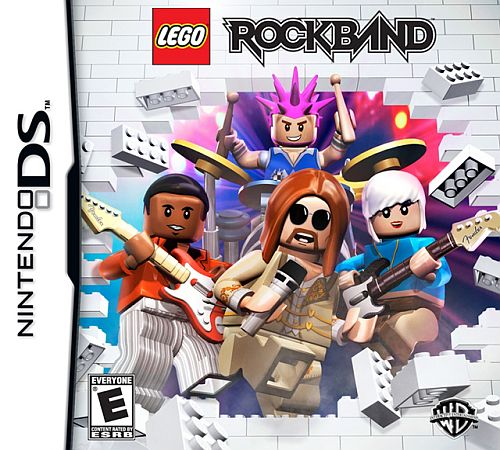
LEGO Rock Band Nintendo DS is a 2009 rhythm game developed by Backbone Entertainment and published by Warner Bros. Interactive Entertainment. It brings the Rock Band and LEGO franchises to Nintendo’s dual-screen handheld in a form designed specifically for the system, rather than simply recreating the Xbox 360, PlayStation 3, and Wii editions. The game turns a band’s rise from small gigs into a colorful LEGO-styled career, combining licensed pop and rock music with collectible studs, customizable minifigures, and the playful fantasy of LEGO games.
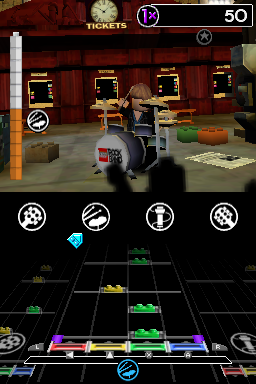
The Nintendo DS version abandons the plastic guitar, drum, and microphone peripherals used by the home-console releases. Instead, one player manages an entire four-piece group, moving between guitar, bass, drums, and vocals as the song plays. Colored note lanes are handled with the DS face buttons, while the shoulder buttons switch between the active band members. That constant rotation is the central challenge: a strong performance on one part is not enough if the other musicians are left unattended.
Each instrument has a happiness meter that gradually drains, so successful note runs must be followed by a purple brick that secures the player’s progress and lets the band member remain satisfied for a time. Keeping all four performers happy preserves the scoring multiplier and helps earn stars. Difficulty settings range from the beginner-friendly Super Easy mode through Expert, allowing the same compact control scheme to serve newcomers and players looking for denser note patterns. The design shares its band-juggling approach with the portable Rock Band Unplugged, but was tailored around the DS buttons and screens.
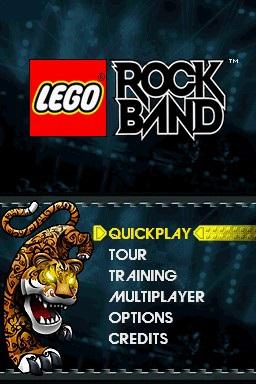
Career play follows the band from early appearances toward bigger venues. Stars and fans earned from performances open further gigs and locations, while studs function as the game’s LEGO-style reward currency. Players can use their earnings for items that personalize the band’s hangout and its minifigure look. Special Rock Power Challenges add a more overtly comic LEGO twist to the tour: completing musical objectives can solve exaggerated problems such as clearing away a troublesome ghost. Quick Play is available for immediately selecting songs outside the career.
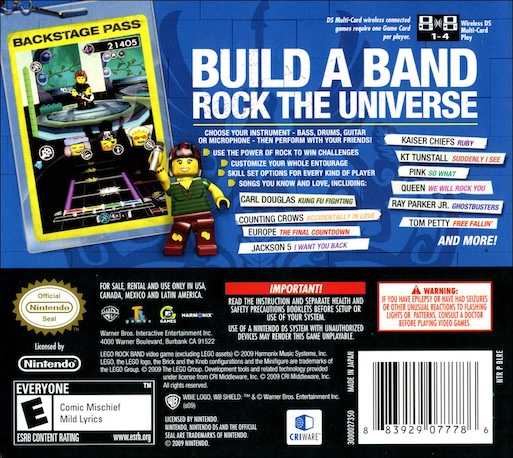
LEGO Rock Band on DS includes 25 songs, a smaller selection than the 45-track home-console soundtrack. The family-oriented lineup spans artists and songs such as David Bowie’s “Let’s Dance,” Iggy Pop’s “The Passenger,” Queen’s “We Will Rock You,” the Jackson 5’s “I Want You Back,” Europe’s “The Final Countdown,” and Vampire Weekend’s “A-Punk.” Several famous performers also appear as LEGO-style characters when their music is played, extending the licensed presentation beyond the track list. Unlike the console versions, this handheld release did not use downloadable songs, so its built-in playlist defines the available repertoire.
The game supports local wireless multiplayer for up to four Nintendo DS systems, letting participants take separate instrumental roles in cooperative or competitive play. That option complements the solo design, where one person must balance every lane themselves. Its all-button approach also means it works without special accessories and remains compatible with the Nintendo DSi, whose lack of a Game Boy Advance slot complicated some other DS music-game peripherals.
As part of both the LEGO and Rock Band series, LEGO Rock Band Nintendo DS captures the series’ performance-and-progression loop in a portable format with a different rhythm-game structure from its console counterparts. The combination of instrument switching, purple-note timing, customization, and short-form career goals gives the DS edition its own identity. For players seeking a handheld Rock Band experience that emphasizes managing the whole band rather than mastering a single controller, it is a distinct 2009 adaptation rather than a direct console port.
Gallery
Details
- Developer
- Backbone Entertainment
- Publisher
- Warner Bros. Games
- Genre
- Rhythm Game
- Players
- 1
- Release Date
- November 3, 2009
- System
- NDS