About
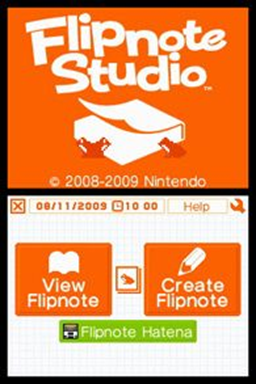
Flipnote Studio for Nintendo DSi is Nintendo’s free DSiWare creative application, released in Japan in late 2008 and in North America and Europe during August 2009. Known in Japan as Ugoku Memocho, or “Moving Notepad,” it turns the DSi’s touch screen, stylus, microphone, and wireless functions into a compact tool for handwritten notes and frame-by-frame animation. Rather than presenting levels or a conventional game campaign, Flipnote Studio invites one player to make short creations called Flipnotes: drawings that can remain simple memos or become animated sketches with sound.
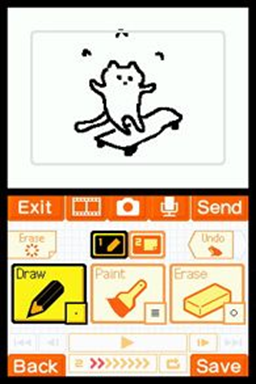
The central process begins on the lower touch screen. A creator draws a page with the stylus, adds another page, and then plays the sequence back to produce movement in the manner of a flipbook. Pen, brush, eraser, fill, selection, and copy-and-paste tools make it possible to build an image gradually, while the page-management screen handles inserting, removing, and arranging frames. Animation speed can be adjusted, so a quick gag, a looping motion, or a longer illustrated sequence can be timed to suit the idea. The D-pad also provides direct shortcuts while working and previewing, keeping many operations on the handheld’s physical controls instead of menus alone.
Flipnote Studio’s modest DSi presentation gives the user a deliberately restricted animation workspace. Each frame can use two drawing layers, allowing a background to stay in place while the foreground changes, and draft and onion-skin-style aids help artists keep movement and proportions consistent from page to page. Flip, resize, and layer tools offer simple ways to transform a drawing without starting again. That design is suited both to quick notes and to the careful repetition required by traditional animation: the appeal comes from experimenting with a limited set of marks and seeing them move when the pages are played in order.
Sound is an equally important part of a finished Flipnote. The Nintendo DSi microphone can record brief vocal clips, effects, or music, and the application can also work with audio saved through Nintendo DSi Sound. These recordings can be combined into a soundtrack for an animation. Creators could also incorporate pictures from the DSi Camera Album, giving the tool another route from a photo or sketch to a moving sequence. A Flipnote could therefore be a handwritten reminder, an illustrated diary entry, a miniature cartoon, or an audiovisual message, depending on how its pages and sound were assembled.
Sharing originally extended the studio beyond one system. Finished Flipnotes could be exchanged directly with other DSi users through the system’s wireless communication, while the online Flipnote Hatena community, operated by Hatena, let connected users upload work, browse themed channels, download creations, give them Stars, and comment. Depending on the creator’s settings, downloaded animations could be altered and expanded before being shared again. Nintendo’s official service notice records that Flipnote Hatena ended on May 31, 2013, so those network functions are part of the application’s historical context rather than an available feature today; the core note-making and animation tools remain the defining experience on the DSi.
The application’s origin reflects that blend of personal creation and audience participation. In Nintendo’s Iwata Asks interview, producer Yoshiaki Koizumi and programmer Hideaki Shimizu describe an early drawing-and-sound prototype that developed from their own experimental project into a notepad and animation tool, with the Nintendo DSi proving a natural fit. Flipnote Studio later led to the Nintendo 3DS application Flipnote Studio 3D, but this DSi original remains distinct for its stylus-led flipbook format and the community of user-made animations built around Flipnote Hatena.
Gallery

Details
- Developer
- Nintendo
- Publisher
- Nintendo
- Genre
- Productivity
- Players
- 1
- Release Date
- August 12, 2009
- System
- NDS