About
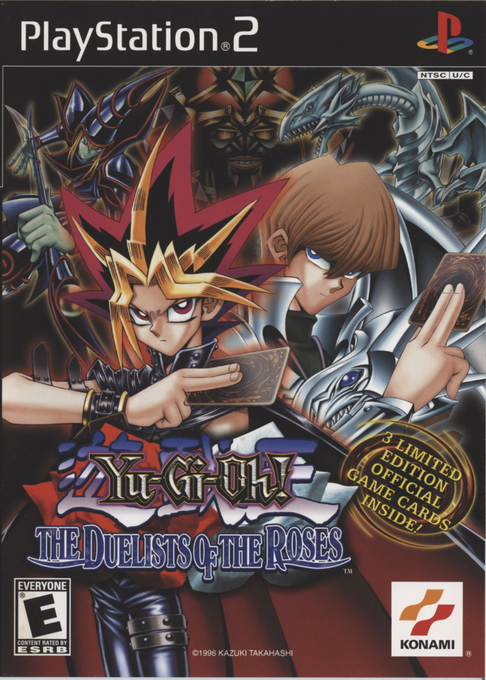
Yu-Gi-Oh! The Duelists of the Roses for PlayStation 2 is Konami's strategy-card interpretation of Kazuki Takahashi's Yu-Gi-Oh! world. Developed and published by Konami, it debuted in Japan on September 6, 2001 as Yu-Gi-Oh! Shin Duel Monsters II: Keishō Sareta Kioku, then arrived in North America in February 2003 and Europe later that year. Rather than reproduce a standard Trading Card Game match, this PS2 entry turns familiar cards, monsters, and anime characters into a campaign fought across a tactical board. It also follows the earlier PlayStation game Yu-Gi-Oh! Forbidden Memories in spirit and story references, while giving its duels a distinctly different presentation and structure.
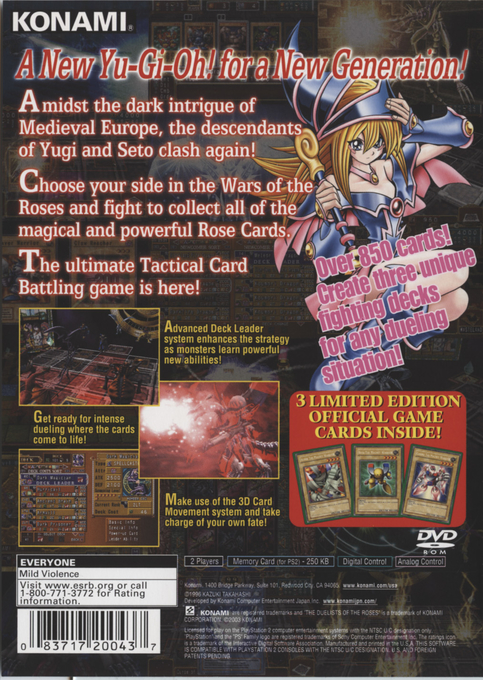
The setting blends the series with a fantasy version of England's Wars of the Roses. The player is a Rose Duelist summoned into a conflict between the Red Rose and White Rose factions, with Yugi and Kaiba recast as rival leaders. Early in the adventure, the player chooses a side; that decision changes the sequence of opponents and the route through the campaign. The struggle centers on magical Rose Cards, while recognizable Yu-Gi-Oh! characters appear under roles within the two armies. This alternate-history premise gives the solo game a larger objective than isolated exhibitions: win duels, take the opposing side's rose cards, and advance toward the confrontation at Stonehenge.
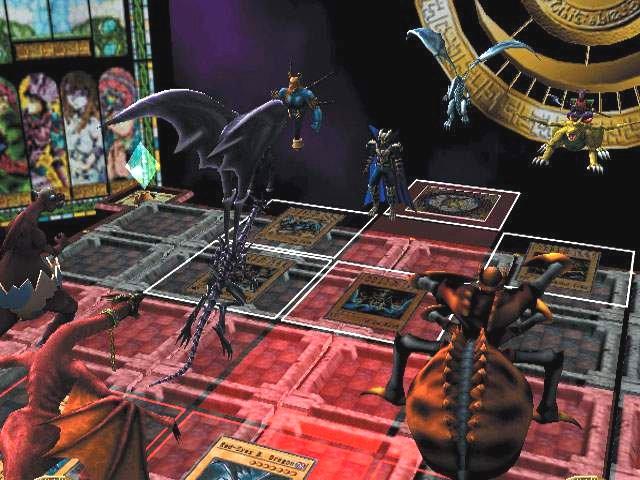
Each battle takes place on a seven-by-seven field. Players deploy monsters around a chosen Deck Leader and move them square by square, so placement and paths matter as much as a card's printed combat values. Terrain affects the outcome: different spaces can favor particular monster types, while unusual spaces such as water, mountains, forests, and other special ground reshape a route across the board. Monsters are often placed face down before contact, making scouting and positioning part of every turn. A direct attack on the opposing Deck Leader can end a duel, and surrounding that leader's summoning spaces provides another route to victory. The result is a turn-based contest where a powerful card alone does not guarantee a clear path to the enemy.
Deck construction is equally important. A deck contains forty cards, but it must satisfy the deck-cost limit attached to a particular duel. That restriction encourages players to weigh strong creatures against economical choices instead of simply loading every high-stat card available. Monster, magic, and trap cards all serve within the board system, and combat resolves when opposing monsters meet. Victories feed back into progression through card rewards, including a graveyard-slot selection after a duel. The game also includes Reincarnation, which trades a card for a random group of replacements, making collection management part of the long campaign rather than an afterthought.
The Deck Leader system is one of The Duelists of the Roses' defining ideas. A promoted monster can become the leader that represents the player on the field, and its experience grows through survival, combat, and attacks. Promotions can unlock leader abilities, giving chosen monsters practical value beyond their usual attack and defense figures. Because the leader is both a vital game piece and the source of new placements, deciding whether to advance, protect it, or use its position to pressure the opponent becomes a central tactical question. Konami's PS2 presentation supported this experimental format with three-dimensional monster models, bringing the card clashes into motion on the battlefield.
The Western release was packaged with three exclusive trading cards, reflecting the close connection between the video game and the physical Yu-Gi-Oh! card phenomenon of the period. Its Japanese title and release preceded the English-language edition, and the localized version is the one known as Yu-Gi-Oh! The Duelists of the Roses. For players looking for a PlayStation 2 Yu-Gi-Oh! game built around campaigns, terrain, card collection, and board control rather than conventional head-to-head card rules, it remains a notable early-2000s Konami take on the series.
Gallery
Details
- Developer
- Konami
- Publisher
- Konami
- Genre
- Card Game
- Players
- 1-2
- Release Date
- September 6, 2001
- System
- PS2