About
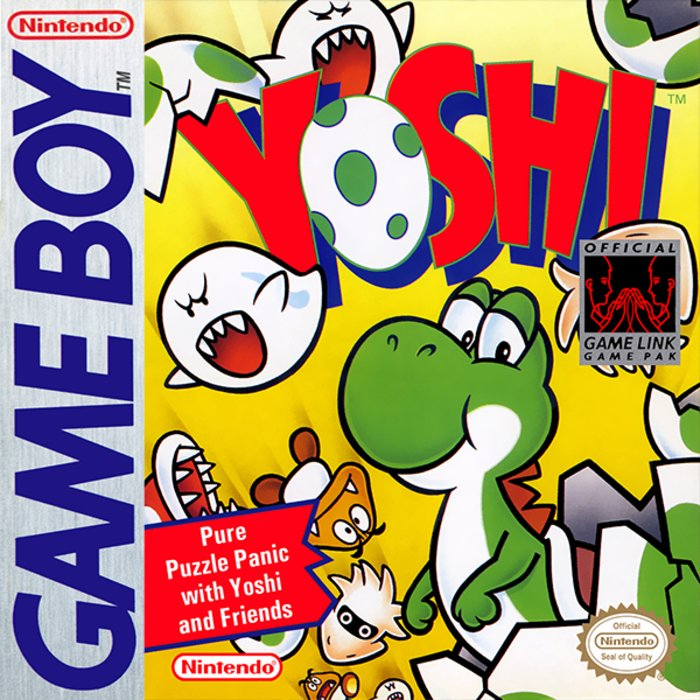
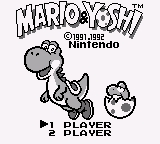
Yoshi for Game Boy is a monochrome falling-piece puzzle game developed by Game Freak and published by Nintendo. It debuted in Japan on December 14, 1991 alongside a Nintendo Entertainment System edition, then reached North America as Yoshi in 1992. In PAL territories it was called Mario & Yoshi, while the Japanese title was Yoshi no Tamago. Rather than a platform adventure, this early Mario-universe spin-off puts Mario below a compact four-column playfield, where he must keep an invasion of familiar enemies from filling the screen.
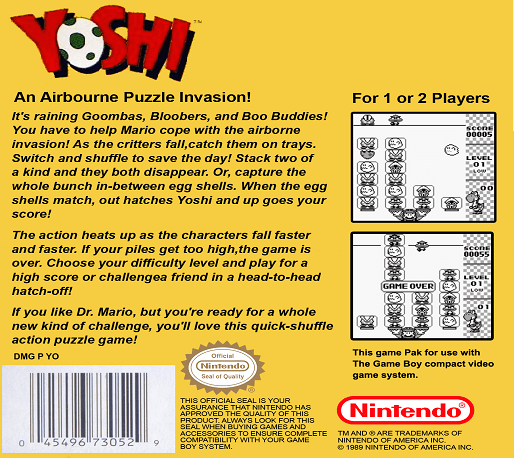
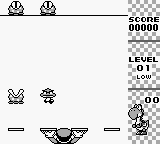
Goombas, Bloopers, Boo Buddies, and Piranha Plants descend one at a time into the columns and become blocks when they land. Mario can switch any neighboring pair of stacks, making position rather than direct movement the central control. A falling monster clears itself and the matching block when it lands on the same enemy type. Because only the pieces at the tops of stacks can be paired this way, each switch has consequences for what can be matched next. The pace rises as play continues, and the game ends when a column grows past the limit at the top of the field.
The egg-shell pieces provide Yoshi's signature scoring opportunity. A lower half can sit within a stack until a matching upper half falls into the same column. When the two halves meet, every enemy trapped between them is cleared and a Yoshi hatches. Enclosing more enemies produces a larger Yoshi and a greater bonus, so an apparent obstruction can become a useful setup if it is protected long enough. This risk-and-reward element sits alongside the ordinary matching rule: players constantly decide whether to clear a stack immediately or preserve it for an egg combination.
Its Game Boy presentation translates the rules into a deliberately small, readable play area. The system's directional controls move Mario's selection across the four columns and perform the swaps, while the falling sequence supplies the changing puzzle. The Game Boy version has room for seven objects in a stack, one fewer than the NES version, so space management is especially important. Mario appears as the player character beneath the board, while the enemies and egg shells turn recognizable Mario imagery into the pieces of a competitive score chase.
Yoshi includes more than one way to play. A-Type is the open-ended solo challenge, focused on surviving and building a score as the falling pieces accelerate. B-Type instead begins with blocks already arranged on the board and asks the player to clear the field; later stages increase the starting clutter. The Game Boy cartridge also supports a two-player contest with a second Game Boy and Game Link Cable. Each player works on a separate board, and a round can be won by clearing the field or outlasting the opponent; the first player to win three rounds takes the match. A password feature lets players record progress for later.
The release is notable as an early collaboration between Nintendo and Game Freak, years before Game Freak became closely associated with Pokémon. It also arrived soon after Yoshi's first appearance in Super Mario World, using the new character's egg imagery in a puzzle format rather than building a game around platforming. Yoshi is therefore a distinct entry in the broader Mario and Yoshi catalogue: a quick, stack-switching Game Boy puzzle game whose goal is to turn falling enemies and paired egg shells into carefully timed clears.
Gallery
Details
- Developer
- Game Freak
- Publisher
- Nintendo
- Genre
- Logic Puzzle
- Players
- 1-2
- Release Date
- December 14, 1991
- System
- GB