About
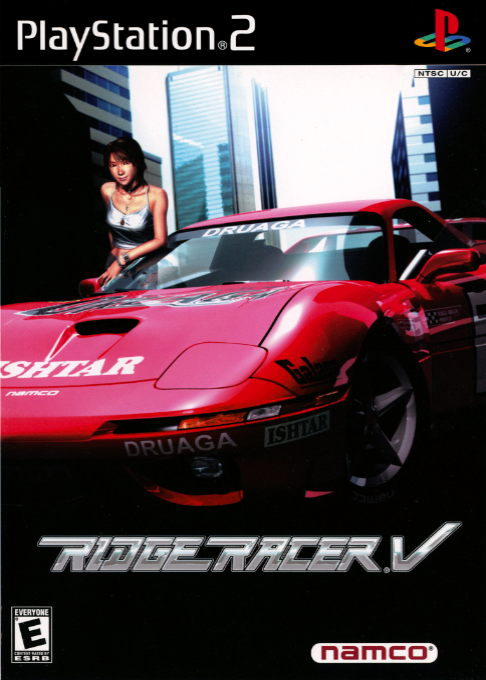
Ridge Racer V is Namco’s arcade-style racing game for PlayStation 2, released in 2000 as one of the console’s Japanese launch titles. The fifth main Ridge Racer entry follows R4: Ridge Racer Type 4 but takes a more direct route: rather than build its races around a story campaign, it centers on fast competition through the fictional resort metropolis of Ridge City. Namco developed and published the PlayStation 2 game, bringing its long-running drift-focused series to the new hardware with a city built around sunlit coastlines, urban roads, tunnels, overpasses, and night lighting.
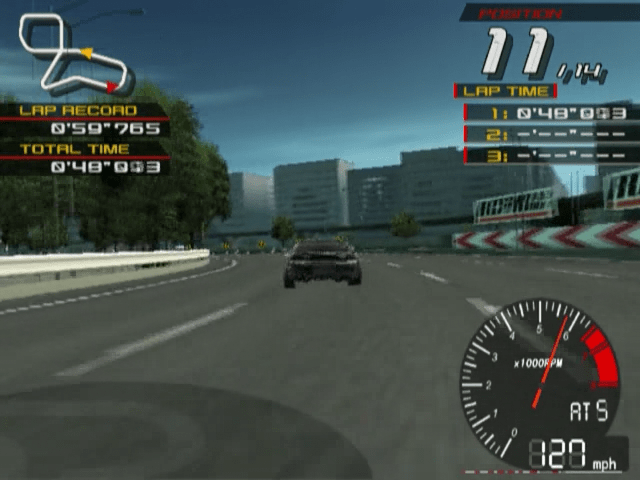
This is not a driving simulation. Ridge Racer V rewards carrying speed into a corner and controlling a slide on the way out, making deliberate drifting the heart of lap-time improvement. Players steer with a standard controller’s analog stick or compatible specialist controllers, accelerate and brake with the face buttons, and can use manual shifting when they want more control over gear changes. Camera views can be changed during a race, while the game’s handling asks drivers to balance clean corner entry against the momentum needed to stay ahead of the field.
Grand Prix is the main progression route. A new entrant registers a racing team and advances through a sequence of championships, facing a full pack of rivals over multi-lap events. Victories open further challenges and vehicles, turning the garage into part of the reward for learning the courses. The selection includes familiar Ridge Racer-style routes and their reverse layouts, so a road that is comfortable in one direction can demand different braking points and drift timing when run the other way.
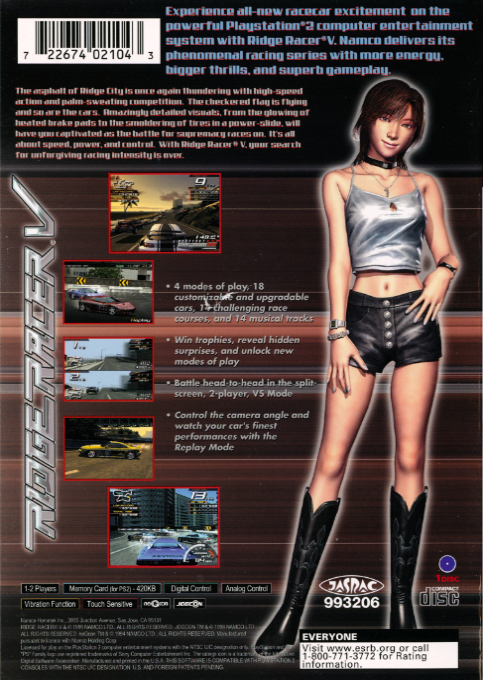
Outside the championship structure, Ridge Racer V offers ways to practice, chase records, or race another player. Time Attack puts the emphasis on finding the quickest line, while Free Run lets unlocked courses be explored without the same championship pressure. The unusually long 99 Trial provides an endurance-oriented test on Sunny Beach, and Duel events set the player against rival bosses for special cars. Completing those confrontations leads to Battle Royale, a tougher series of challenges. Two people can also compete in split-screen versus races, a feature suited to the game’s immediate arcade controls.
Ridge City gives the game a unified identity instead of treating every event as a trip to an unrelated circuit. Its roads move between built-up districts, coastal scenery, vegetation, elevated structures, and tunnels, with selectable times of day for many non-Grand Prix runs. Fictional manufacturers and cars supply the field rather than licensed road vehicles, and the garage includes paint customization. Replays can be watched from different angles, allowing a close look at a clean pass, a long drift, or the city’s reflections and changing light.
Music and presentation are equally tied to that place. The game frames its soundtrack as broadcasts from Ridge City FM 76.5, combining Namco composers with guest contributions including Boom Boom Satellites and Mijk van Dijk. Ai Fukami appears as the new Ridge Racer race queen for this installment. In 2001, Namco adapted the game into Ridge Racer V: Arcade Battle for its System 246 arcade hardware, although that version removed some home-game modes. For PlayStation 2 owners, Ridge Racer V remains a focused early showcase for the system: a single-player and split-screen racer built around fictional cars, repeatable courses, quick drifting, and the pursuit of a faster lap.
Gallery
Details
- Developer
- Namco
- Publisher
- Namco
- Genre
- Racing & Driving
- Players
- 2
- Release Date
- October 26, 2000
- System
- PS2