About
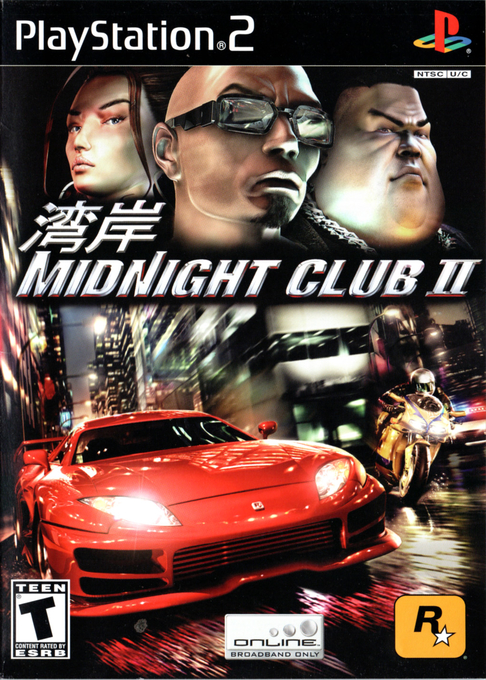
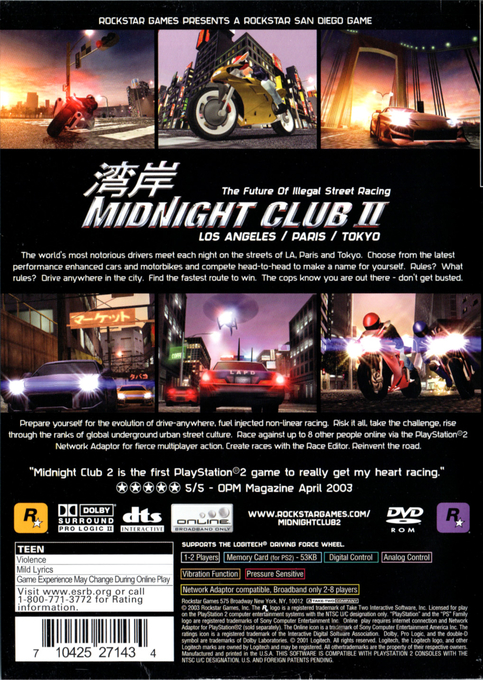
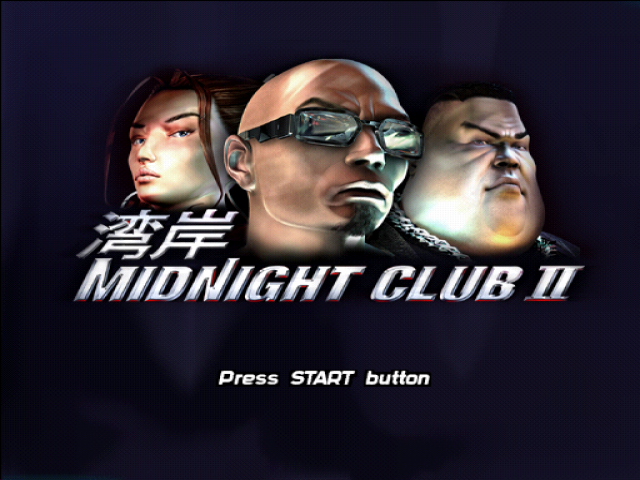
Midnight Club II for PlayStation 2 is a 2003 arcade-style street-racing game developed by Rockstar San Diego and published by Rockstar Games. Released in North America in April 2003, it follows Midnight Club: Street Racing and sends a new underground racer into after-hours contests across Los Angeles, Paris, and Tokyo. Rather than treating each event as a sealed circuit, the game makes the cities the course: traffic, broad boulevards, narrow lanes, ramps, elevated roads, and unexpected cut-throughs all become part of the race.
Career mode begins with a modest vehicle and asks the player to find rival drivers while cruising each city. Challenges lead to checkpoint races and tournaments, with victories opening further opponents, cars, and eventually the next destination. Short pre-race exchanges introduce the competitors, but progress is driven chiefly by learning the streets and beating them at their own events. A separate Arcade mode allows access to races outside the campaign structure, while Cruise mode provides room to explore an unlocked city without immediately starting an event.
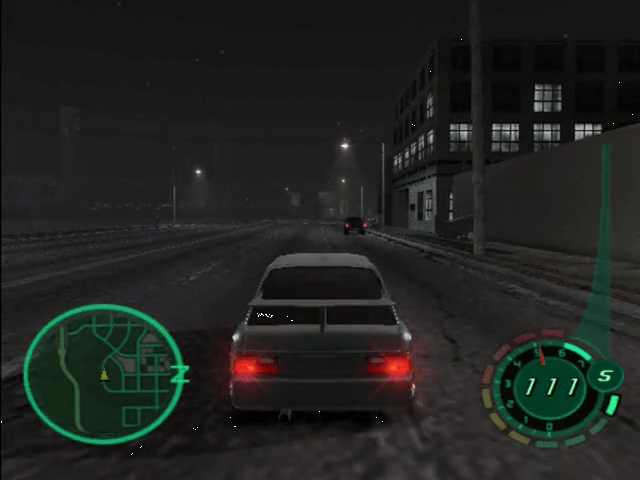
The essential goal in a Midnight Club II race is to pass through glowing checkpoints before the other drivers. Some events prescribe their order, with the on-screen guidance indicating the next gate; others leave the route open, requiring the player to decide which checkpoint to tackle first and how to join them together. There are no conventional track walls to keep a car on a single racing line. Successful runs depend on recognizing a shortcut, choosing when a risky jump is worthwhile, and recovering quickly when traffic or a wrong turn breaks momentum.
The PS2 game expands the series' vehicle mix with motorcycles alongside its fictionalized, street-modified cars. Cars and bikes behave differently, and the motorcycles introduce a two-wheel driving maneuver that can help a rider thread through congested spaces. A boost system adds another tactical tool, while a damage display records collisions and hard landings. Vehicles can be temporarily disabled after taking too much punishment, but damage does not permanently reduce their performance, so the focus remains on maintaining speed and picking a better route.
Each setting gives the same freeform racing idea a different texture. Los Angeles combines hills, highways, and sprawling traffic; Paris brings tight streets, roundabouts, riverside routes, and the catacombs; Tokyo emphasizes dense neon-lit avenues and alleys. The cities include recognizable-inspired landmarks but are designed as condensed playgrounds rather than literal maps. This design makes local knowledge valuable: a route that looks longer on the map can win if it avoids traffic or reaches a ramp, bridge, or hidden passage at the right moment.
Midnight Club II also supports multiplayer on PlayStation 2, with split-screen play for two people and network play for larger groups where the required hardware and service were available. It was released as the series moved from its PS2 launch-era first installment into a broader multi-platform sequel, also appearing on Xbox and Windows. The PS2 version remains notable for putting route selection and city exploration at the center of competitive racing, making quick navigation as important as raw vehicle speed.
Gallery
Details
- Developer
- Rockstar San Diego
- Publisher
- Rockstar Games
- Genre
- Racing & Driving
- Players
- 1-2
- Release Date
- April 8, 2003
- System
- PS2