About
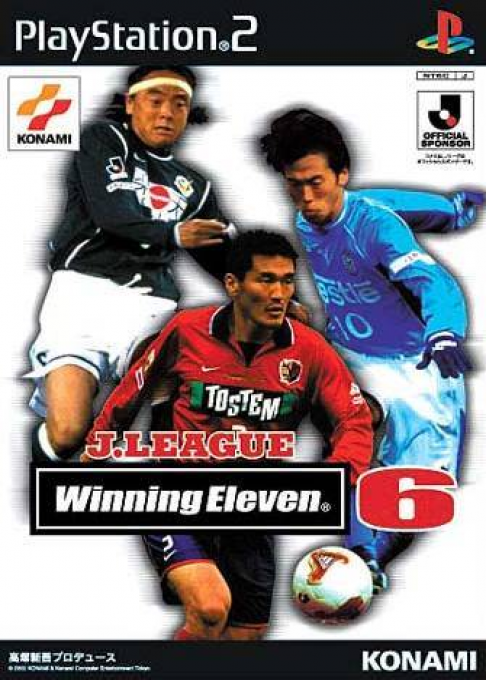
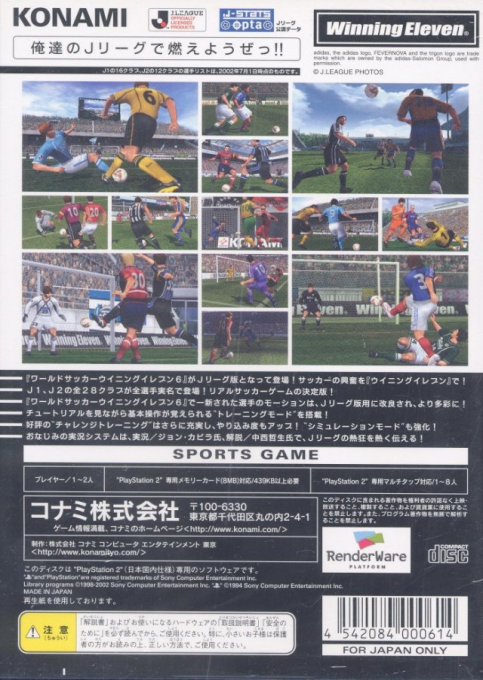
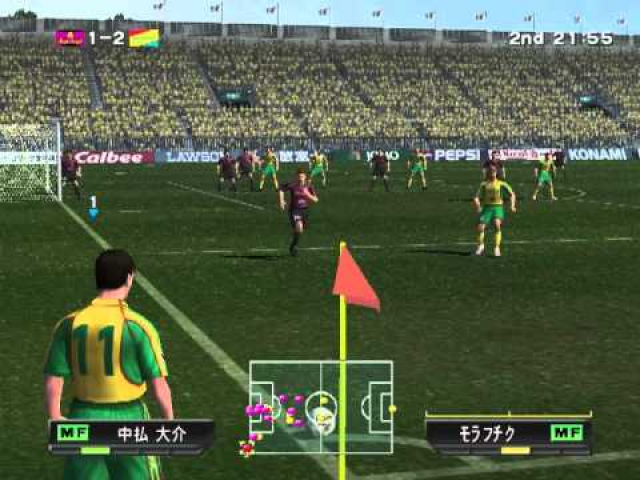
J.League Winning Eleven 6 is Konami’s Japan-only PlayStation 2 football game, released on September 19, 2002. Developed by Konami Computer Entertainment Tokyo and published by Konami, it is the J.League-focused counterpart to World Soccer Winning Eleven 6 rather than a separate international Pro Evolution Soccer release. The game places Japan’s professional clubs at the center of a fast, tactics-minded association football simulation, while retaining the wider Winning Eleven framework of exhibition matches, cups, league play, training, editing, and long-form team building.
On the pitch, J.League Winning Eleven 6 asks players to control a full side through the familiar rhythm of football: move into space, circulate the ball, create a passing lane, and finish attacks before the opposition recovers its shape. A match can be played with straightforward passes and shots, but the underlying system rewards learning its fuller range of movement and ball options. Through balls, different types of crosses, dribbling choices, changes of pace, set pieces, and tactical adjustments give the player ways to approach the same defence from more than one angle. That makes awareness of teammates and positioning as important as simply finding the shoot button.
The J.League edition is defined by its domestic club selection. Its J1 lineup includes sides such as Kashima Antlers, Urawa Red Diamonds, FC Tokyo, Yokohama F. Marinos, Júbilo Iwata, Gamba Osaka, Vissel Kobe, and Sanfrecce Hiroshima, while the J2 group includes Kawasaki Frontale, Cerezo Osaka, Albirex Niigata, Oita Trinita, and other clubs from the period. The presentation also draws on Japanese football venues, with stadiums including Sapporo Dome, Kashima Soccer Stadium, International Stadium Yokohama, Nagai Stadium, and Hiroshima Big Arch. Japanese commentary is led by Jon Kabira with former player Tetsuo Nakanishi.
For players looking beyond one-off fixtures, Master League supplies the game’s central progression mode. A campaign begins with a modest squad and turns results into the resources needed to maintain and improve it. The mode is organized across three divisions, so winning league matches and managing the team’s fortunes can lead to promotion toward the top flight. Building a stronger roster matters, but so does keeping a side functioning as a unit: successful passing and established partnerships feed into the emphasis on teamwork. The structure gives single-player sessions a longer objective than simply winning the next match.
Training provides another route into the game’s systems. Challenge-style exercises test skills such as dribbling, passing, free kicks, possession, and timed movement through small, focused tasks. Good performances earn points and can unlock additional players for Master League, tying practice to the larger campaign. J.League Winning Eleven 6 also supports both single-player and multiplayer play, so its club and national-team-style football can be treated as a solo season, a practice ground for particular techniques, or a competitive match with another player. As an early PlayStation 2 entry in Konami’s J.League Winning Eleven line, it captures the series’ 2002 blend of Japanese club football, detailed control options, and team-management progression.
Gallery

Details
- Developer
- Konami
- Publisher
- Konami
- Genre
- Football (Soccer)
- Players
- 1-2
- Release Date
- September 19, 2002
- System
- PS2