About
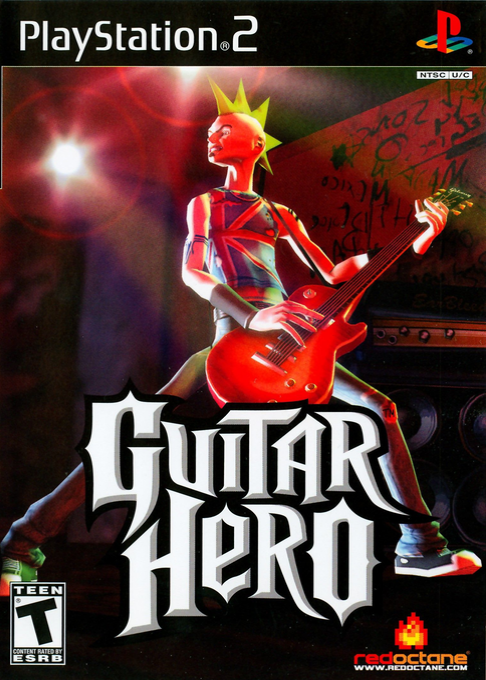
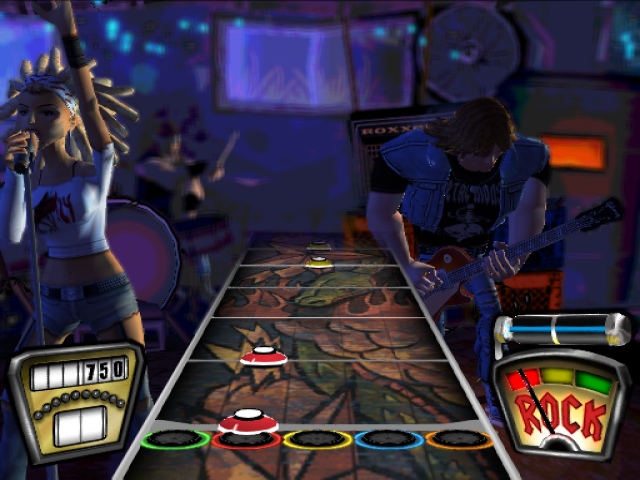
Guitar Hero for PlayStation 2 is a music rhythm game developed by Harmonix Music Systems and published by RedOctane. It debuted in North America in November 2005 as the first entry in the Guitar Hero series, built around a bundled, guitar-shaped controller modeled after a Gibson SG. Rather than trying to reproduce every part of a band performance, the game turns lead-guitar timing into an accessible on-screen challenge: colored notes travel down a virtual fretboard, and players match them at the right moment to perform rock songs.
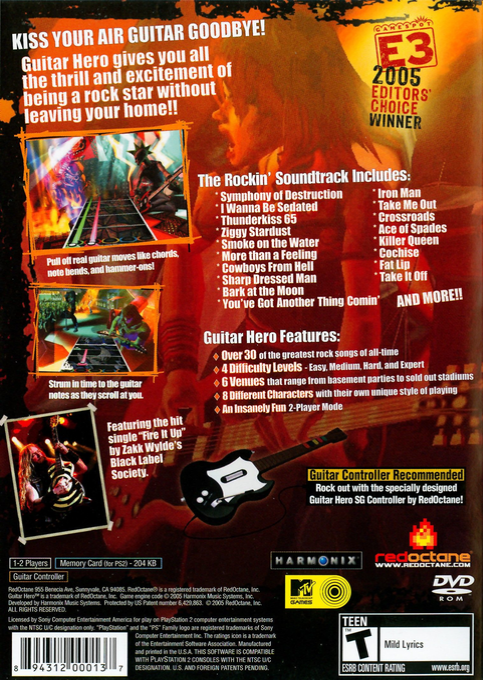
The dedicated controller gives Guitar Hero its defining physical language. Five colored fret buttons sit on the neck, while a strum bar and whammy bar occupy the body. To play a note, the player holds the matching fret or chord combination and strums as it reaches the target line. Sustained notes can be shaped with the whammy bar, while certain rapid passages allow hammer-ons and pull-offs without a fresh strum. The original PlayStation 2 release can also be played with a standard controller, and its handedness setting lets players arrange the guitar for either left- or right-handed use.
Each performance is judged through points, note streaks, a score multiplier, and the Rock Meter. Consecutive successful notes build the multiplier; repeated misses drain the meter and can end a song before its conclusion. Glowing note phrases reward accurate playing with Star Power. Once enough has been collected, Star Power can be triggered by tilting the guitar upward or using a controller input. It increases scoring and helps stabilize the Rock Meter, so deciding when to use it becomes especially important during demanding passages.
Career Mode frames progression as a climb through fictional concert venues. Players choose a guitarist and instrument presentation, then work through sets of songs, unlocking more music and store items as performances are completed. Easy, Medium, Hard, and Expert difficulties steadily expand the note charts and expectations, from simplified patterns using fewer frets to denser arrangements that test timing, chord changes, and endurance. Quick Play offers unlocked songs outside the career, and local multiplayer presents score-based face-offs in which two players alternate through sections of the same track.
The PlayStation 2 soundtrack combines rock songs associated with several decades with bonus material, giving the game a mix of classic and contemporary selections for its era. Many of the principal tracks are newly recorded cover versions rather than original master recordings, a practical choice that still allowed the game to build its set list around recognizable songs. Its note charts focus on prominent guitar parts and memorable musical changes, translating riffs, chords, and solos into patterns that can be read at speed while retaining the sensation of performing along with a band.
Guitar Hero grew out of RedOctane's interest in bringing the custom-controller appeal of Konami's GuitarFreaks to a broader North American console audience. Harmonix had already explored interactive music through FreQuency, Amplitude, and Karaoke Revolution, and applied that experience to a game designed around strumming, fretting, and stage performance. The initial release remained a PlayStation 2 title, and its unexpected popularity established the basis for a much larger series of sequels, expansions, and related rhythm games.
For the original Guitar Hero, the central appeal is the relationship between a simple control scheme and increasingly intricate songs. A player can begin by following a few colored prompts, then gradually learn to read more elaborate patterns, protect a streak, and save Star Power for a difficult section. That structured learning curve, the distinctive SG-style controller, and the focus on rock guitar performance make this 2005 PlayStation 2 game a landmark early entry in the modern instrument-based rhythm genre.
Gallery
Details
- Developer
- Harmonix Music Systems
- Publisher
- RedOctane
- Genre
- Rhythm Game
- Players
- 1-2
- Release Date
- November 7, 2005
- System
- PS2