About
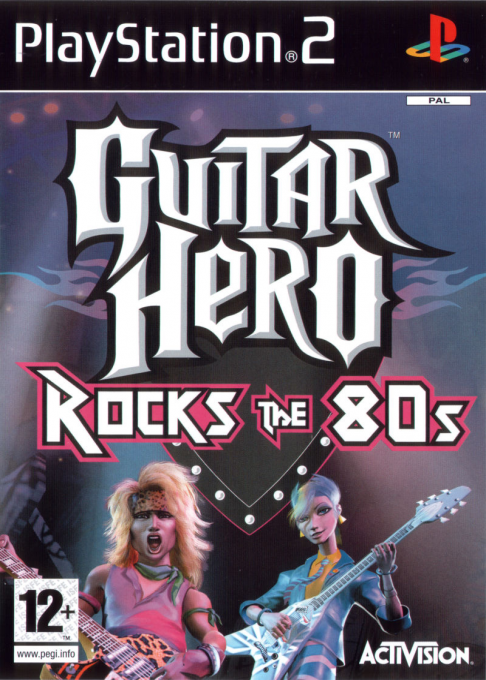
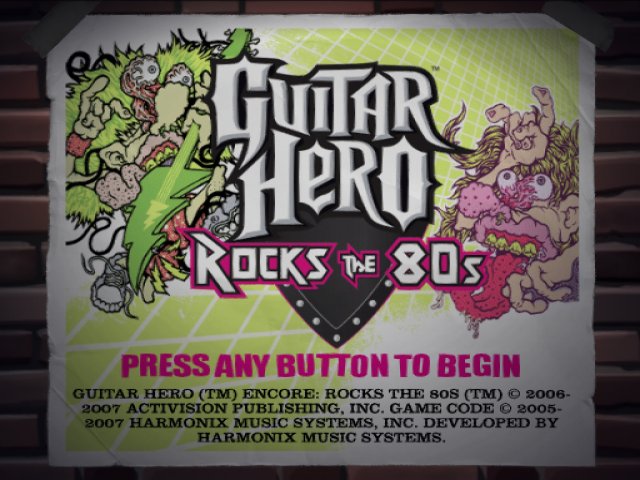
Guitar Hero: Rocks the 80s for PlayStation 2 is a 2007 rhythm game from Harmonix Music Systems, released by Activision and RedOctane. North American packaging uses the longer title Guitar Hero Encore: Rocks the 80s, while European releases drop “Encore.” It is the third Guitar Hero game and a PS2-only, 1980s-themed follow-up to Guitar Hero II rather than a full new sequel. Its familiar note highway, difficulty settings, characters, and broad structure make it an immediately recognizable entry for players of the first two games, while its song selection, fashion, venues, and artwork turn the spotlight toward the decade of new wave, hard rock, hair metal, and punk.
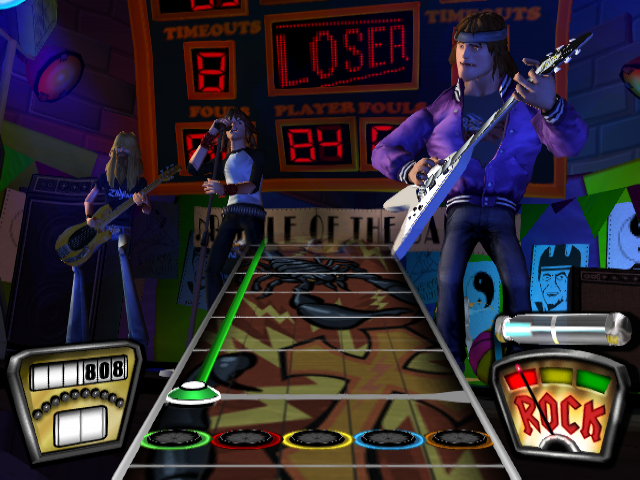
The essential goal is to play a guitar part in time with a scrolling stream of colored notes. Using a compatible Guitar Hero controller, the player holds the matching fret buttons and strums up or down as each note reaches the target. The game accommodates ordinary PlayStation 2 controllers as well, but the guitar’s five fret buttons, strum bar, whammy bar, and tilt sensor are central to its stage-performance feel. Sustains ask players to keep a fret held, chords combine two or more notes, and the whammy bar changes the sound of long notes while it is pressed. Four difficulty levels steadily increase the demands, culminating in Expert charts that use all five frets and more complicated chord work.
A performance succeeds by keeping the Rock Meter healthy while building score and note streaks. Well-played groups of star-shaped notes fill the Star Power meter; on sufficiently full charge, a player can activate the temporary boost by tilting the guitar upward or pressing Select. The manual also lets players earn more Star Power from long marked notes with the whammy bar. Results track score, accuracy, streak, and up to five stars, and strong performances pay career money for the in-game store. That store unlocks guitars, guitar finishes, videos, and other extras, while career progress opens songs and venues. Quick Play provides access to earned songs, and the practice option can isolate song sections and slow them down for rehearsal.
The single-player Career mode sends a chosen rocker through a sequence of themed stages, building from approachable songs toward more demanding material. Returning Guitar Hero personalities—including Johnny Napalm, Judy Nails, Izzy Sparks, Pandora, Axel Steel, and the Grim Ripper—receive 1980s-inspired looks, and the existing style of Guitar Hero II venues is recast for the theme. The game’s presentation leans into the era’s bright colors, leather, big hair, and arena-rock spectacle without changing the underlying formula. This balance makes Rocks the 80s a focused companion to Guitar Hero II: the new content is primarily musical and cosmetic, but the established career loop retains its clear reward structure.
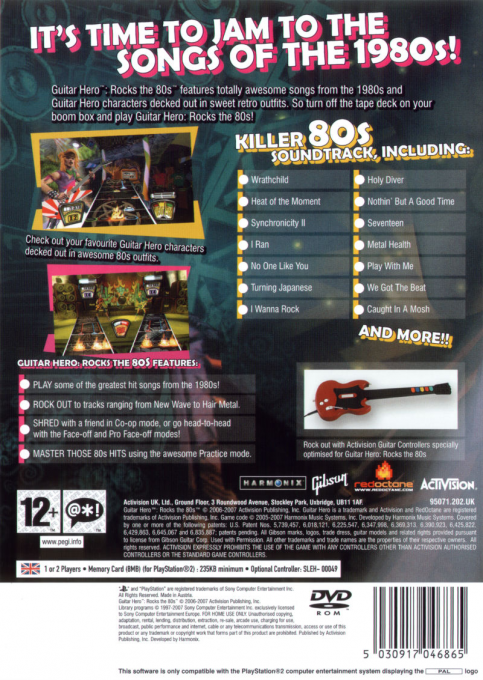
Its 30-song setlist mixes officially licensed master recordings with newly performed covers. Songs associated with artists such as A Flock of Seagulls, Twisted Sister, Judas Priest, Dio, Asia, Quiet Riot, Poison, Iron Maiden, the Go-Go’s, and the Police give the PlayStation 2 game a deliberately broad view of the decade’s rock music. “Because, It’s Midnite,” credited to the fictional Homestar Runner hair-metal act Limozeen, is the one song written specifically for the game’s throwback concept. Unlike the earlier Guitar Hero releases, Rocks the 80s does not add a separate bonus-song collection after the main career setlist, concentrating its music around the central progression instead.
Multiplayer preserves the competitive and cooperative options associated with Guitar Hero II. Face-Off has two players take turns on the same chart and permits separate difficulty choices, while Pro Face-Off puts both players on the same chart at the same difficulty after it is unlocked through career progress. Cooperative play divides the arrangement between lead guitar and rhythm or bass guitar, with a shared Rock Meter and simultaneous Star Power activation. The game also offers tutorials for learning its techniques, adjustable audio and video settings, a left-handed display option, and a lag-calibration feature for televisions whose audio and picture do not align.
Guitar Hero: Rocks the 80s arrived at a transitional moment for the series. It was Harmonix’s final Guitar Hero project before the studio moved on to Rock Band, while the next major Guitar Hero installment, Guitar Hero III: Legends of Rock, was developed by Neversoft. Activision promoted Rocks the 80s as new content for the PS2 audience between those larger releases, and the game remains a distinct snapshot of the series’ original Harmonix era: a compact, platform-specific encore that applies the Guitar Hero II play experience to a tightly defined decade of rock.
Gallery
Details
- Developer
- Harmonix Music Systems
- Publisher
- Activision
- Genre
- Rhythm Game
- Players
- 1-2
- Release Date
- July 27, 2007
- System
- PS2