About
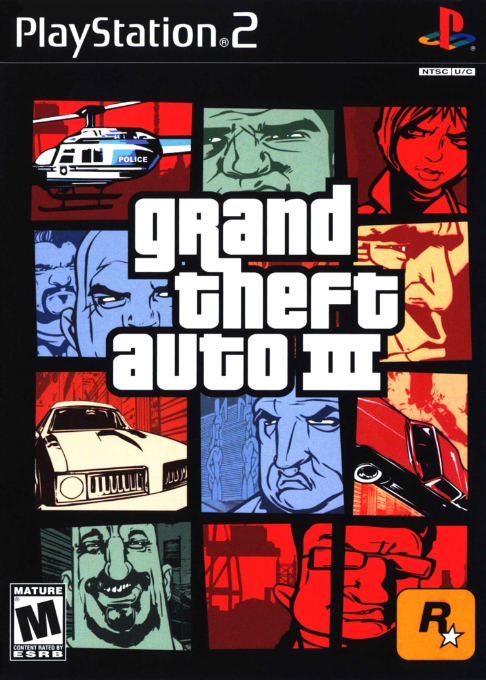
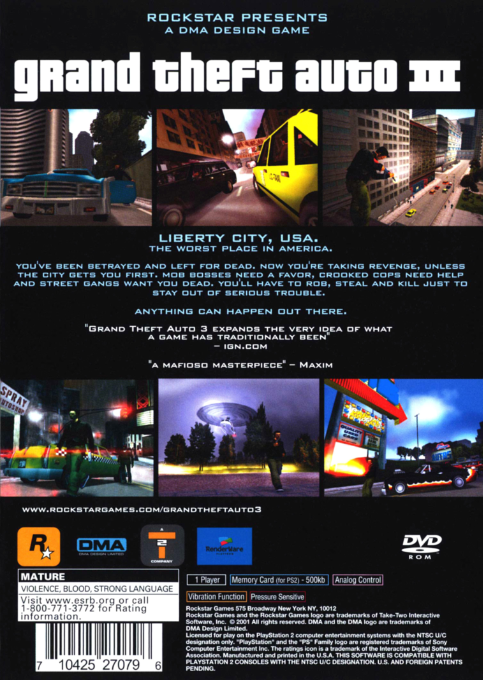
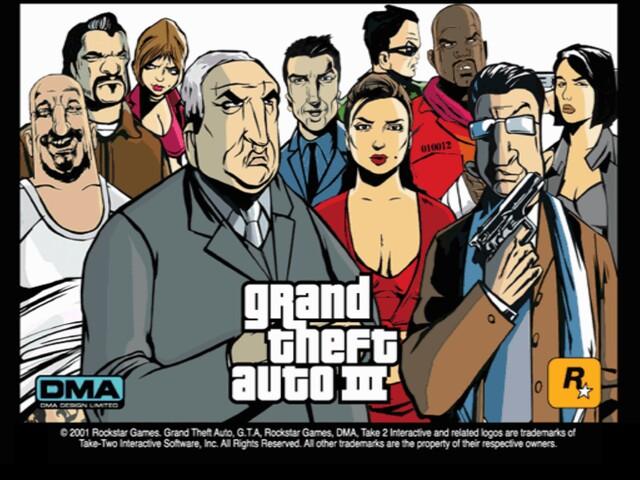
Grand Theft Auto III is the PlayStation 2 crime-action landmark released in North America on October 22, 2001. It was developed by DMA Design, the Edinburgh studio later known as Rockstar North, and published by Rockstar Games under Take-Two Interactive. The game is the series' first fully three-dimensional main entry, bringing the car theft, criminal jobs, radio stations, and free-roaming structure of the earlier games into a dense third-person city. Its original PS2 version is the foundation of the release, before later Windows, Xbox, mobile, and remastered editions changed platforms, presentation, or controls.
The setting is Liberty City, a fictional East Coast metropolis built as a loose, exaggerated reflection of New York City. It is divided into three distinct islands: industrial Portland, the commercial high-rises of Staunton Island, and suburban Shoreside Vale. Progress through the campaign gradually opens those districts, turning the map into both a reward and a practical change in how the player travels. Streets, docks, alleys, bridges, traffic, pedestrians, gang territories, and the constant churn of broadcasts help sell the city as a place rather than a sequence of isolated levels.
Players control Claude, a silent small-time criminal betrayed by Catalina during a Liberty City bank robbery. He survives being shot, is arrested, and escapes during an attack on his prison transport alongside explosives expert 8-Ball. From there, Claude works through Liberty City's underworld, taking jobs for the Leone Mafia, the Yakuza, corrupt police contacts, and wealthy businessman Donald Love. The plot moves through gang conflict, the Cartel's SPANK drug operation, and Claude's pursuit of Catalina, while cutscenes give the missions a crime-film atmosphere without making the player character a talkative hero.
Most story advancement comes from missions collected at character locations and payphones. These jobs regularly combine driving, pursuit, delivery, sabotage, protection, timed escapes, and gunfights, so the route through the city matters as much as raw firepower. Outside the main chain, Liberty City remains open for exploration and optional work. Taxi, ambulance, fire truck, and vigilante activities invite players to adopt the role of a public-service vehicle driver or police substitute, while stunt jumps, hidden packages, and other discoveries give detours lasting value. Failing a mission does not close off the city; it encourages another attempt with a different vehicle, weapon, or route.
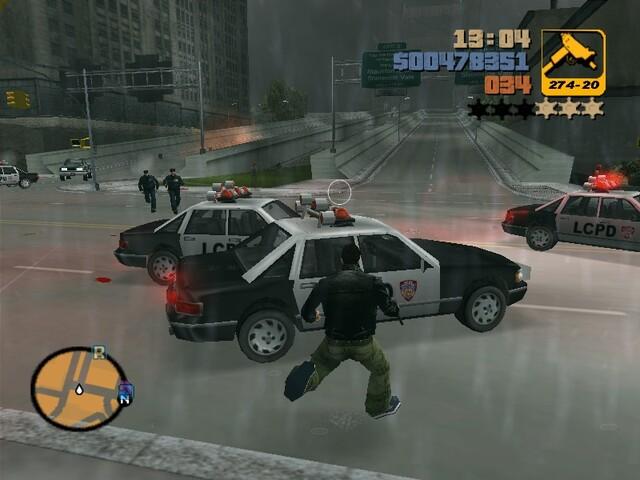
On foot, Claude can run, jump, collect weapons and health, and use melee attacks, firearms, and explosives. Auto-aim supports the original console-focused combat, while certain weapons allow more deliberate first-person aiming. Vehicles are central to both traversal and improvisation: players can take ordinary cars, sports cars, trucks, taxis, emergency vehicles, boats, and more, then use their handling, speed, toughness, or special mission access to solve a problem. Drive-by shooting adds another option during chases, making traffic, road layout, and a quick escape car part of the action rather than merely scenery.
Crime has immediate consequences through the wanted-level system. Stars on the on-screen meter show how intensely law enforcement is pursuing Claude; minor trouble may draw local officers, while high wanted levels bring increasingly forceful attempts to stop him. Breaking line of sight and leaving the search area can let the pressure subside, and familiar series tools such as resprays give players ways to reset a pursuit. Hospitals restore Claude after defeat but cost money and equipment, so armour, health pickups, weapon placement, and a reliable getaway plan become meaningful pieces of the mission loop.
The PS2 release uses the constraints of its era to shape its character. Its third-person driving and on-foot controls, lock-on shooting, draw distance, and camera behavior feel more deliberate and occasionally rougher than in later entries, but they are inseparable from the game’s early-2000s identity. The audio is especially important: multiple music stations, commercials, callers, DJs, and the Chatterbox talk station turn long drives into a comic portrait of Liberty City. The radio gives the open world texture even when no mission marker is active, and it remains one of the clearest demonstrations of how the game joins sound, satire, and player freedom.
Grand Theft Auto III became a defining PlayStation 2 success and a major reference point for subsequent open-world games. It did not invent every ingredient in its formula, but its achievement was to make a 3D city, vehicles, combat, side activities, mission storytelling, and player-led wandering feel like parts of one coherent system. Its impact can be seen in later crime sandboxes and in Rockstar's own follow-ups, including Vice City and San Andreas. For players returning to the original PS2 edition, it is both a direct crime story set in Liberty City and a historically important snapshot of the moment open-world design became a dominant game format.
Gallery
Details
- Developer
- Rockstar North
- Publisher
- Take 2 Interactive
- Genre
- Other Adventure
- Players
- 1
- Release Date
- October 22, 2001
- System
- PS2