About
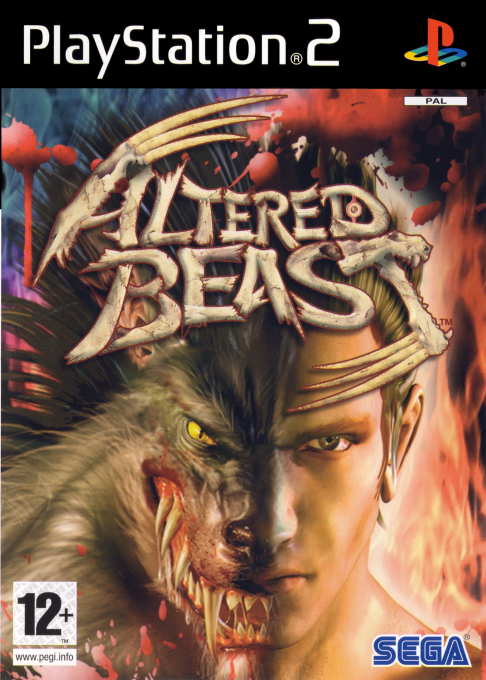
Altered Beast PS2 is a single-player 3D action game developed by Wow Entertainment and published by Sega. Released in Japan in January 2005 as Jūōki: Project Altered Beast and later in Europe as Altered Beast, it reworks the transformation idea associated with Sega’s earlier arcade game into a modern science-fiction story. This is not a retelling of the 1988 Greek-mythology adventure: its world, hero and conflict are new, and its combat unfolds from a third-person viewpoint on PlayStation 2.
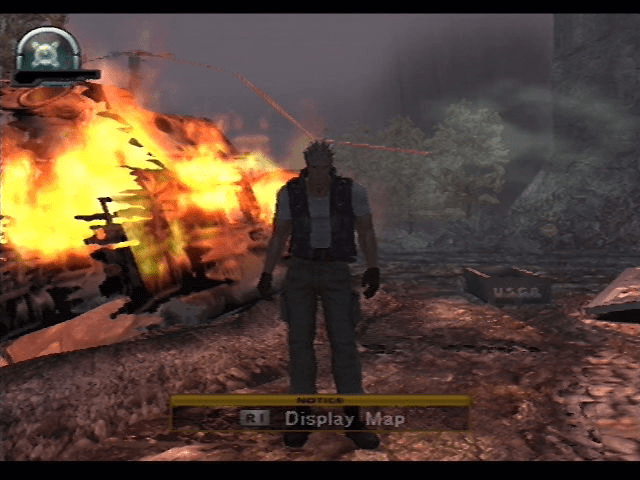
The player controls Luke Custer, an amnesiac survivor of a helicopter crash in a city sealed off by a mutagenic mist. Luke gradually learns that he is a Genome-Cyborg, a person altered through genetic technology. The search for his past leads through areas affected by the project and its creatures, while the story introduces the people connected to the research and the Genome-Chips that make Luke’s abilities possible. The premise gives the game’s transformations a scientific-fiction explanation rather than relying on the gods and ancient setting of the original Altered Beast.
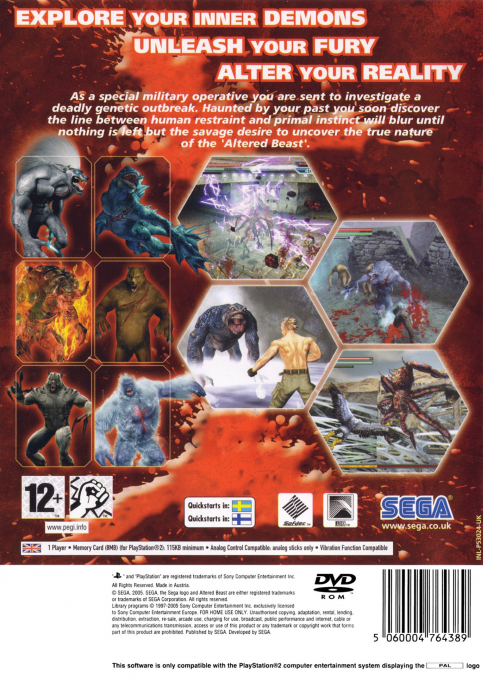
In ordinary human form, Luke can fight with basic close-range attacks, but his central advantage is the ability to change into beast forms once their genetic data has been obtained. The initial werewolf is quick and built around claw attacks, while later transformations broaden the combat and exploration options. Available forms include the Merman, Garuda, Wendigo, Fire Minotaur and Thunder Dragon. Each has its own attacks and practical strengths, so changing shape is a direct part of approaching encounters rather than simply a visual power-up.
The action moves through compact, linear areas populated by mutated enemies, with objectives generally leading toward a boss encounter. Combat is built around melee attacks, combos and managing the benefits of a chosen form. Transformation is not permanent: beast energy is consumed while Luke remains altered, encouraging the player to switch back when necessary and keep fighting for replenishing pickups. Genome-related rewards can also be used to develop moves, giving battles and exploration a role in expanding Luke’s fighting options.
The beasts matter outside straightforward combat as well. Their specialized movement and elemental or physical abilities are used to overcome obstacles and solve environmental problems. A werewolf’s mobility can open up higher routes, for example, while the Minotaur can break selected barriers with a charge. Sega described the game’s bosses and puzzle elements as being designed around recognizing which beast ability is needed, making the choice of form a progression mechanic as well as the game’s signature spectacle.
Although Altered Beast PS2 shares a name and the broad concept of a hero becoming monsters with the 1988 Sega game, its structure and tone are distinct. The classic side-scrolling arcade format gives way to full 3D stages, a genetic-experiment narrative and a cast centered on Luke’s lost identity. The Japanese release’s Project Altered Beast subtitle makes that change in direction especially clear, while the European edition used the shorter series name. The game was not released in North America.
Completion opens further ways to revisit its combat. Sega’s own material highlighted collection elements and boss time-attack challenges, alongside the Elevator of Doom mode, which focuses on defeating successive enemies. Additional transformation forms can also be earned through the game’s extra content, including a white tiger-like form, a grizzly bear and U.W.H. The result is a PlayStation 2 interpretation of Altered Beast that preserves transformation as its defining mechanic while building a separate, modern-era action story around it.
Gallery
Details
- Developer
- Wow Entertainment
- Publisher
- SEGA
- Genre
- Beat 'em Up
- Players
- 1
- Release Date
- February 25, 2005
- System
- PS2