About
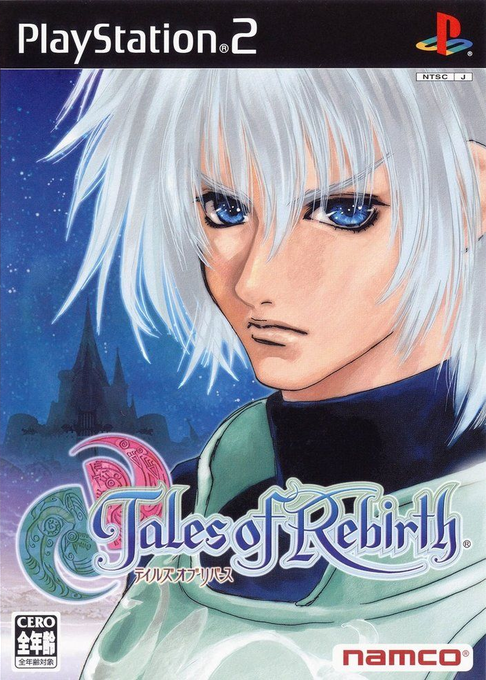
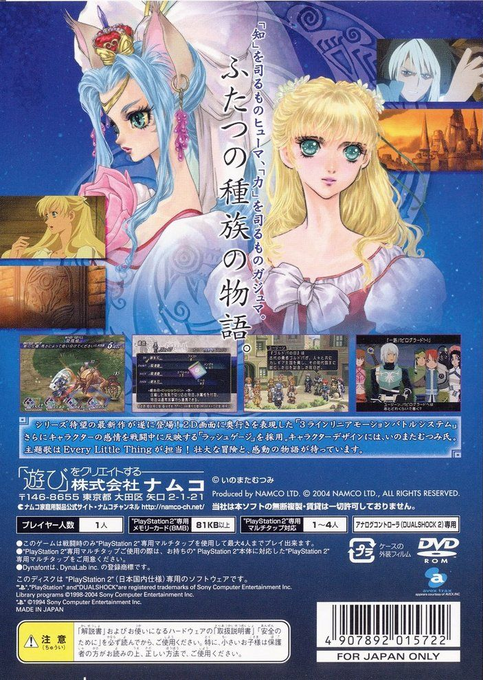
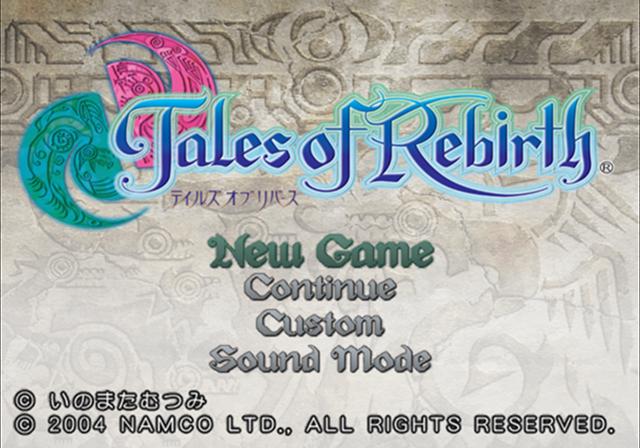
Tales of Rebirth is a Japanese PlayStation 2 action role-playing game released by Namco in Japan on December 16, 2004. Developed by Namco Tales Studio, it is a mainline entry in the Tales series and combines an illustrated, character-led adventure with real-time battles. The story takes place in Karegia, where the human Huma and animal-featured Gajuma live together amid deepening distrust. Players follow the withdrawn young Huma Veigue Lungberg after events in his snowy home village draw him into a journey to find and save his childhood friend, Claire Bennett.
Veigue travels with a growing party whose members come from both peoples, including the spear fighter Eugene, the fire-using Mao, healer Annie, martial artist Tytree, and card-wielding Hilda. Their personal histories and attitudes give the journey its changing perspective on the conflict dividing Karegia. The group moves between towns, dungeons, and story locations through a world-map travel system, while optional character exchanges called Screen Chats add conversations beyond the main scenes. The game’s premise ultimately expands from Claire’s disappearance into a larger crisis involving the kingdom, prejudice, and the possibility of coexistence.
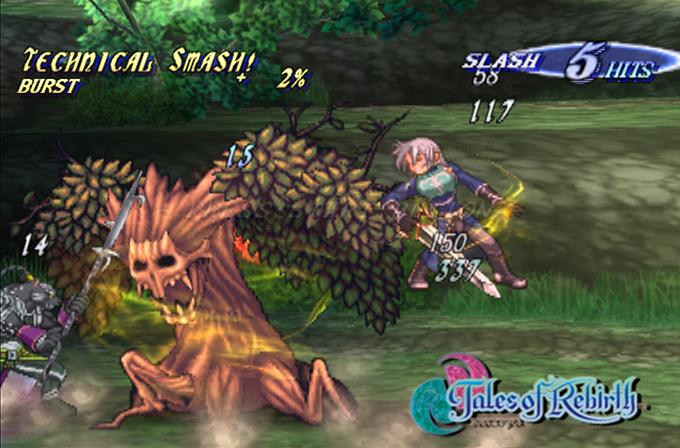
Combat uses the Three-Line Linear Motion Battle System, a version of the series’ real-time battle format built around three parallel positions on the field. Up to four party members can participate, and players direct a selected character while allies act under configurable computer control. Shifting among the lines helps the party reach opponents, avoid attacks, and seek openings, while the side-view presentation keeps clashes focused on positioning, defense, normal strikes, and special techniques. Each playable hero has a different weapon style and a Force ability tied to an element or concept, giving the party distinct roles in battle.
The battle system also asks players to manage its gauges. Force powers draw on a Force Gauge that refills during combat, so special actions must be timed rather than used without limit. The Rush Gauge can strengthen offense while reducing defensive resilience, creating a trade-off during difficult encounters. Characters can equip multiple skills, and powerful cooperative Mystic Artes provide an option for high-impact attacks. Results are graded after battles, while Enhancement Points earned through play are used to improve equipment, making weapon, armor, and accessory choices part of each character’s development.
Away from combat, Tales of Rebirth includes familiar Tales series touches such as recipes that restore the party after battles. Repeatedly preparing a dish can lead to mastery and its associated benefits. The PS2 game also includes optional diversions, including a river-rafting challenge, a fortune-telling card activity, and inn service work. These activities sit alongside a story presented with animated sequences and character designs by Mutsumi Inomata; Production I.G created the anime cutscenes, and Motoi Sakuraba and Shinji Tamura composed the score. Every Little Thing’s song “good night” accompanies the Japanese opening.
Rebirth arrived during a period when the Tales series was exploring different presentation styles on PlayStation 2. Its 2D character sprites and side-on combat distinguish it from the fully 3D approach of some neighboring series entries, while its three-line system extends the earlier Linear Motion framework in its own direction. A PlayStation Portable version followed in Japan in 2008 with adjustments and additional content, but this PS2 release is the original version of Veigue’s adventure. For players interested in Japanese-era Tales games, Tales of Rebirth pairs a substantial party RPG with a battle system centered on movement across the field and deliberate resource management.
Gallery
Details
- Developer
- Namco
- Publisher
- Namco
- Genre
- JRPG
- Players
- 1-4
- Release Date
- December 16, 2004
- System
- PS2