About
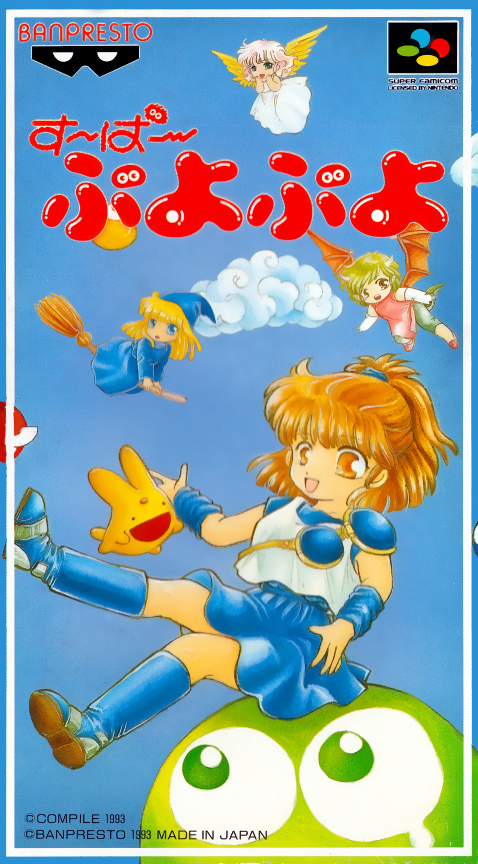
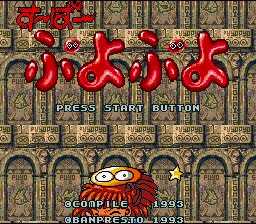
Super Puyo Puyo is Compile’s falling-piece puzzle game for the Super Famicom, published in Japan by Banpresto on December 10, 1993. Often catalogued as Super Puyo Puyo SNES, it is a Japanese Super Famicom adaptation of the early Puyo Puyo formula rather than the later Puyo Puyo 2 ruleset. Its colorful blobs, quick rounds and competitive emphasis helped bring one of Compile’s defining puzzle concepts to Nintendo’s 16-bit hardware.
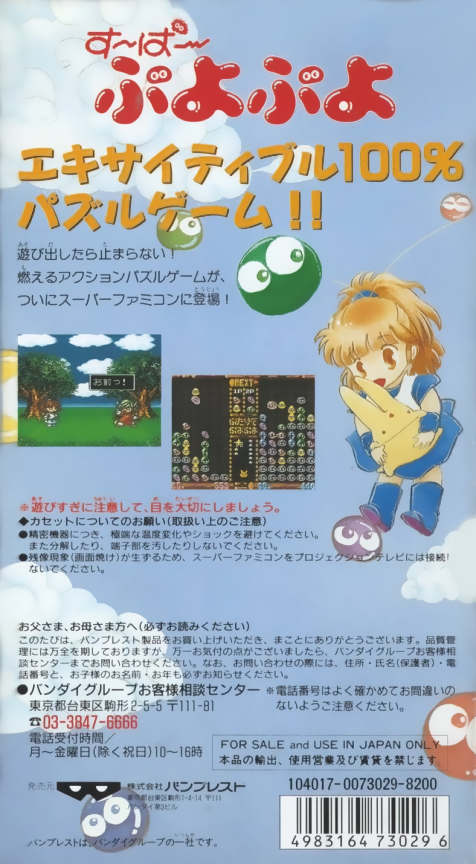
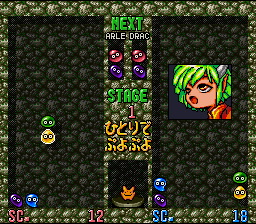
Each turn delivers a connected pair of round Puyos in different colors. The player moves the pair across a narrow vertical well, rotates it, and drops it into position. Connecting four or more Puyos of one color makes that group vanish; gravity then pulls the remaining pieces downward. A carefully planned clear can therefore create another group, then another, producing the cascading chains that are central to both scoring and attack play. The board steadily becomes more dangerous when pieces are placed carelessly, and a stack reaching the top ends the round.
Super Puyo Puyo rewards looking ahead rather than simply removing the first available group. One color can be left in place as a bridge, a gap can be prepared for a later pair, and a falling column can be arranged to expose a fresh match after a clear. The immediate goal is simple—keep the playfield under control—but the more satisfying objective is to build chains that trigger in sequence. Its controls suit that short, repeatable loop: guide each two-Puyo piece, rotate it before it lands, and decide whether the current drop should tidy the field or extend a larger setup.
The game also makes that chain-building useful in head-to-head play. Two players work on separate boards at the same time, and a successful chain sends nuisance Puyos to the opposing field. Those unwanted pieces consume valuable space and can turn an opponent’s recovery into a losing scramble. This creates a duel in which speed matters, but so do timing and judgment: a player may clear a small group to survive, or hold back for a chain that can disrupt the other board at a decisive moment. Computer opposition and solo play provide ways to practice the same fundamentals away from a second controller.
The Puyo Puyo setting comes from Compile’s Madō Monogatari world, bringing its fantasy-themed cast and playful presentation to a puzzle contest built around colored blobs. That character connection distinguishes the Japanese release from the many puzzle games that use only abstract blocks and score counters. The Super Famicom version belongs to the original Puyo Puyo generation, before later entries refined the competitive rules with features such as countering incoming attacks; its matches retain the direct pressure of building chains while garbage is on the way.
For Super Famicom owners in 1993, Super Puyo Puyo offered an accessible puzzle game whose depth became clearer with every rematch. Four matching Puyos are enough to understand the rules, yet efficient layouts, cascading combinations and simultaneous multiplayer boards give the game lasting tactical variety. It also documents the series’ expansion across early-1990s Japanese hardware: developed by Compile, issued by Banpresto, and followed on the system by later Puyo Puyo releases that developed the idea further.
Gallery
Details
- Developer
- Compile
- Publisher
- Banpresto
- Genre
- Tile-Matching Puzzle
- Players
- 1-2
- Release Date
- December 10, 1993
- System
- SNES