About
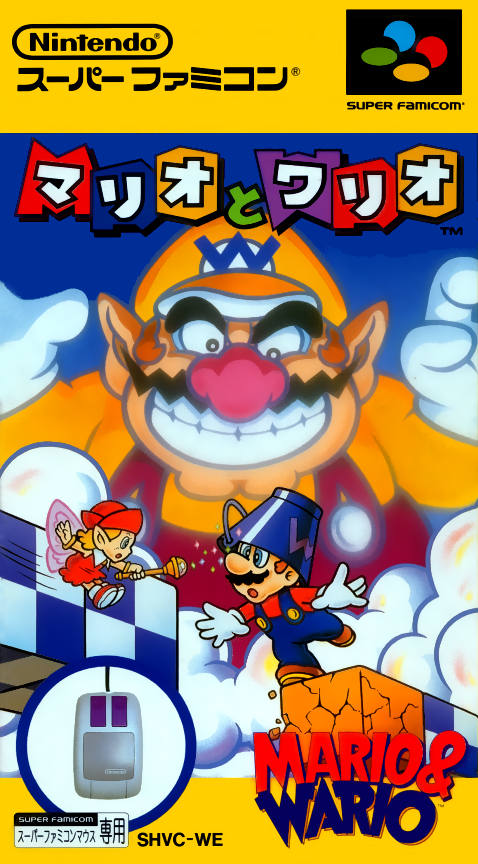
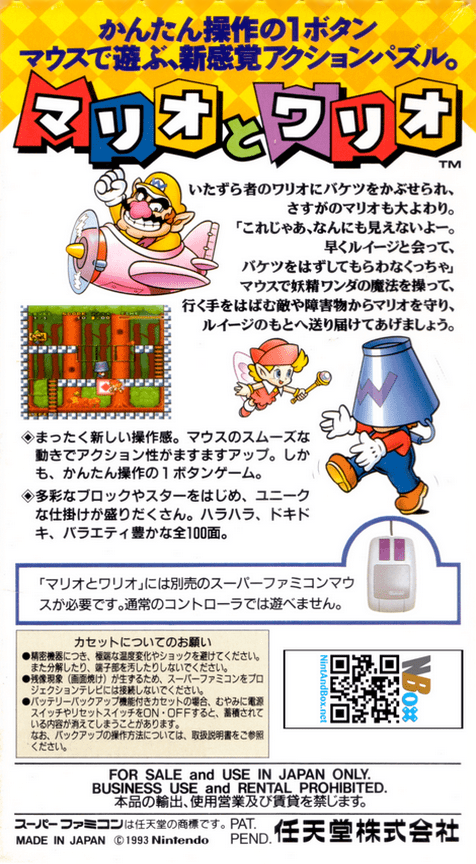
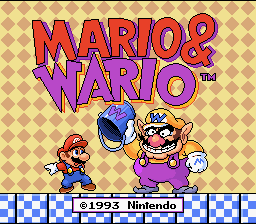
Mario to Wario for Super Famicom is a mouse-controlled action-puzzle game developed by Game Freak and published by Nintendo in Japan on August 27, 1993. Known in Japanese as Mario to Wario, it turns Wario's pranks into the premise for a fast, stage-by-stage rescue challenge. Wario swoops in aboard his Bulldog aircraft and drops an object over Mario's head, leaving him unable to see. The player does not steer Mario directly; instead, they take the role of the forest fairy Wanda and use her magic to guide the stranded hero to Luigi.
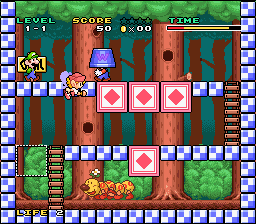
The Super Famicom Mouse is essential to the original release. With the pointer and a left-button click, Wanda can affect elements in the course while Mario keeps walking in the direction he is facing. Clicking Mario can send him back the other way, while interacting with the scenery lets Wanda create or alter the safe route ahead. The design asks the player to observe a moving character, react quickly, and use the available objects before a hazard, edge, or enemy brings the attempt to an end.
Each level is a compact puzzle built around timing and route planning. Mario must be escorted past obstacles and traps to reach Luigi, who can remove the item obscuring his vision. Blocks, bridges, enemies, and other stage features give Wanda's wand a practical role, so the game is as much about choosing when to click as it is about finding a path. A time limit adds pressure, while points come from progress through the course, collected items, defeated enemies, and time remaining at the goal.
Mario is not the only character Wanda can lead. Players can choose Mario, Princess Peach, or Yoshi, and their different walking speeds change the pace of a level and the demands on the person holding the mouse. The adventure contains 100 stages across ten themed areas, including environments such as forests, deserts, and underwater sections. At the end of an area, Wanda confronts Wario directly, shifting the focus to a boss encounter against his aircraft while the chosen character watches on.
Mario to Wario occupies an unusual place among Super Famicom Mario games because its central control idea was designed around a console peripheral rather than a standard pad. It was a Japanese release and its original Super Famicom version requires the mouse, even though its on-screen text is in English. Game Freak’s involvement also makes it a notable early Nintendo collaboration from the studio later closely associated with Pokémon: Satoshi Tajiri is credited with the game’s design, while Junichi Masuda contributed programming and music. Its mix of familiar Mario characters, direct pointing controls, and continuously moving puzzle subjects gives this 1993 release a distinct identity within the wider Mario and Wario catalogue.
Gallery
Details
- Developer
- Game Freak
- Publisher
- Nintendo
- Genre
- Logic Puzzle, Platformer
- Players
- 1
- Release Date
- August 27, 1993
- System
- SNES