About
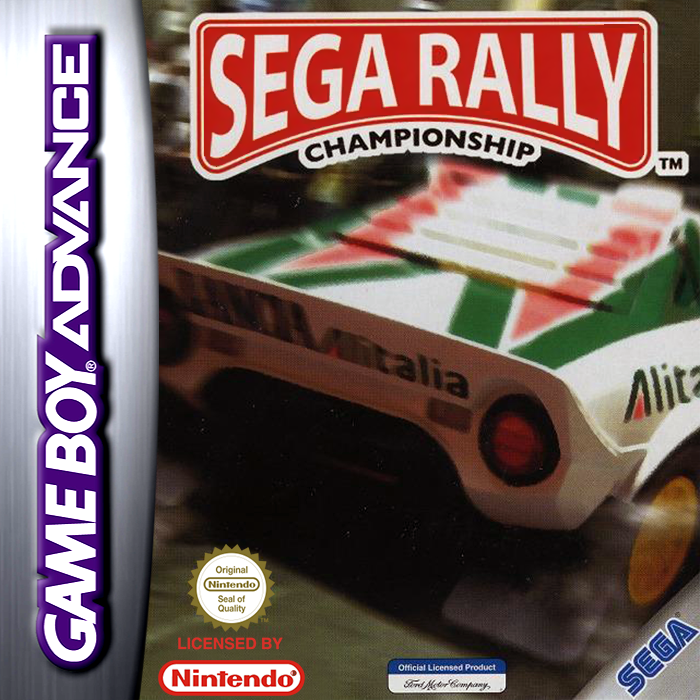
Sega Rally Championship for Game Boy Advance brings Sega’s rally-racing series to Nintendo’s handheld in a purpose-built 2002–2003 release. Sega published the game, whose credits identify Sega Rosso as creator and Dice Co., Ltd. as a cooperating development studio. It arrived in Japan in late 2002 and reached North America and Europe during 2003. Rather than attempting a direct copy of the 1995 arcade game’s short championship, this portable interpretation builds a larger single-player structure around international rally events, unlockables, and the compact controls of the Game Boy Advance.
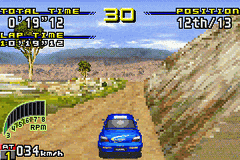
The central Championship mode puts the player into a sequence of cup events against computer-controlled rivals. Races demand a balance of speed and consistency: reach the checkpoints, keep momentum through bends, and finish high enough to open the way to later cups. Courses range across varied rally scenery, including desert, mountain, village, forest, snow, sandstorm, island, jungle, hill-climb, and city-themed settings as the available events expand. Weather conditions can change the character of a course, while the game’s arcade-minded handling keeps the focus on negotiating corners and chasing the leaders rather than on building a detailed simulation.
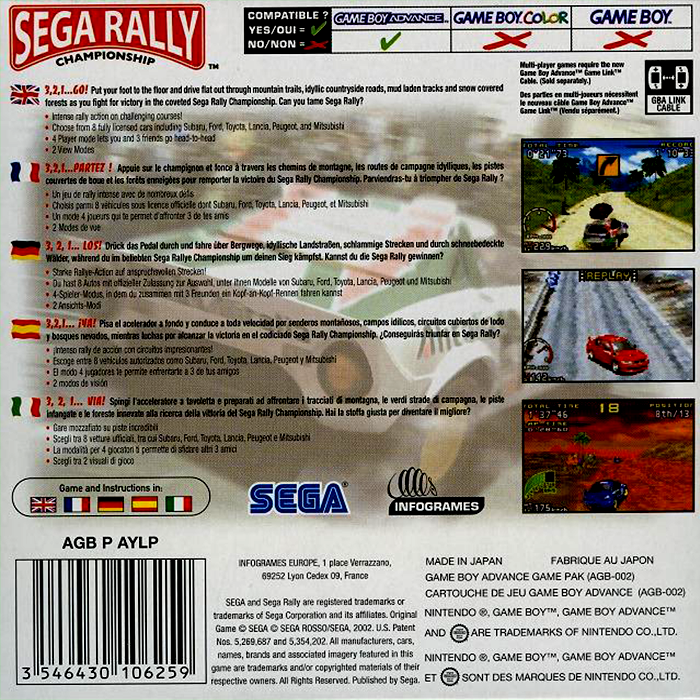
A selection of licensed rally cars gives the Game Boy Advance Sega Rally Championship a recognisable motorsport lineup. Manufacturers represented include Ford, Mitsubishi, Peugeot, Subaru, and Toyota, and the cars are not simply cosmetic choices: players can adjust settings and choose automatic or manual transmission. With the default Type A layout, the Control Pad steers, A accelerates, and B applies the brake; manual drivers use the shoulder buttons to change gear. Those simple inputs are used to manage braking points, corner exits, and the changing demands of the courses on a handheld that has no analogue stick or steering wheel.
Progression revolves around Rally Points. Successful Championship runs award this currency, which can be spent in the Shop on cup entries, courses, vehicles, and gallery material. New cups must be earned in order, with a top-three finish required to buy entry to the next one. Purchased courses also feed into Time Attack, where the goal is to set a faster solo time on tracks that have been added to the player’s collection. This structure gives repeated racing a practical purpose and makes the game’s growing selection of content part of its long-term challenge.
The GBA version also adds RC Rally, a set of small remote-control-car challenges separate from the full-size rally races. Depending on the event, the player gathers coins around a miniature circuit, collects coins dropped by a CPU car, or drives through a chain of appearing checkpoints. These activities award additional Rally Points and become more available as cups are cleared, providing a distinct alternative to the regular championship events. The extras include a Sega Rally history section and an art gallery, framing the handheld game as both a new entry point and a celebration of the wider series.
For competition away from the single-player cups, Sega Rally Championship supports Time Attack and link-cable multiplayer for up to four players, provided each participant has the necessary Game Boy Advance hardware, Game Pak, and cables. Its six initial international courses, adjustable cars, changing conditions, and bonus-driven shop distinguish it from the famous arcade original while preserving the series’ emphasis on accessible rally action. The result is a portable Sega Rally designed around quick races, score and time improvement, and steadily unlocked events rather than a literal recreation of its 3D predecessors.
Gallery
Details
- Developer
- Dice
- Publisher
- SEGA
- Genre
- Racing & Driving
- Players
- 1-4
- Release Date
- March 10, 2003
- System
- GBA