About
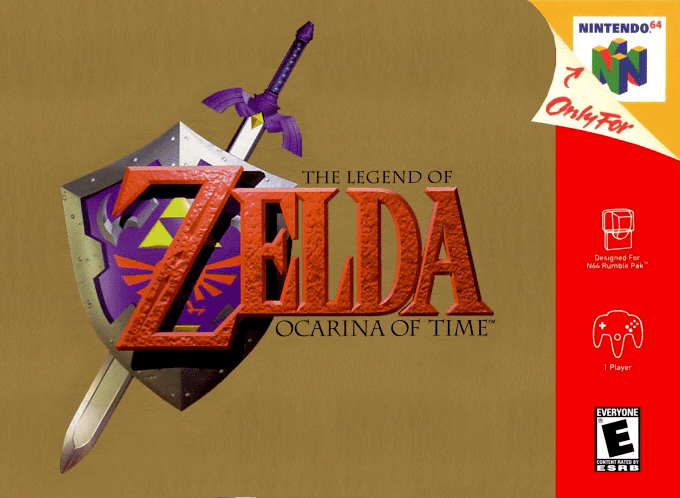
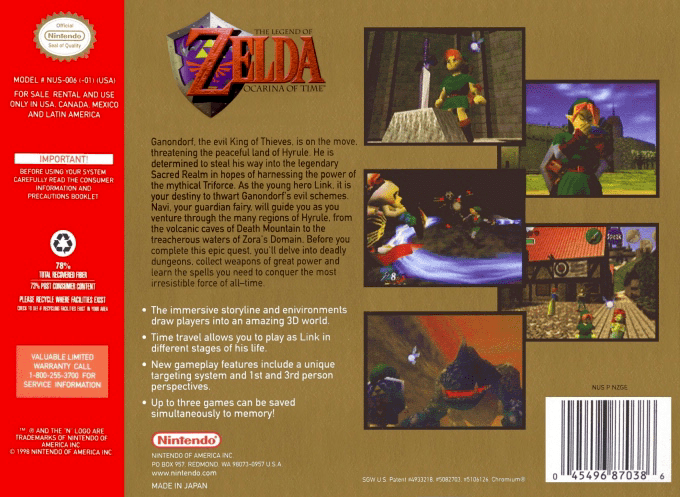
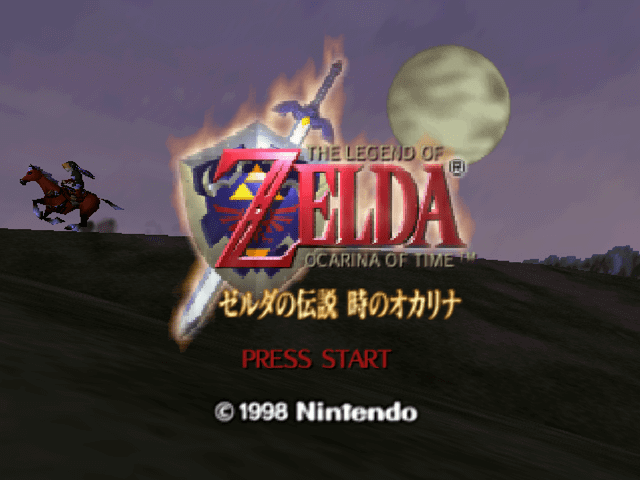
The Legend of Zelda: Ocarina of Time is Nintendo's 1998 action-adventure for Nintendo 64, developed and published by Nintendo. It arrived first in Japan on November 21, 1998, then in North America on November 23, placing this N64 edition in the period when the series made its defining move into a fully three-dimensional Hyrule. Rather than simply translating earlier Zelda ideas to a new camera, the game builds a broad connected kingdom around forests, villages, Death Mountain, Lake Hylia, Gerudo territory and Hyrule Field, giving every major destination a distinct atmosphere, people and purpose.
Link begins as a boy raised among the Kokiri, summoned from the forest by the dying Great Deku Tree and accompanied by the fairy Navi. A meeting with Princess Zelda sets him against Ganondorf, the Gerudo king seeking the Triforce. The opening quest has Link gather the three Spiritual Stones and use the Ocarina of Time to reach the Master Sword in the Temple of Time. That success carries a consequence: Link is sealed away for seven years while Ganondorf takes control of Hyrule, turning the search for the Sages into a journey across both a lost childhood and a damaged future.
The change between young Link and adult Link is more than a story device. Each age can enter different spaces, use different equipment and see the same locations in sharply different circumstances. Returning the Master Sword to its pedestal lets the player move between eras to prepare a route in one age and complete it in the other. This structure makes the Temple of Time a practical center of the adventure, while the contrast between familiar places such as Kakariko Village, Zora's Domain and the market gives the stakes a personal dimension.
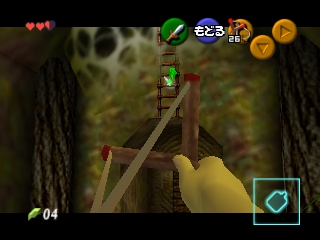
Ocarina of Time made its 3D combat and exploration readable through Z-targeting, which locks Link's attention onto an enemy or object so the camera and his facing stay useful in motion. Context-sensitive actions change what a button does according to the situation, whether Link is climbing, talking, pushing, opening, diving or striking. Sword-and-shield encounters expand with arrows, bombs, boomerangs, hookshots, magic and more, and the C buttons put frequently used tools at hand. The result is an adventure built around observing a space, choosing the right tool and acting at the right moment.
Music is directly woven into that tool set. Link learns melodies on the ocarina to call effects, reveal opportunities and travel to places he has already visited, while the same instrument opens the path to the Master Sword. Songs, switches, blocks, light, water levels and enemies all become parts of dungeon puzzles. Major temples are not merely combat stages: they are layered spaces in which keys, maps, special items and boss doors organize a series of discoveries, culminating in a confrontation that tests the skills and equipment learned inside.
Hyrule also rewards curiosity outside the main temples. Link can collect heart pieces, bottles, Gold Skulltula tokens and upgrades, take part in a long trading sequence, fish at Lake Hylia, and meet characters whose small stories make the world feel inhabited. At Lon Lon Ranch he can learn Epona's Song and earn the horse Epona, adding fast travel across Hyrule Field and mounted bow attacks. These diversions give the game a sense of lived-in adventure while still feeding into its exploration, inventory and progression systems.
The original N64 game has several cartridge revisions, including changes that fixed issues and adjusted certain presentation details; they should not be confused with later rereleases or the more difficult Master Quest. Nintendo later brought Ocarina of Time to other services and platforms, and the 2011 Nintendo 3DS remake refreshed it for a handheld generation. The 1998 version remains especially important for the way its targeting, context-aware controls, camera language, time-travel structure and carefully themed dungeons became touchstones for 3D action-adventure design, while its tale of Link, Zelda, Ganondorf and Hyrule continues to anchor the Zelda series.
Gallery
Details
- Developer
- Nintendo
- Publisher
- Nintendo
- Genre
- JRPG
- Players
- 1
- Release Date
- November 23, 1998
- System
- N64