About
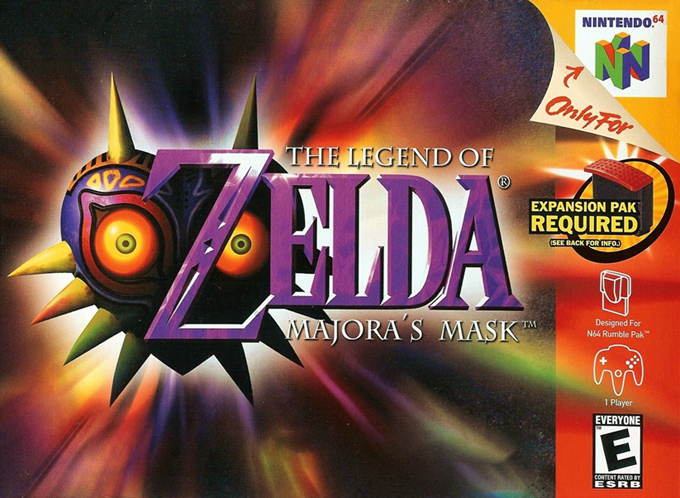
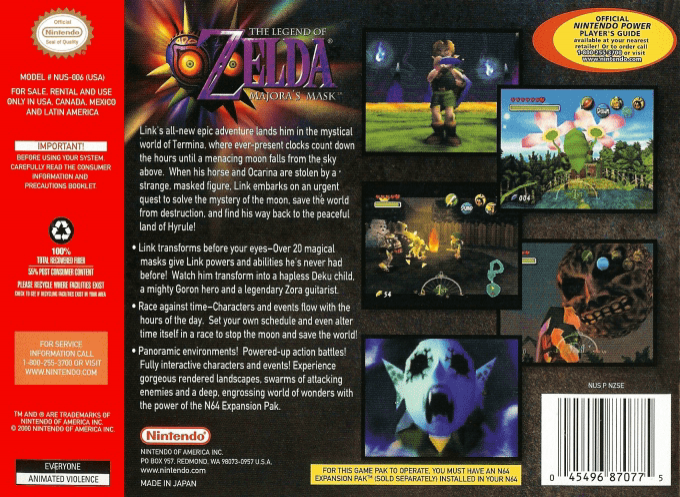
The Legend of Zelda: Majora's Mask for Nintendo 64 is Nintendo's 2000 action-adventure follow-up to Ocarina of Time. Developed and published by Nintendo, it sends Link away from Hyrule and into Termina, a world facing disaster: a huge moon is due to fall in three days. After Skull Kid steals the Ocarina of Time and leaves Link cursed in Deku form, the quest becomes a race to recover Majora's Mask, restore Link, and prevent the catastrophe before the Carnival of Time.
Majora's Mask uses the third-person exploration, sword combat, item use, dungeon puzzles, and Z-targeting familiar from its Nintendo 64 predecessor. Link can defend with his shield, use tools such as bombs, arrows, and the Hookshot, and build his inventory as new routes and obstacles appear. The game rewards observing the world closely. Its four main regions lead to temples with enemies, puzzles, bosses, and trapped Great Fairies, while Clock Town serves as the busy central hub from which Link follows leads in every direction.
The Ocarina of Time gives the adventure its distinctive structure. A complete three-day cycle lasts 72 in-game hours, and events unfold according to the clock. Playing the Song of Time takes Link back to the first morning, preserving major equipment, masks, songs, and dungeon progress while returning many local events to their starting point. Other melodies can slow time, move ahead to a chosen morning or evening, or help Link travel between activated owl statues. This turns conversations, schedules, and repeated visits into useful parts of exploration rather than simple background detail.
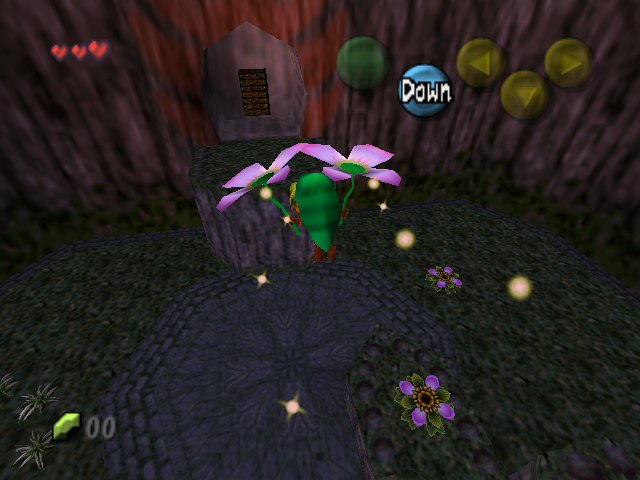
Masks are equally central to Majora's Mask. Link can collect masks through story progress and optional tasks, and several transform him into forms with different movement and combat abilities. Deku Link can use Deku Flowers to launch into the air and skim across water; Goron Link rolls at speed, strikes heavily, and can cross lava; Zora Link excels in water, swimming quickly and using boomerang-like fins. Other masks offer situational benefits, from finding stray fairies to running faster, and the ways Termina's inhabitants react can open new solutions.
The setting gives the Nintendo 64 game a strong sense of place. Beneath the approaching moon, the people of Clock Town and the surrounding swamp, mountain, coast, and canyon areas continue with their own concerns. Link's companion Tatl, Skull Kid, the Happy Mask Salesman, and the Four Giants all figure into the main journey, while many side stories depend on being in the right place at the right time. The Bomber's Notebook helps record people and appointments, making it easier to track the interconnected tasks that unfold across successive cycles.
Majora's Mask was released for Nintendo 64 shortly after Ocarina of Time and uses an enhanced version of that game's technology, including a requirement for the Nintendo 64 Expansion Pak. It is a single-player adventure whose time loop and transformation system set it apart within the series. Nintendo later brought the original game to GameCube, Wii and Wii U Virtual Console services, and Nintendo Classics, while a separate Nintendo 3DS remake, The Legend of Zelda: Majora's Mask 3D, arrived in 2015. The Nintendo 64 original remains the version built around its Expansion Pak hardware and its unusual three-day countdown.
Gallery
Details
- Developer
- Nintendo
- Publisher
- Nintendo
- Genre
- JRPG
- Players
- 1
- Release Date
- October 26, 2000
- System
- N64