About
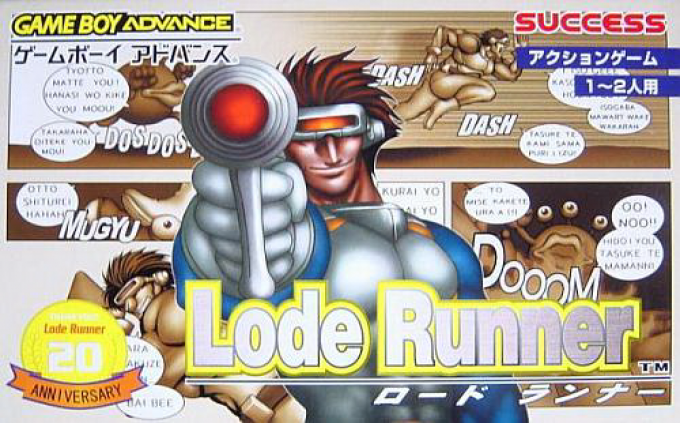
Lode Runner for Game Boy Advance is a Japan-only action-puzzle game released by Success on February 21, 2003. Developed and published by Success as a 20th-anniversary entry in the long-running series, it brings the fundamental chase-and-dig design created by Douglas E. Smith to Nintendo's handheld in a version built specifically around compact, fixed-screen stages. It is not a direct port of the 1983 computer original, the NES adaptation, or Hudson's later Nintendo DS game; this is Success's own Game Boy Advance installment.
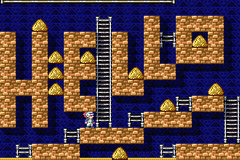
Each stage asks the Runner to gather every gold bar while avoiding pursuing enemies. Ladders carry the player between floors, overhead bars create routes across gaps, and the exit becomes available only after the gold has been collected. The Runner cannot jump, so deciding when to climb, turn, wait, or take a longer route is central to completing a screen safely. Enemies can steal gold by walking over it, which can turn a simple collection task into a problem of timing and positioning.
The signature digging mechanic supplies both the game's danger and its solutions. The player can dig into suitable brick flooring to open temporary pits, then lure enemies inside before the ground reforms. Those holes can clear a route, delay a pursuer, recover a gold bar dropped by an enemy, or create a trap for the Runner if used carelessly. Because a digging action changes the layout for only a short time, later stages reward route planning, quick execution, and an understanding of how guards move through the screen.
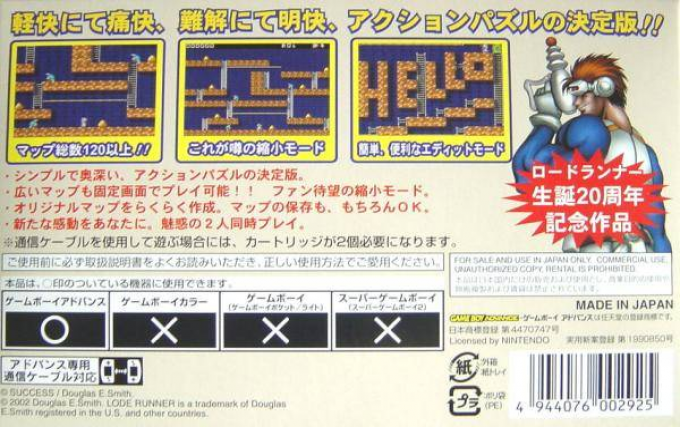
Success organized the Game Boy Advance game into four worlds, each containing 24 regular levels, and included additional hidden stages. Every level fits on a single screen, preserving the immediately readable layout associated with early Lode Runner while allowing individual puzzles to focus on a particular route, trap, or order of collection. The game also adds movable blocks, expanding the ways a player can reshape a stage and setting it apart from the immutable layouts of many earlier series entries.
Progress involves more than simply clearing the regular levels. The GBA release awards medals for meeting particular conditions, including completing a stage without a miss, and it ties hidden content to collecting the hidden-character items found throughout the game. Score goals and technical bonuses provide further incentives for careful play, so replaying a completed world can be useful even after its normal route is known.
Lode Runner for GBA also includes a level editor, continuing a tradition that reaches back to the original game's famous creation tool, and supports two-player play through the Game Boy Advance link cable. Its Japan-only release makes it a separate branch of the series rather than a localization of another Lode Runner edition. For players exploring the Game Boy Advance library, it offers a dense portable interpretation of the classic formula: collect the gold, manipulate the terrain, outthink the guards, and find a safe way to the exit.
Gallery

Details
- Developer
- Success
- Publisher
- Success
- Genre
- Platformer
- Players
- 1
- Release Date
- February 21, 2003
- System
- GBA