About
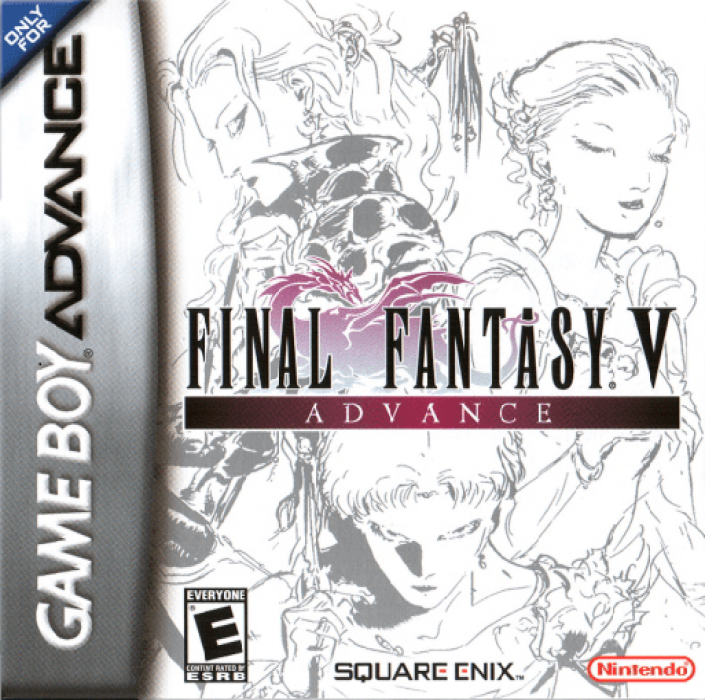
Final Fantasy V Advance for Game Boy Advance is Square Enix's handheld edition of the 1992 Super Famicom role-playing game. It follows Bartz, a wandering traveler accompanied by his chocobo Boko, after a meteor falls and the wind abruptly dies. His path crosses with Princess Lenna, the amnesiac Galuf, and the pirate captain Faris as the four elemental crystals that sustain the world begin to fail. What begins as a race to reach the Wind Shrine grows into a journey across worlds and into the struggle against the sorcerer Exdeath.
The party's connection to the crystals gives the adventure its central structure. Each crisis opens another route, region, or means of travel, and the group moves between towns, castles, caves, forests, towers, islands, and other dungeons as the scope of the conflict widens. The cast changes over the course of the story, with Galuf's granddaughter Krile becoming an important member of the group. Supporting figures including Cid, Mid, and the recurring rival Gilgamesh provide more of the setting's history and personality.
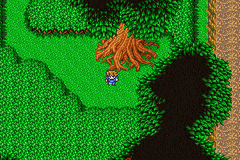
Exploration uses the familiar top-down format of the era. On the world map the party travels on foot and eventually gains vehicles and creatures suited to particular terrain, opening access to new destinations. In settlements, inns restore the party, shops sell gear and supplies, and conversations often point toward the next objective. Dungeons combine treasure, branching paths, switches, hidden passages, puzzle-like obstacles, and random encounters, while optional discoveries and later side activities encourage returning to previously visited places with new capabilities.
Battles use Active Time Battle, so combatants act as their gauges fill instead of waiting through a purely turn-by-turn order. When a character's turn arrives, the player chooses commands such as attacking, casting magic, using an item, defending, or calling on a learned ability. Enemy weaknesses, party formation, status effects, healing, and resource management all matter, while the visible timing gauges make speed an important consideration. Bosses frequently ask for a particular response or a carefully prepared combination of tools rather than simple force.
The defining system is the job system. Crystal shards unlock jobs, and each character can change between roles such as Knight, Black Mage, White Mage, Thief, Monk, Summoner, Blue Mage, Time Mage, and many others. Battles award both regular experience and Ability Points. Ability Points raise job levels, unlocking job commands and passive skills that can be equipped after a character changes to another job. A Knight can therefore carry a learned spell command, or a spellcaster can borrow a utility skill, creating room to shape a party around a favorite tactic or a difficult encounter.
Final Fantasy V Advance preserves that core game while presenting the first official English release on a Nintendo handheld in North America. It uses a new English script and modestly updated presentation compared with the original Super Famicom release. It also supplies a quick-save option suited to portable play, plus a Bestiary for tracking encountered monsters and a music player. These features supplement the adventure without replacing its original plot or job-driven progression.
The Advance edition expands the job roster from the original game's 22 jobs to 26. Gladiator, Cannoneer, Oracle, and Necromancer are additional roles, each with its own abilities to learn and combine with the established classes. Their availability later in the game gives experienced parties further ways to experiment, whether emphasizing weapon attacks, magical effects, item-based techniques, or specialized commands. New equipment accompanies these additions, giving the extra jobs tangible reasons to revisit party setups.
Its major optional challenge is the Sealed Temple, a new multi-floor dungeon with additional encounters, rewards, and the boss Enuo. The location is designed for a well-developed party and makes fuller use of the Advance-only jobs and equipment. This distinguishes the GBA release from the earlier PlayStation port, which added animated opening and ending sequences but did not include this job-and-dungeon expansion. Later mobile versions carried much of the Advance material forward, while the Pixel Remaster returned to the original game's content set rather than retaining the Sealed Temple and four extra jobs.
Gallery

Details
- Developer
- Square Enix
- Publisher
- Nintendo
- Genre
- JRPG
- Players
- 1
- Release Date
- November 6, 2006
- System
- GBA