About
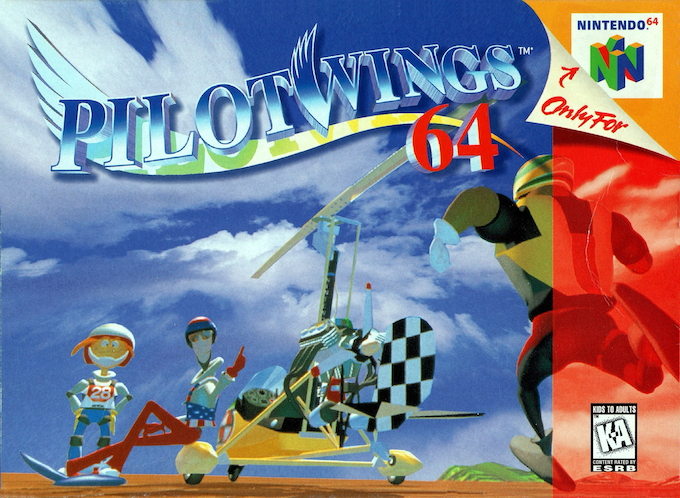
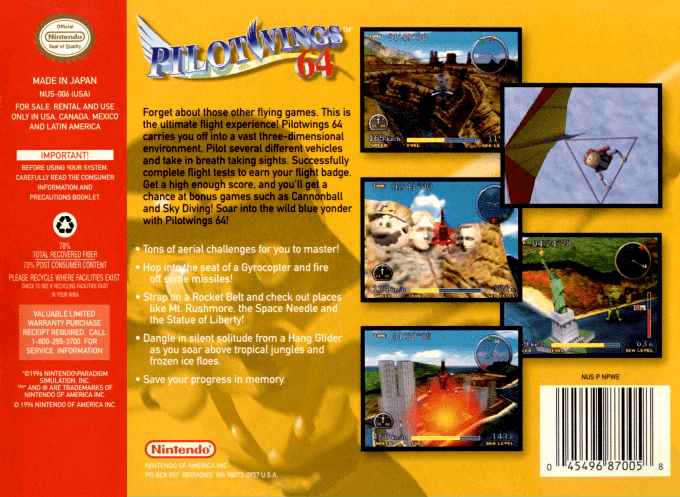
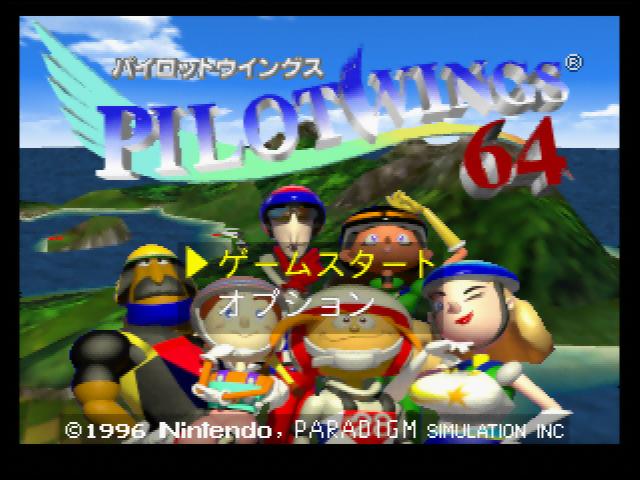
Pilotwings 64 Nintendo 64 is a flight-action game published by Nintendo for the console’s 1996 launch period. It follows the Super NES Pilotwings as a new three-dimensional aerial training course, developed with Paradigm Simulation alongside Nintendo’s teams. Rather than presenting a military flight sim, the game frames flying as a series of demanding but playful license tests. Players select from six aviators, then work toward higher qualifications by meeting objectives across large island landscapes.
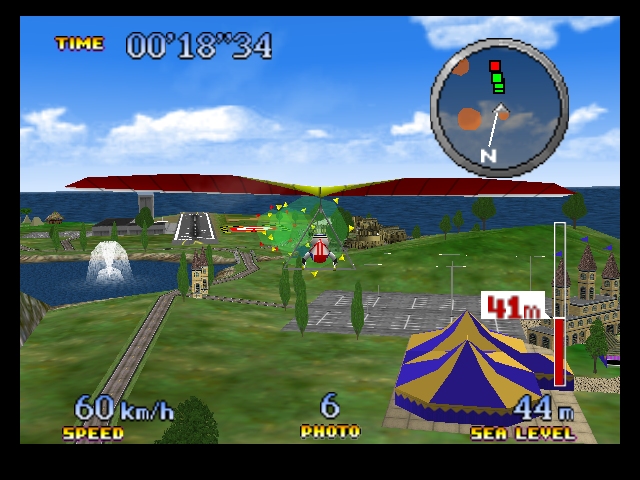
The main course is built around three very different machines: a hang glider, a Rocket Belt and a gyrocopter. Each gives the Nintendo 64’s analog Control Stick a distinct role. Hang gliding asks the pilot to manage altitude and drifting air currents; the Rocket Belt permits hovering, turning and carefully controlled thrust; and the gyrocopter combines takeoffs and landings with powered flight. Tests may require a clean route through airborne markers, a precise landing, target work, or photographic evidence gathered from the air.
Every attempt is scored, so simply reaching an endpoint is not always enough. Performance can depend on factors such as time, fuel, accuracy, damage and landing quality, and the resulting score determines whether a bronze, silver or gold license is awarded. Better results unlock the increasingly difficult class tests, giving the campaign a clear progression from introductory exercises to more exacting aerial challenges. The selectable pilots also have different physical characteristics, making the choice of flyer part of planning a run rather than a purely cosmetic decision.
Pilotwings 64 expands its course with bonus activities earned through strong main-event performance. These include skydiving, a Human Cannonball challenge aimed at a distant target, and Jumble Hopper, which equips a pilot with spring-loaded boots for a bounding trip across the terrain. Birdman is the most open-ended diversion: wearing a winged suit, the player can soar around the islands without a conventional test route. That mode turns the detailed scenery into a place to explore at a gentler pace.
The four island environments give the game a deliberately stylized sense of scale. One recreates portions of the United States as a miniature landscape, mixing recognizable cities and landmarks with Nintendo-themed visual jokes. The contrast between practical flying goals and these fanciful sights is central to the game’s character. Wind, thermals, fuel limits and landing areas make the courses feel like aviation exercises, while balloons, rings and unusual bonus events keep the tone closer to Nintendo’s accessible action design.
In Japan, Pilotwings 64 arrived with the Nintendo 64 in June 1996; it followed in North America that September and reached Europe in 1997. Its release positioned it as both a sequel to the 1990 Super NES game and an early demonstration of the new console’s analog control and expansive polygonal environments. It is a single-player game centered on earning licenses and uncovering optional activities, with the freedom of Birdman providing a useful counterpoint to the precision of its structured tests. Nintendo later made the original Nintendo 64 game available again through the Nintendo Switch Online + Expansion Pack service, while the separate Nintendo 3DS follow-up, Pilotwings Resort, continued the series years later.
Gallery
Details
- Developer
- Nintendo
- Publisher
- Nintendo
- Genre
- Flight Simulator, Arcade Racing
- Players
- 1
- Release Date
- September 29, 1996
- System
- N64