About
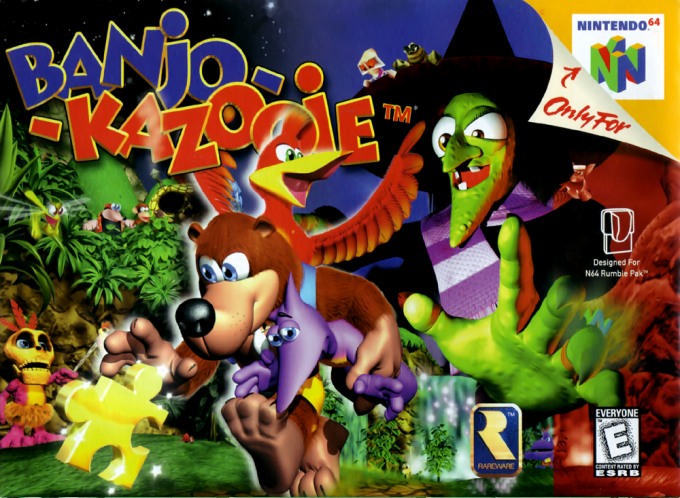
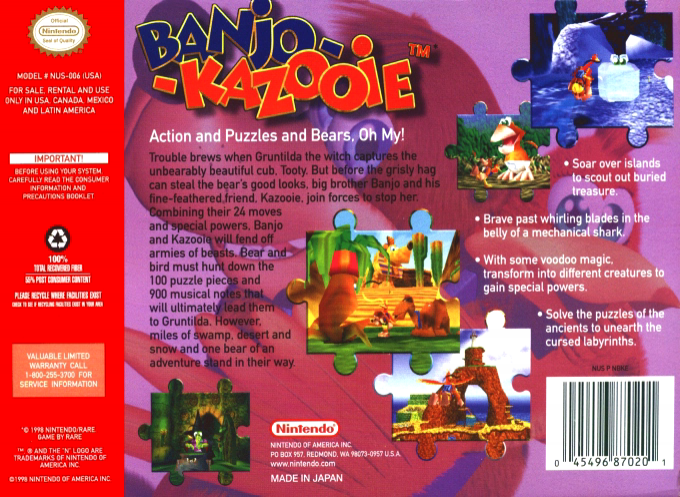
Banjo-Kazooie is Rare's Nintendo 64 platform adventure about an unlikely rescue team: Banjo, a good-natured bear, and Kazooie, the sharp-tongued red-crested breegull who rides in his blue backpack. When the witch Gruntilda kidnaps Banjo's sister Tooty for her beauty-stealing machine, the pair head into Gruntilda's Lair to bring her home. The premise gives the game its personality from the start, pairing storybook villainy with characterful jokes, musical catchphrases and a bear-and-bird partnership built around very different talents.
The original Nintendo 64 game unfolds from Gruntilda's Lair, a connected central hideout whose rooms, doors and passages gradually become reachable as Banjo and Kazooie earn their way forward. It is not a straight line from stage to stage. Players explore the lair, find the entrances to its worlds and use the jigsaw-shaped Jiggies they have collected to complete the picture puzzles that open new areas. Musical Notes provide another gate, making exploration within each world as important as reaching the exit.
Nine large worlds supply the adventure's changing settings: the rocky slopes of Mumbo's Mountain, the pirate-flavored Treasure Trove Cove, the submerged machinery of Clanker's Cavern and the murky Bubblegloop Swamp are only the beginning. Freezeezy Peak turns the hunt into a snowy climb, Gobi's Valley trades it for desert ruins, and Mad Monster Mansion leans into haunted-house surprises. Rusty Bucket Bay and Click Clock Wood arrive later with their own hazards and routes, giving the N64 game a memorable sense of place without losing the thread back to Gruntilda's lair.
Banjo provides the sturdy starting point for the duo, while Kazooie transforms the way they travel. Their expanding move set includes higher jumps, rapid running on Kazooie's legs, attacks, egg-based tricks and limited flight, with new techniques taught by Bottles the mole. On the Nintendo 64 controller, the Control Stick handles movement while the face buttons and Z Button drive the pair's actions; the C Buttons and R Button support the camera. Learning a move is not merely a reward: it changes which ledges, switches, enemies and secrets can be approached in the worlds already visited.
Collecting is the engine of Banjo-Kazooie, but the items have distinct jobs. Jiggies unlock the picture puzzles in the lair, and Musical Notes open note doors on the path toward Gruntilda. Jinjos are small creatures waiting to be rescued, Mumbo Tokens pay the resident shaman Mumbo Jumbo for transformations, and empty Honeycomb Pieces expand Banjo's health when enough have been found. Extra Honeycombs restore energy along the way. The game regularly mixes these goals with races, timed challenges, platforming tests, enemy encounters and compact puzzles, so a distant collectible is often an invitation to work out a route rather than simply make a jump.
Mumbo's transformations are a key source of variety in the original game. By changing Banjo and Kazooie into forms suited to a particular world, the adventure opens tasks that their normal bear-and-bird form cannot solve. That idea sits neatly beside Kazooie's mobility: the pair may return to an earlier location with a new move or a new form and see its obstacles differently. It is a structure that rewards curiosity and makes the hub, the stages and the collectible hunt feel like parts of the same journey.
The presentation remains central to the appeal. Rare fills the N64 adventure with talkative supporting characters, exaggerated enemy designs and locations that give each challenge a comic context. Grant Kirkhope's score shifts with the surroundings, helping the music follow the player from one portion of a world to another. Rather than treating its cheerful tone as decoration, Banjo-Kazooie uses it to make clues, transformations and repeated visits feel playful even when the route to the next Jiggy takes some investigation.
For players seeking a defining Nintendo 64 3D platformer, Banjo-Kazooie offers a substantial single-player quest built on exploration, movement and gradual mastery. Its nine worlds do not ask only for quick reflexes: they ask players to notice unusual objects, remember unopened paths, learn how each collectible works and decide where a newly learned ability might matter next. The result is an original N64 adventure with a clear rescue story, a richly connected lair and a bear-and-bird move set designed to turn every new discovery into another way to explore.
Gallery
Details
- Developer
- Rareware
- Publisher
- Nintendo
- Genre
- Platformer
- Players
- 1
- Release Date
- June 29, 1998
- System
- N64