About
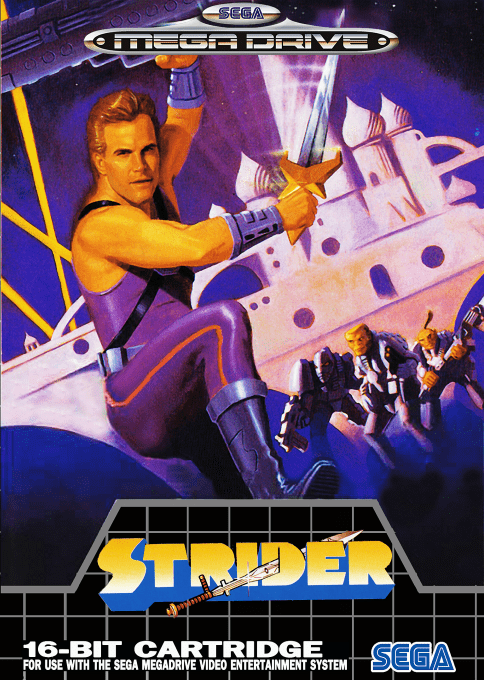
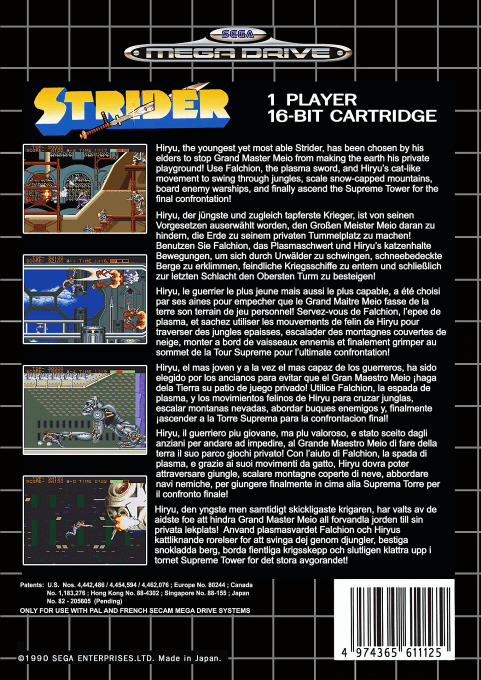
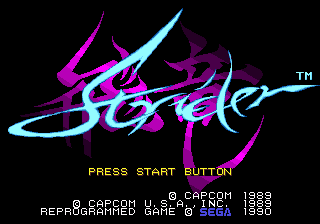
Strider for Sega Genesis, known as Strider Hiryu on Mega Drive in Japan, is Sega’s 1990 home conversion of Capcom’s 1989 arcade action game. The 16-bit release brings the futuristic mission of elite agent Hiryu to the living room: in the late twenty-first century, he infiltrates the domain of the dictator Grandmaster Meio. Although the original arcade game was created and published by Capcom, this Genesis/Mega Drive adaptation was reprogrammed by Sega and released first in Japan before reaching North America and PAL territories. It is a single-player side-scrolling action platformer built around rapid movement, close-range combat, and an unusually international science-fiction backdrop.
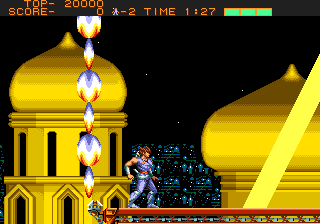
Hiryu’s primary weapon is the Cypher, a plasma blade swung with the attack button. The second button handles jumping, while directional input changes how he moves through dangerous spaces. A standing jump sends him upward, running produces a cartwheel-like leap, and crouching before jumping lets him slide under certain hazards. The defining mechanic is his ability to hook onto designated surfaces and travel across walls or beneath overhangs. That freedom makes positioning part of the challenge: Hiryu can avoid danger, cross gaps, and approach enemies from routes that would be unavailable to an ordinary platform hero.
The Genesis Strider follows the arcade game’s five-stage journey, opening with an assault on the Grandmaster’s Soviet-controlled stronghold and continuing through locations including the Siberian wilderness, the airborne battleship Balrog, the Amazon, and Meio’s final base. Each area is divided into smaller sections with checkpoints and a time limit. Guards, machines, and larger bosses block the route, so survival depends on preserving Hiryu’s health while keeping the forward momentum of the mission. Losing all health, running out of time, or falling off the active playfield costs a life, giving the fast pace a clear arcade-style risk.
Item-carrying enemies can yield useful upgrades. Some extend the Cypher’s reach for a limited number of strikes, while others restore or increase Hiryu’s health, award an extra life, or activate a temporary powered-up state. He can also call on robotic Options to assist in battle; the available helpers include small droids as well as animal-shaped machines. These pickups do not turn the game into a methodical inventory system. Instead, they give a brief tactical advantage during a continually moving assault and encourage players to decide whether to press ahead or use a safer path through a crowded section.
The Mega Drive/Genesis version is closely based on the arcade release but is its own console conversion, with a distinct ending sequence after the final confrontation. It was marketed as an early 8-megabit cartridge for Sega’s hardware, a notable capacity claim for the system at the time. The game should not be confused with the separately developed NES Strider, which tells a different story, or with the licensed Strider II/Journey from Darkness sequel made by U.S. Gold and Tiertex. Its balance of acrobatic traversal, Cypher combat, exotic locations, and boss encounters established the core image of Strider Hiryu that would later reappear in Capcom crossover games and later entries in the series.
Gallery
Details
- Developer
- Capcom
- Publisher
- Capcom
- Genre
- Platformer
- Players
- 1
- Release Date
- May 1, 1991
- System
- Genesis/Megadrive

/Madou_Monogatari_I.png)