About
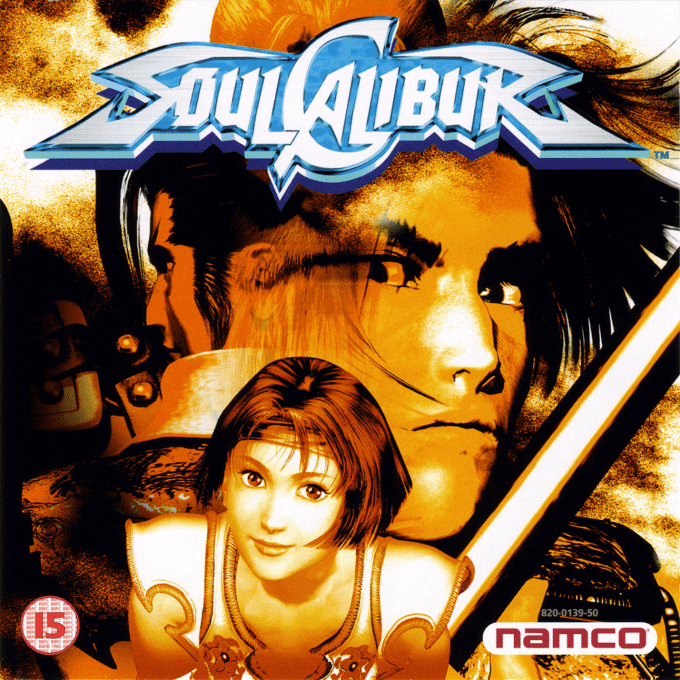
SoulCalibur for Dreamcast is Namco’s weapon-based 3D fighting game, released for Sega’s console in Japan in August 1999 and in Europe that November. It is the home conversion of Namco’s 1998 arcade game and the direct follow-up to Soul Edge, known as Soul Blade in some territories. Rather than treating weapons as a visual flourish, the game builds every combatant around a distinct armament and fighting discipline, from swords and shields to staffs, axes, nunchaku, and unusual bladed weapons. Its one-on-one clashes take place in a stylized late-sixteenth-century world where a cursed sword has become the focus of a conflict spanning many countries.
The story follows the aftermath of Soul Edge’s earlier defeat. The blade’s destructive force has found a new host in the armored Nightmare, and its influence draws fighters with very different purposes into the same struggle. Some seek the weapon’s power, while others want to end the violence connected to it or resolve personal debts. Familiar warriors including Mitsurugi, Sophitia, Taki, Siegfried, Voldo, Rock, Hwang, and Seong Mi-na return from the previous game, joined by fighters such as Kilik, Xianghua, Maxi, Astaroth, Ivy, and Yoshimitsu. Each character brings an individual weapon, command list, and storyline to the quest surrounding Soul Edge.
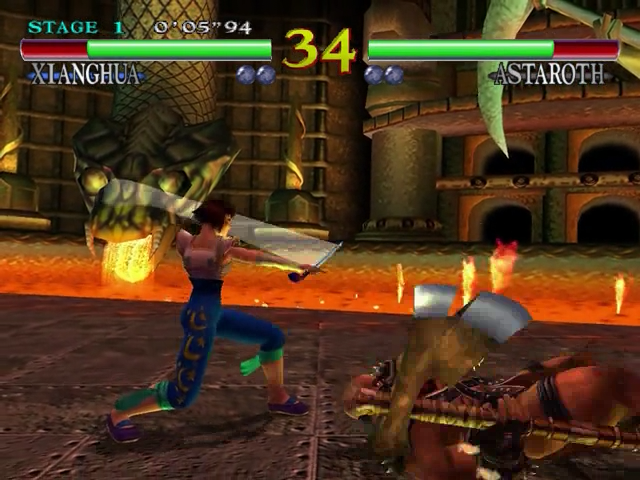
SoulCalibur’s matches are built around four primary actions: horizontal strikes, vertical strikes, kicks, and guard. The different attack directions matter because they interact with both blocking and movement; a wide swing can catch an opponent trying to circle, while a more direct attack can punish an opening. Throws, special attacks, and Guard Impacts add further options. A well-timed Guard Impact can turn aside an incoming blow and create an opening, while certain attacks must be avoided rather than simply defended. Rounds can end by draining an opponent’s health or by forcing them beyond the edge of an arena, making position as important as damage.
A defining system is the 8-Way Run. Holding a direction moves a fighter freely around the 3D stage, allowing players to advance, retreat, angle around linear attacks, and contest the edge of the ring without relying solely on a dedicated sidestep. That freedom gives weapon range and stage placement a central role in every exchange. The game also lets players queue many inputs while a move is recovering, which helps chains and counterattacks flow from one action into the next. The result is a fighting system that rewards learning a chosen character’s range and timing while remaining immediately playable with its straightforward button layout.
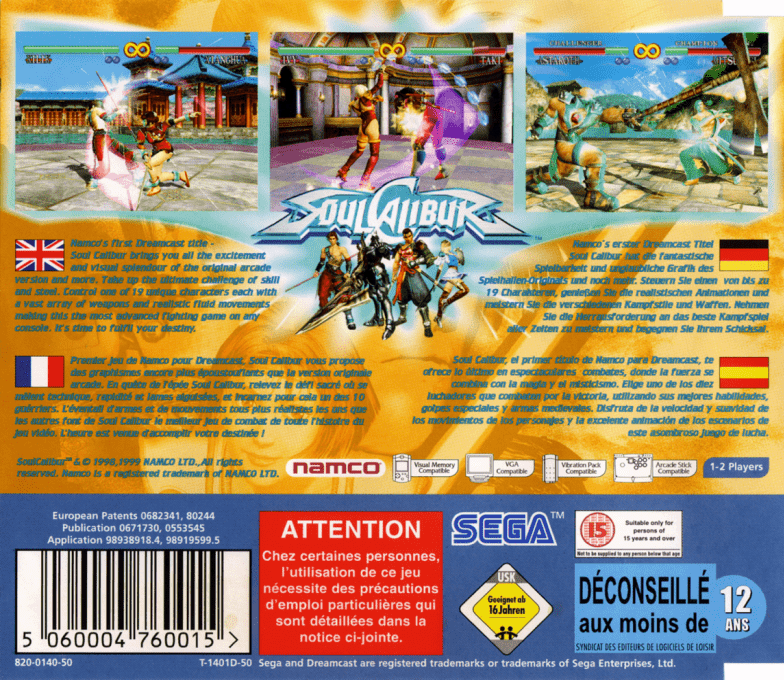
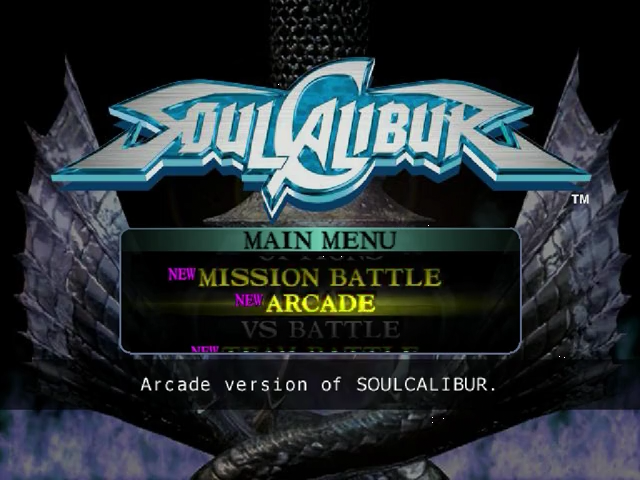
The Dreamcast edition goes beyond a simple arcade port. It retains the arcade-style route for quick fights and supports local two-player versus battles, then adds options for solo play including Team Battle, Survival, Practice, and Tournament play. Mission Battle presents a progression of matches with special conditions and rewards; completing its challenges earns points that unlock additional content. Hidden fighters, alternate costumes, arenas, character material, and other extras give the home version a collection and progression layer that the arcade release did not provide.
Its Museum expands that package with character profiles, artwork, and motion demonstrations, while Battle Theater lets players view performers’ weapon forms. Namco also used the Dreamcast hardware to revise the presentation: the home version’s stages use fully polygonal environments rather than the arcade version’s flat distant scenery, alongside changes to lighting and other graphical detail. This is why the Dreamcast release is often treated as its own substantial edition rather than merely a conversion. It preserves the rapid arcade combat while giving players more ways to practice, unlock content, and explore the cast.
As the first Soulcalibur game to reach home consoles, SoulCalibur for Dreamcast established the direction of the series after Soul Edge: historical-fantasy fighters, character-specific weapons, ring-outs, and a greater emphasis on moving through three-dimensional space. The game’s combination of competitive versus play and extensive single-player unlocks makes it suited both to short local sessions and longer attempts to clear Mission Battle challenges. For Dreamcast players looking for a foundational entry in Namco’s weapon-fighting series, it remains the original console chapter in the long-running battle between Soul Edge and those who oppose it.
Gallery
Details
- Developer
- Namco
- Publisher
- Namco
- Genre
- Fighting
- Players
- 1-2
- Release Date
- November 26, 1999
- System
- Dreamcast