About
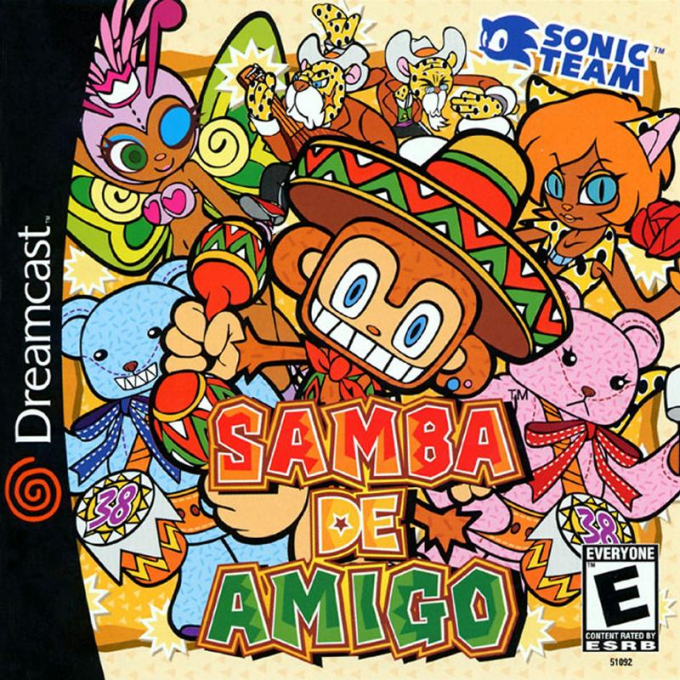
Samba de Amigo is a Dreamcast rhythm game from Sonic Team and Sega that turns a pair of maracas into the center of its performance. Adapted from the 1999 arcade release, the 2000 home version casts the player as Amigo, an exuberant monkey who leads colorful Latin-flavored musical scenes. Its central idea is direct but unusually physical for its era: listen to the music, watch the on-screen prompts, and shake the maracas in the right place at the right time. The result is a rhythm game built as much around movement and showmanship as accuracy.
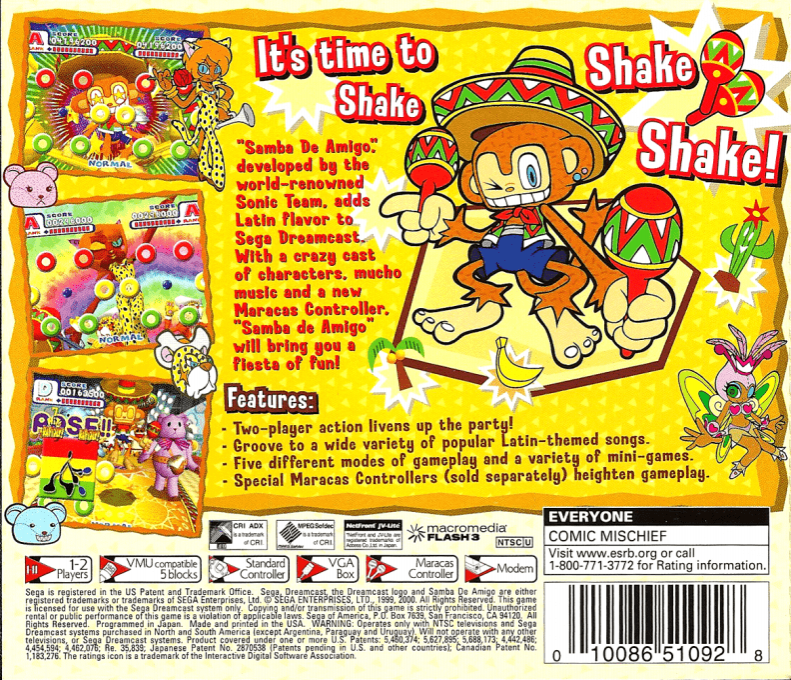
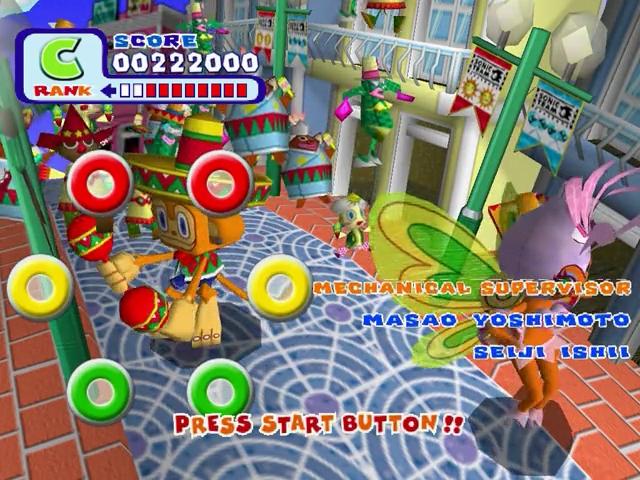
Songs are played against six target positions arranged around a circle: high, middle, and low on both the left and right. Blue markers travel toward those positions, and a player must raise and shake the appropriate maraca as they arrive. Some sequences call for rapid repeated shaking, while Pose prompts ask the player to copy an illustrated stance with both maracas. Timing, placement, and sustained rhythm build a score and combo. Strong performances make the stage crowd and scenery more lively, while missed notes gradually empty the scene around Amigo.
The Dreamcast release is especially known for its dedicated controller set. Two red maracas connect to a sensor bar placed on the floor in front of the player, using ultrasonic positioning to judge where each controller is being shaken. A supplied foot mat helps establish the intended standing position, and the maraca tops can be unscrewed for quieter play. The game can also be controlled with a standard Dreamcast pad, but the specialized hardware is what gives Samba de Amigo its distinctive hands-up, party-game character.
Sonic Team designed the game as an accessible musical performance rather than a conventional button-driven challenge. Its arcade origins are clear in the immediate visual language and short, energetic song sets, but the Dreamcast version expands the structure for home play. Arcade mode recreates the staged arcade format, while Original mode lets players select from unlocked songs. Challenge mode presents progress goals such as target scores and grades, offering a more directed way to practice timing and unlock additional content.
The home version also adds Party mode, a collection of competitive and cooperative activities that use the same maraca controls in different ways. Its minigames include Guacamole, a rhythm variation on whacking targets, and Strike A Pose, which concentrates on matching poses. Battle mode lets two players compete through songs, while Couples, called Love Love in Japan, frames a two-player performance as a compatibility test. These options make the game as suited to shared play and spectators as to a solo score chase.
Its soundtrack mixes samba-oriented material with familiar pop standards and international dance songs, chosen to support broad, energetic rhythms. The music and saturated presentation work together: dancers, animals, crowds, and stage effects react to the player’s success, reinforcing the feeling that each song is a tiny carnival performance. Amigo’s cheerful design, created by Sonic artist Yuji Uekawa, became the visual anchor for the game’s playful tone. The combination of Latin-inspired imagery, cartoon animation, and motion-controlled rhythm set it apart from more austere music games of the period.
The original arcade game was a major success in Japan, and the Dreamcast port drew strong critical attention for bringing its unusual experience home. Reviewers frequently praised its infectious presentation and the novelty of the maraca setup, even as the cost and scarcity of the accessory limited how easily players could experience the intended controls. The game’s acclaim helped secure its reputation as one of the Dreamcast’s most inventive releases and as an early example of a console rhythm game designed around a dedicated peripheral.
Samba de Amigo later received the Japan-only expanded release Samba de Amigo: Ver. 2000, which added music and new modes, but this Dreamcast entry is the original home conversion. Its legacy continued through later Sega appearances for Amigo and follow-up adaptations, including a Wii version and the modern Samba de Amigo: Party Central. For Dreamcast players, however, the original remains a vivid showcase for Sonic Team’s willingness to pair colorful arcade spectacle with an unconventional controller and invite players to perform along with the music.
Gallery
Details
- Developer
- Sonic Team
- Publisher
- SEGA
- Genre
- Rhythm Game
- Players
- 1-2
- Release Date
- October 17, 2000
- System
- Dreamcast