About
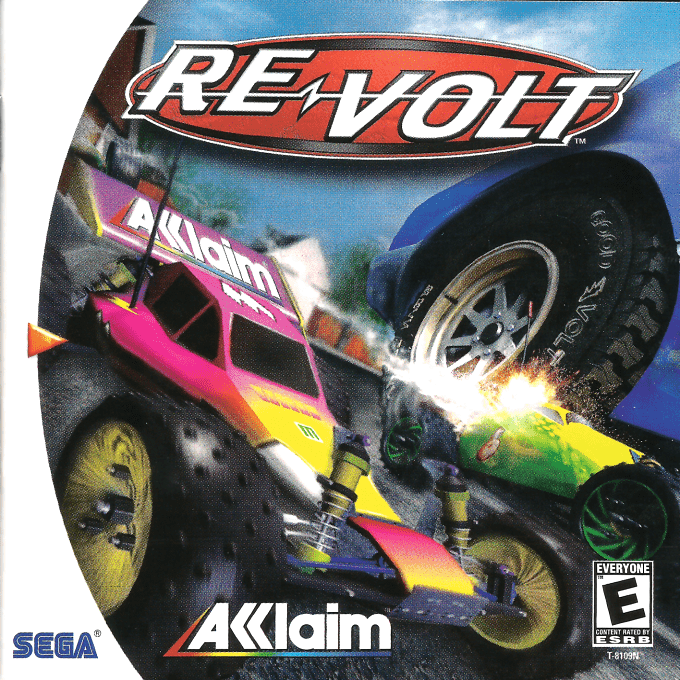
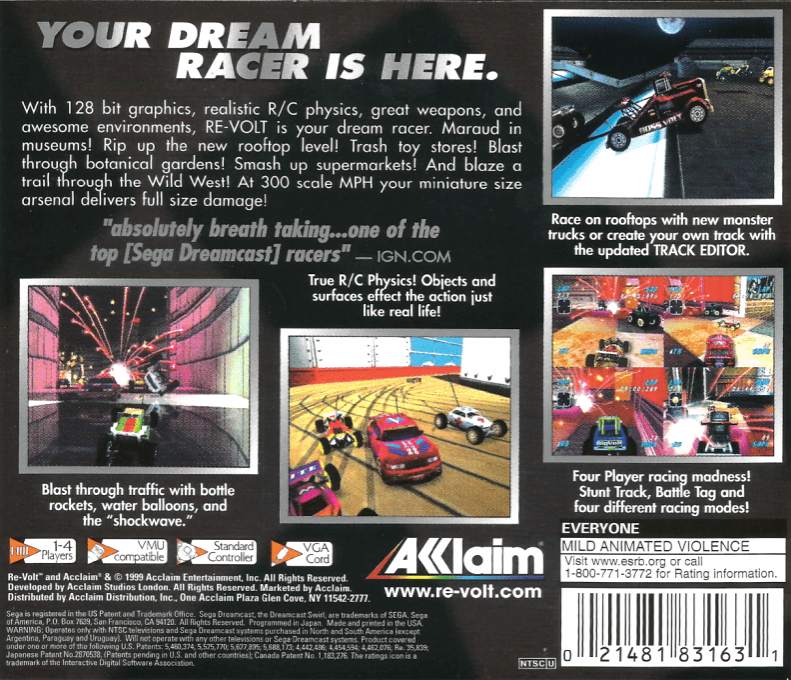
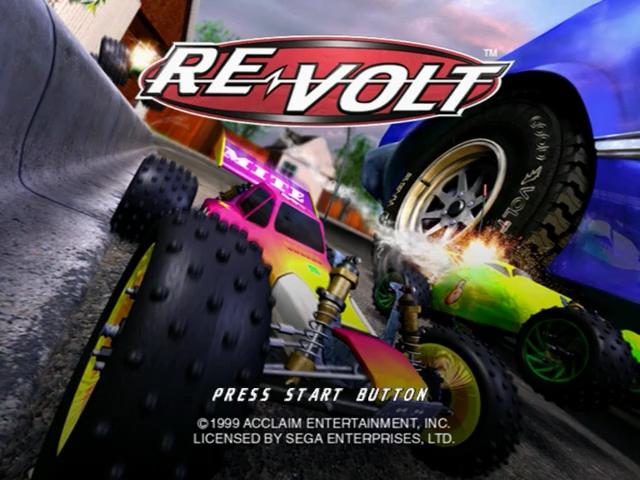
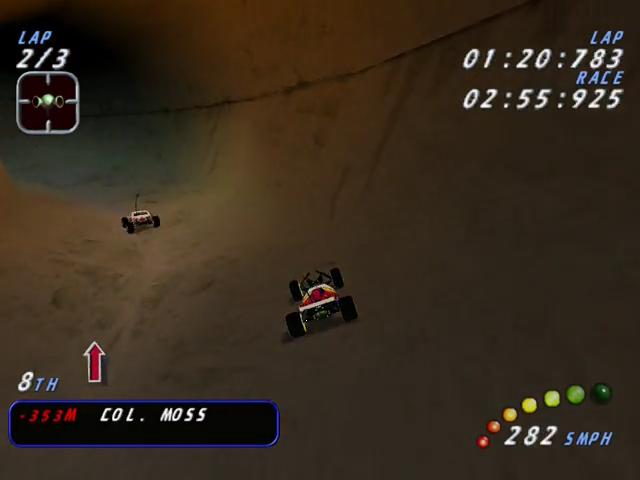
Re-Volt for Dreamcast is a 1999 radio-controlled car racing game developed by Acclaim Studios London and published by Acclaim Entertainment. Instead of sending full-sized vehicles around conventional circuits, it turns ordinary locations into oversized courses for miniature machines: a museum, supermarket, toy-themed spaces, a neighborhood and other obstacle-filled environments become places where curbs, ramps, puddles and loose objects can change a race. The Dreamcast version arrived during the system’s first year and presents the game’s blend of arcade competition and deliberately weighty R/C handling.
Each race begins with choosing a car whose acceleration, top speed and weight affect how it behaves on the road. The cars are available with front-, rear- or four-wheel drive arrangements, and their small scale makes surfaces and collisions matter. Light vehicles can be quick but prone to being knocked off line, while heavier choices offer a different kind of control. Steering, braking and throttle management are essential through tight indoor turns and uneven courses; careless driving can leave a car spinning, overturned or wedged against scenery. Players can select from several physics settings, allowing the same tracks to demand a more forgiving approach or a closer simulation of temperamental radio-controlled racing.
Races are not limited to clean laps. Pickups placed around the courses can be used against rivals, including projectiles, water balloons and oil slicks, which introduce a vehicular-combat edge without changing the goal of reaching the finish first. Eight cars compete in the standard races, and the unusual course scale gives the action its character: racing beneath furniture, through shop displays or past everyday objects makes each shortcut and hazard feel much larger than the vehicles. The tracks can also be run in reverse, mirrored, or both once the relevant variations have been earned, adding new lines and obstacles to learn without abandoning the original environments.
Progression is organized around several single-player activities. Championship mode groups races into cups and awards points for finishing positions, while requiring the player to place well enough to continue. Winning cups opens further cars and tracks. Single Race provides a direct contest against computer opponents, Time Trial focuses on lap times, and Practice lets drivers explore a course without a race clock or rival pack. Practice tracks also hide collectible stars, and gathering them helps unlock vehicles. The Stunt Arena replaces a conventional circuit with ramps, loops and a half-pipe, challenging players to collect twenty stars; completing that task opens the Clockwork Carnage mode, a race involving wind-up cars rather than the usual eight R/C competitors.
Re-Volt on Dreamcast also supports local multiplayer for up to four people. Alongside ordinary multiplayer races, Battle Tag has players seek a star in an arena while a personal timer counts down, with the first timer to reach zero winning. The Dreamcast edition is a distinct console release of the original multi-platform game rather than a later Re-Volt Classic mobile adaptation. Its core appeal lies in the tension between easy-to-understand toy-car racing and handling that rewards patience: competitors must read the course, choose when to use a pickup, and keep a tiny vehicle stable through spaces designed for people rather than cars.
Gallery
Details
- Developer
- Acclaim Entertainment
- Publisher
- Acclaim Entertainment
- Genre
- Racing & Driving
- Players
- 1-4
- Release Date
- December 17, 1999
- System
- Dreamcast