About
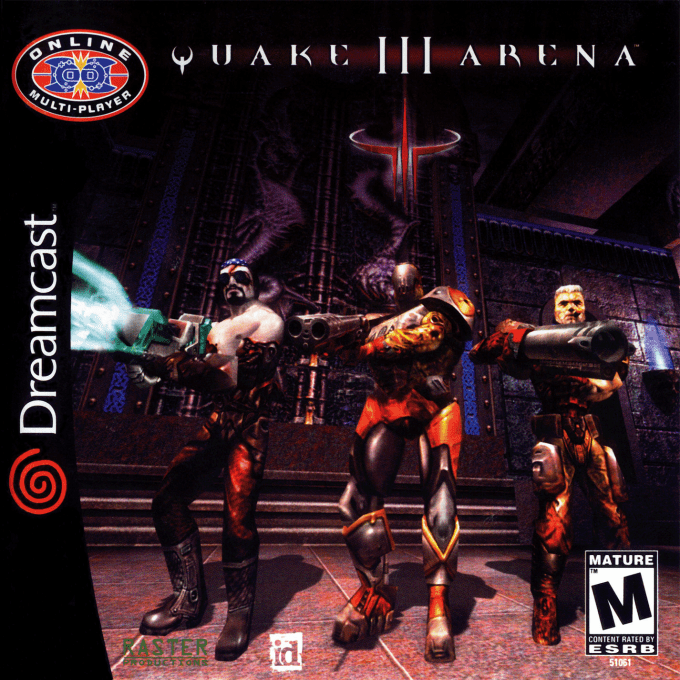
Quake III Arena for Dreamcast is Sega’s 2000 console edition of id Software’s arena-focused first-person shooter. Released in North America in October 2000 and published by Sega, it brings the competitive Quake III experience to the Dreamcast through a conversion credited to Raster Productions, with No Cliché associated with the European work. Rather than a conventional campaign with a long narrative, this entry turns Quake’s science-fiction mythology into a succession of gladiatorial contests in the Arena Eternal, a battleground assembled by the mysterious Vadrigar.
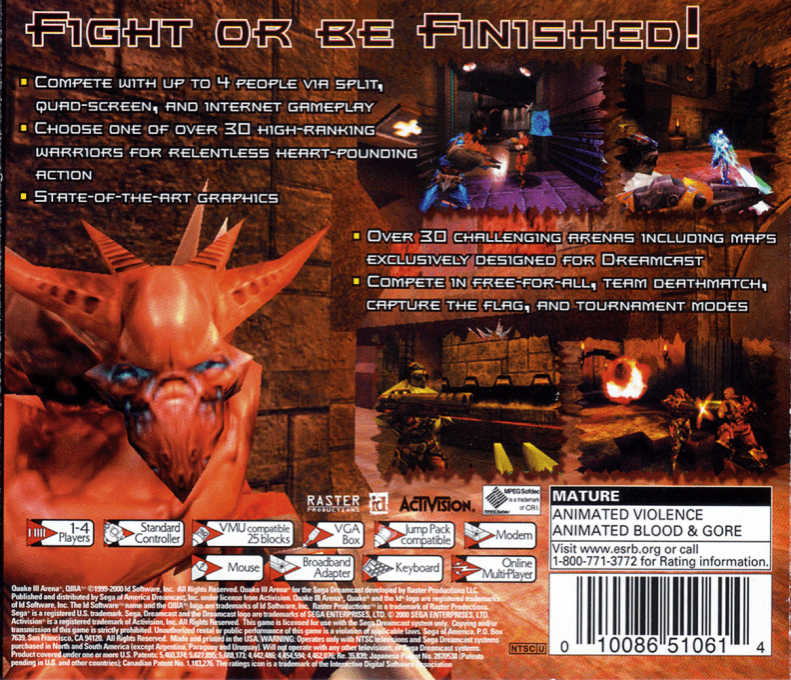
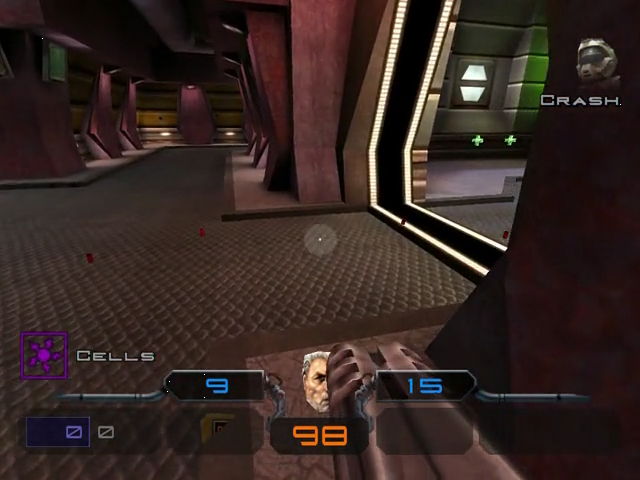
The central aim is direct: score more frags than the opposition before the match ends. Combat rewards quick movement, map knowledge, timing, and the ability to switch between weapons suited to different distances. Every combatant begins with a gauntlet and machine gun, then races around each arena to collect armor, health, ammunition, and stronger tools such as the shotgun, grenade launcher, rocket launcher, lightning gun, plasma gun, railgun, and BFG. Because weapons and pickups return at fixed locations, controlling useful parts of a map is as important as winning an individual exchange.
Its arenas are designed as compact, layered spaces full of routes and risks. Jump pads, teleporters, moving platforms, doors, hazardous drops, and item placements create opportunities to outmaneuver another player or escape a losing fight. Explosive weapons can be dangerous at close range as well as useful against an opponent, while the railgun favors careful long-distance aim and the lightning gun is most effective when an enemy is nearby. The result is a game built around repeated respawns and fast tactical decisions rather than slow exploration.
Solo play substitutes computer-controlled gladiators for human opponents. The Dreamcast manual divides this mode into five tiers of four arenas, requiring the player to win each arena to advance toward Xaero, the final opponent. The roster includes familiar Quake and id Software figures alongside original arena fighters, with characters presented as warriors drawn from different times and worlds. Five difficulty settings let players tailor the bots’ challenge, while match medals track achievements such as accuracy, quick consecutive eliminations, and railgun hits.
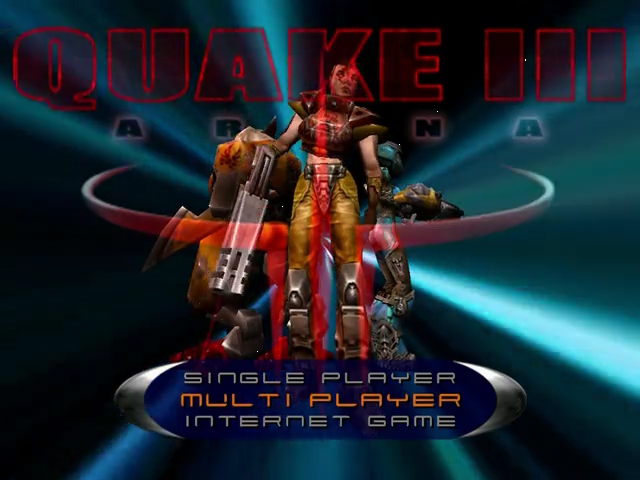
Quake III Arena also supports Free for All, Team Deathmatch, Tournament, and Capture the Flag rules. Dreamcast owners could stage local split-screen matches for up to four people, or take the game online through the console’s modem and SegaNet or another compatible provider. The release was notable for carrying this kind of rapid, mouse-and-keyboard-friendly shooter into an online console environment. It supports the Dreamcast keyboard and mouse as alternatives to the standard controller, and its interface includes configurable player and control settings.
The Dreamcast port is not simply a straight copy of the 1999 PC release. It retains most of the original map selection while adding Dreamcast-exclusive arenas designed around the console version’s four-player limit. Its network setup included server listings and a connection-speed indicator to help players select a suitable match, and the game was designed to work with both dial-up service and Sega’s broadband adapter. Cross-platform Dreamcast-versus-PC play was part of the release’s online identity, although access depended on the contemporary server environment.
Within the Quake series, Quake III Arena marks a deliberate move away from the exploration-led single-player structure of the earlier games toward competitive multiplayer. The Dreamcast version preserves that emphasis while offering bots, local multiplayer, and console-specific maps for players away from the network. Its combination of arena design, weapon balance, selectable control methods, and online ambition makes it a distinctive chapter in both the Quake franchise and the Dreamcast library.
Gallery
Details
- Developer
- No Cliché
- Publisher
- SEGA
- Genre
- First-Person Shooter
- Players
- 1-4
- Release Date
- October 23, 2000
- System
- Dreamcast