About
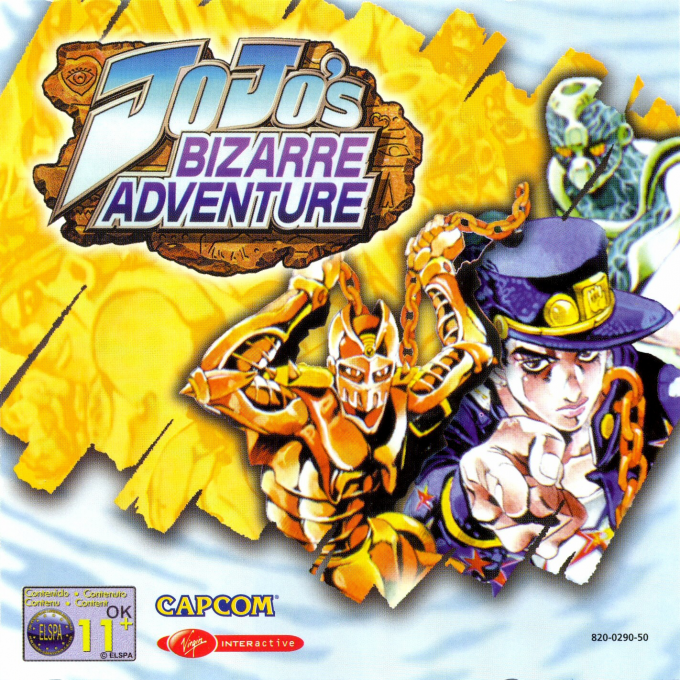
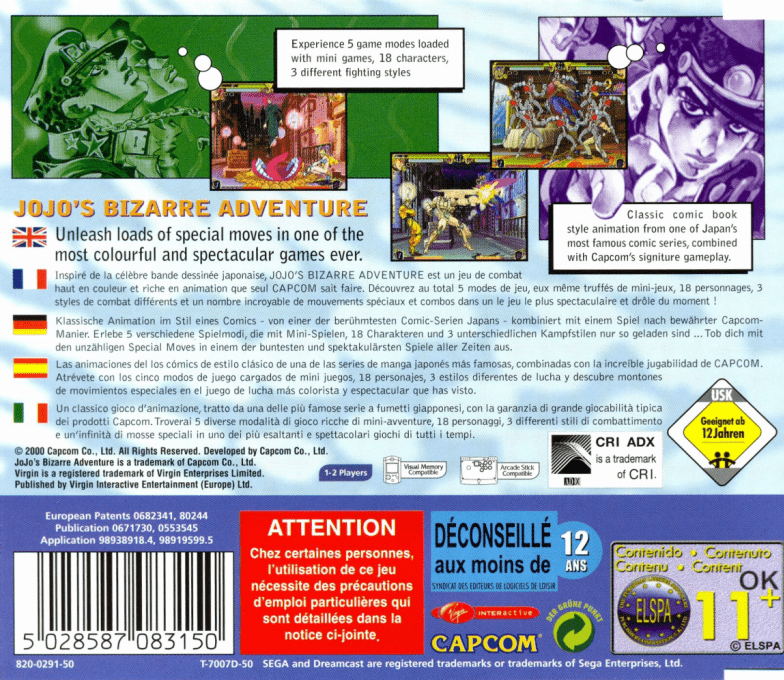
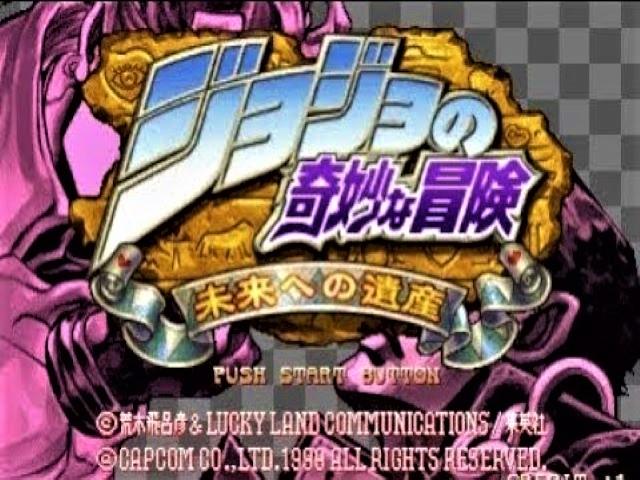
JoJo's Bizarre Adventure for Dreamcast is Capcom's 2D fighting game based on Stardust Crusaders, the third major arc of Hirohiko Araki's manga. Developed by Capcom from its CPS-3 arcade releases, this home version arrived in Japan in late 1999 and reached Europe in 2000 through Virgin Interactive. It brings the flamboyant characters, comic-book visual style and one-on-one combat of the arcade game to Sega's system, while collecting both the original JoJo's Venture and its expanded follow-up, JoJo's Bizarre Adventure: Heritage for the Future.
Matches are fought from a side-on view, with each player trying to empty the opponent's life gauge through punches, kicks, special techniques and super moves. The Dreamcast controller maps light, medium and heavy attacks to the face buttons, with motion inputs and button combinations opening up character-specific attacks. A super gauge builds during combat and can be spent on stronger moves. Standard fighting-game options such as round settings, time limits, damage settings and difficulty adjustments let players tailor a session, and an Easy Control option makes selected special moves more accessible.
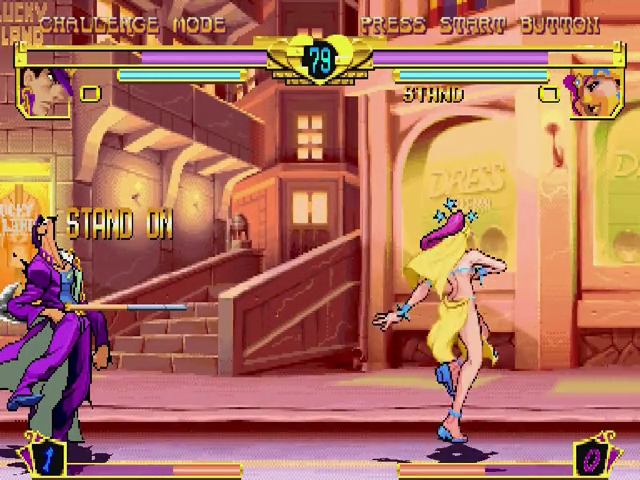
Its defining mechanic is the Stand system. Many fighters can call out a supernatural companion with a dedicated button, changing their reach, attacks and available techniques; certain characters gain abilities such as a double jump or attacks that work separately from the user. That extra power has a cost. A deployed Stand has its own gauge, and damage to it endangers its owner. If the gauge is depleted, a Stand Crash briefly leaves the fighter exposed. Players must choose when to dismiss a Stand, let its gauge recover, or risk keeping it active to press an advantage. Other characters use variants of the system or rely on their own distinctive abilities instead.
The roster draws from Jotaro Kujo's journey with Joseph Joestar and their allies as they pursue the vampire Dio. Fighters have moves and presentation rooted in the series' characters and powers, giving the game a cast that ranges from close-range brawlers to combatants built around unusual weapons, traps or long-distance Stand attacks. The Heritage for the Future material expands on the earlier arcade lineup, and the Dreamcast disc lets players select either arcade version. The result is a fighting game in which matchup knowledge and resource management matter as much as execution.
For solo play, JoJo's Bizarre Adventure includes arcade challenges alongside training and challenge options, while Versus mode supports head-to-head competition for up to two players. The Dreamcast release preserves the arcade-focused structure instead of including the PlayStation version's exclusive Super Story Mode. That difference is important: this edition emphasizes access to the two arcade games and their fighting systems rather than a lengthy manga retelling with scripted story sequences.
Capcom's presentation pairs hand-drawn, anime-influenced character art with exaggerated attacks that suit Araki's world. The project came from the studio behind Street Fighter III, and its CPS-3 roots are apparent in the detailed sprites and fluid 2D animation. For Dreamcast owners, JoJo's Bizarre Adventure remains a distinctive licensed fighter: a console version of two related arcade releases, built around the tactical risk and flexibility of Stand combat rather than a conventional roster of interchangeable martial artists.
Gallery
Details
- Developer
- Capcom
- Publisher
- Virgin
- Genre
- Fighting
- Players
- 1-2
- Release Date
- April 21, 2000
- System
- Dreamcast