About
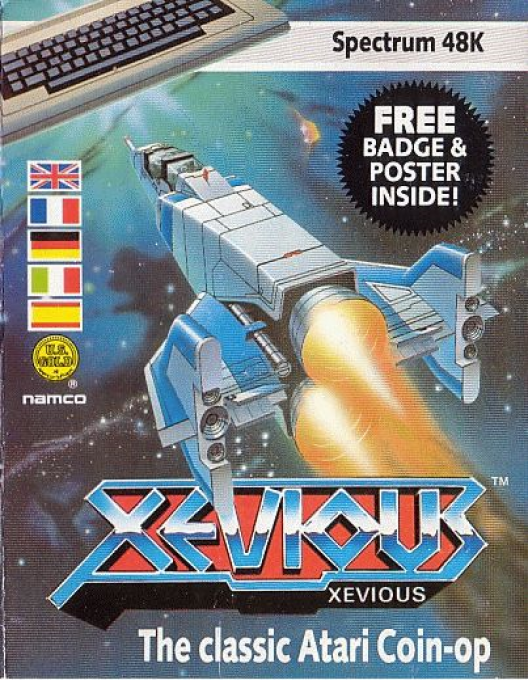
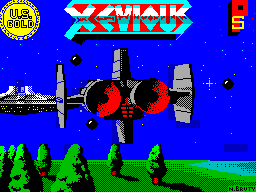
Xevious for the ZX Spectrum is Probe Software's home-computer conversion of Namco's vertical arcade shooter, published in the UK by U.S. Gold in the 1986-87 release period. It brings the conflict between Earth and the returning Xevious civilization to the 48K Spectrum: the player pilots the Solvalou over an ever-advancing landscape, trying to withstand alien air attacks and dismantle the invaders' defenses. The conversion was made for the Spectrum rather than being an original entry in the series, but it retains the arcade game's distinctive attack on two planes at once.
The Solvalou moves around a vertically scrolling playfield while enemy craft arrive in formations from above. Its forward fire is for airborne opponents, while bombs are needed for installations, vehicles, and other threats on the ground below. That division is central to Xevious: staying alive means reading the next aerial wave, steering away from fire and collisions, and still finding moments to deal with targets on the terrain. Ground defenses can launch their own attacks, so concentrating on one layer can leave the other dangerously unattended.
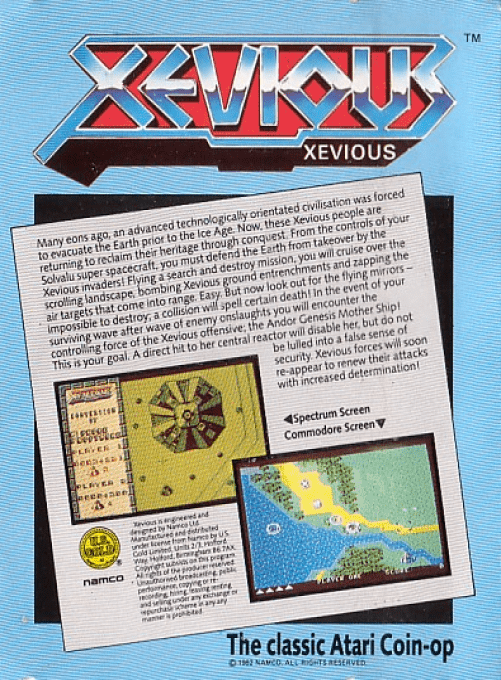
The route passes over a stylized Earth of natural and built-up features before bringing the player into confrontations with the Xevious force. Flying enemies differ in movement and attack patterns, and the scrolling journey grows more demanding as it goes on. One especially hazardous obstacle is the floating mirror, which cannot simply be shot away and turns positioning into an immediate concern. The objective is ultimately to reach the Andor Genesis mothership and attack its vulnerable central reactor, after which the enemy assault resumes at a tougher pace.
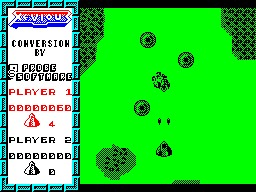
Probe's ZX Spectrum version is designed around the machine's controls and display constraints. It supports cursor controls, Kempston and Interface 2 joysticks, plus redefinable keys, giving players a choice of input schemes. The game offers an alternating two-player option, so two pilots can take turns pursuing scores rather than flying simultaneously. Its action occupies a split-screen-style layout, and the main play area uses a largely monochrome presentation; this trade-off reduces the colourful detail associated with the arcade cabinet while helping the conversion keep its scrolling action moving quickly.
The Spectrum release shares its stage design with the Amstrad CPC conversion, yet it is a distinct version with its own visual character. Contemporary Spectrum coverage noted the smooth vertical scroll, shaded sprites, and the way the restricted palette avoided the usual colour-clash problem. Reviews also recognized the compromises: roads and scenery are simplified compared with the original arcade landscapes, and the reduced display cannot recreate the coin-op's elaborate colour work. Those choices make Xevious ZX Spectrum a useful example of how a major arcade design was adapted to a home computer with far tighter technical limits.
Xevious began as a Namco arcade game released in 1983 and became important to the scrolling shoot-'em-up tradition through its combination of air combat and bombing targets on the ground. U.S. Gold licensed it for European home systems, with Probe Software handling the Spectrum conversion. The result preserves the recognizable Solvalou mission, scrolling assault patterns, and mothership objective in a form built for the Spectrum's 48K hardware. For players exploring the platform's arcade conversions, it is a fast-moving take on a landmark shooter whose core challenge is deciding where to aim attention when dangers fill both the sky and the ground.
Gallery
Details
- Developer
- Probe Software
- Publisher
- U.S. Gold
- Genre
- Shoot 'em Up
- Players
- 1
- Release Date
- January 1, 1987
- System
- ZX Spectrum