About
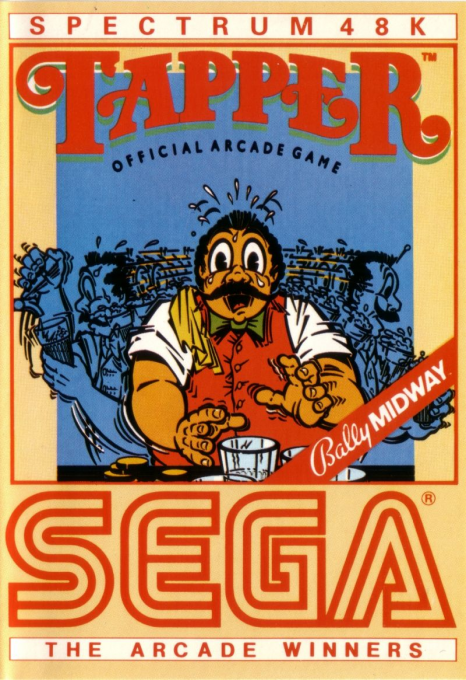
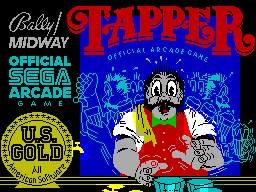
Tapper for ZX Spectrum is a 1985 48K home-computer conversion of Bally Midway’s arcade action game. Ocean Software produced the Spectrum version, with Ian Morrison and David Anderson credited for the conversion, while U.S. Gold released it in the United Kingdom under Sega’s home licence. The game turns bartending into a quick reflex challenge: one lone server must keep four busy counters supplied before the customers reach the kegs at the far end of the bar.
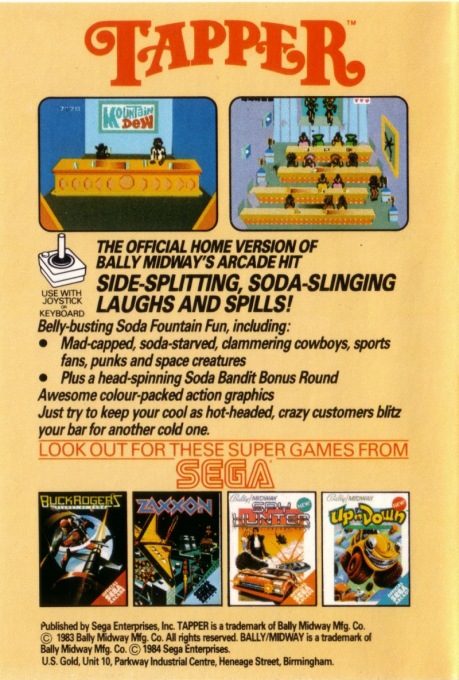
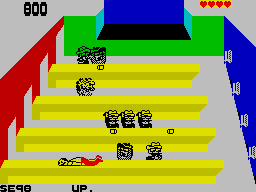
Each counter has its own queue, and the bartender moves between them with the keyboard or a supported Cursor, Sinclair, or Kempston joystick. At a keg, the player fills a mug and sends it sliding toward an approaching customer. A successful delivery pushes that customer back toward the exit; if they are close enough, they leave. The danger is in reading all four lanes at once, judging when to pour and when to run, and ensuring that no glass is sent down a counter without somebody ready to take it.
A returned empty mug adds another urgent job. It must be caught before it tumbles off the keg end of the counter, while an undelivered full drink also costs a life when it falls at the opposite end. Letting a customer reach the bartender is equally costly. These simple rules make every screen a balancing act between serving the nearest threat, catching glasses in flight, and moving rapidly to a lane that has become crowded.
The Spectrum game follows the arcade design through a succession of differently themed bars. Cowboys appear first, followed by sportspeople, punk rockers, and space creatures, with the pace and pressure building as customers arrive faster and the counters hold more of them. Clearing every customer completes a screen, and the number of screens required rises with each setting. Difficulty choices and extra-bartender score thresholds give players room to choose a more forgiving start or pursue the harsher arcade-style challenge.
Between stages, Tapper switches to a bonus game built around a rack of soft-drink cans. A masked figure shakes and rearranges the cans; choosing the unshaken one earns a bonus, while picking a shaken can gives the bartender a comic soaking. Tips left on the counters are also valuable. Collecting one triggers a short cabaret distraction that can halt part of the crowd, although distracted customers cannot take a drink, so the effect has to be used with care rather than treated as a universal escape.
This ZX Spectrum release is distinct from the original Budweiser-branded American arcade cabinet. Its instructions identify the 1983 Bally Midway game as the source, but the home version uses Mountain Dew branding and presents the bartender as a soda server. It retains the four-bar layout, escalating customer management, themed stages, and bonus-rack idea that made the arcade game recognisable, while adapting the controls and presentation for the Spectrum’s 48K hardware. Robin Muir supplied the conversion’s original theme music, and the game supports either solo play or two-player turns.
Tapper arrived during the mid-1980s wave of licensed arcade conversions for British home computers. Rather than recreating an arcade cabinet’s tap handle, the ZX Spectrum version asks the player to master the same rapid decisions through keys or joystick: pour, send, catch, and move before the next queue becomes unmanageable. Its lasting appeal lies in that clear, immediately legible routine, which grows more demanding as the four counters fill with faster and less patient customers.
Gallery
Details
- Developer
- Ocean
- Publisher
- SEGA
- Genre
- Turn-Based Strategy
- Players
- 1-2
- Release Date
- January 1, 1985
- System
- ZX Spectrum