About
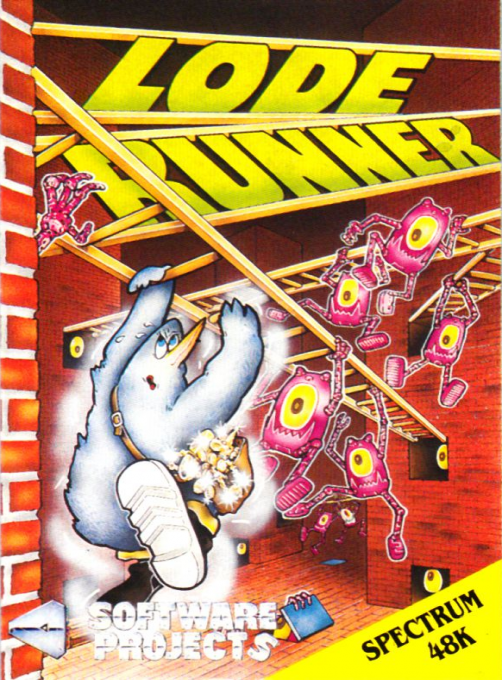
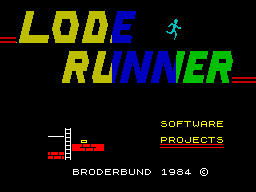
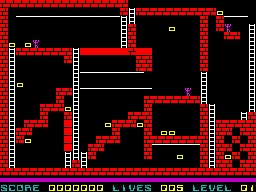
Lode Runner on ZX Spectrum is a compact puzzle-platform game built around routes, timing and the constant pressure of pursuing guards. Published by Software Projects in 1984, this Spectrum release brings Doug Smith's celebrated Brøderbund design to Sinclair's home computer. The premise is simple but durable: guide the runner through a single-screen maze, recover every bar of gold and then find the exit that becomes available once the screen has been cleared. Its immediately readable ladders, hanging bars and brick floors conceal puzzles that demand far more than quick reflexes.
Every stage is a self-contained obstacle course. The runner can travel along platforms, climb ladders, hang from bars and drop through selected openings, but cannot jump or dig through the indestructible ground. Guards patrol the same network and make a direct encounter dangerous, so the essential tool is the ability to dig a temporary hole in a brick floor to the left or right. A well-placed pit delays a pursuer, creates a path or changes the position of a gold bar; a careless one can leave the player with no route out before the bricks regenerate.
That digging rule gives Lode Runner its strategic character. Guards can fall into holes, climb back out or be removed when a hole closes, and a guard carrying gold drops it when trapped. The player can even run over the head of an enemy stuck below, which turns a threat into a momentary bridge. Later layouts use these details to make the order of collecting treasure as important as the movement itself. Some gold is accessible only after arranging a guard's route, while other screens require a precise dash through a passage that will soon close again.
The Spectrum game offers 150 screens, providing a long sequence of increasingly intricate problems rather than a short arcade challenge. Early rooms establish the basics of ladders, ropes and traps, while later ones ask players to read the full map, anticipate enemy movement and preserve a safe return path. Failure is often instructive: restarting a screen reveals why a particular bar had to be collected first or why an apparent shortcut was a trap. This design makes the action feel like a conversation between planning and execution, with each room rewarding a cleaner solution.
A defining feature of Lode Runner is its level editor. Players can create new arrangements of bricks, ladders, bars, gold and guards without programming, then test whether their ideas produce a solvable challenge. The editor helped make the original game notable at a time when commercial releases rarely gave players tools to build their own content. On the ZX Spectrum, that creative option sits naturally beside the carefully designed built-in stages, extending a game already based on understanding how a small set of rules can combine in surprising ways.
The game originated from Smith's work on the Apple II after earlier university prototypes made with James Bratsanos and Tracy Steinbeck, before Brøderbund published the original Lode Runner in 1983. Its success led to many computer and console versions, sequels and remakes, but the core remains recognizable: collect the gold, avoid the guards and use the level's architecture against them. The 1984 Spectrum edition was received as a strong conversion by contemporary Sinclair press, preserving the original's blend of accessible controls, tense chases and carefully constructed puzzle-platform design.
Lode Runner remains an important retro game because its rules are easy to explain yet rich enough to support a huge range of puzzles. The lack of jumping focuses attention on position, routes and deliberate use of the digging tool, while the guards ensure that no plan can be carried out mechanically. Whether approaching the supplied 150 levels or experimenting with the editor, ZX Spectrum players get a focused example of early computer-game design in which a small screen and a handful of objects create lasting tactical depth.
Gallery

Details
- Developer
- Brøderbund Software
- Publisher
- Software Projects
- Genre
- Platformer
- Players
- 1
- Release Date
- January 1, 1984
- System
- ZX Spectrum