About
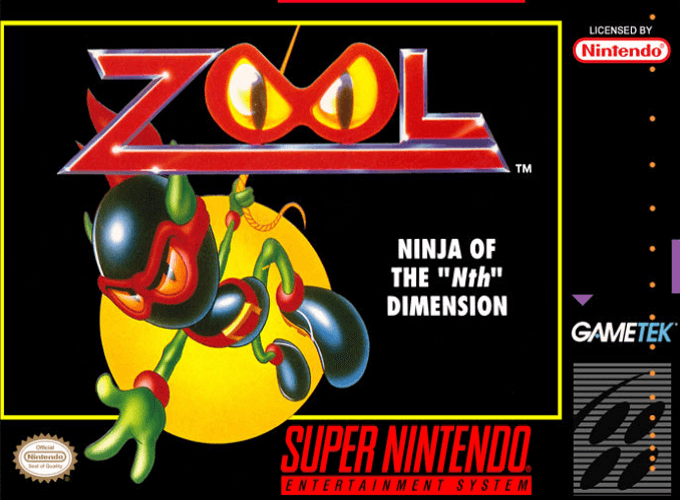
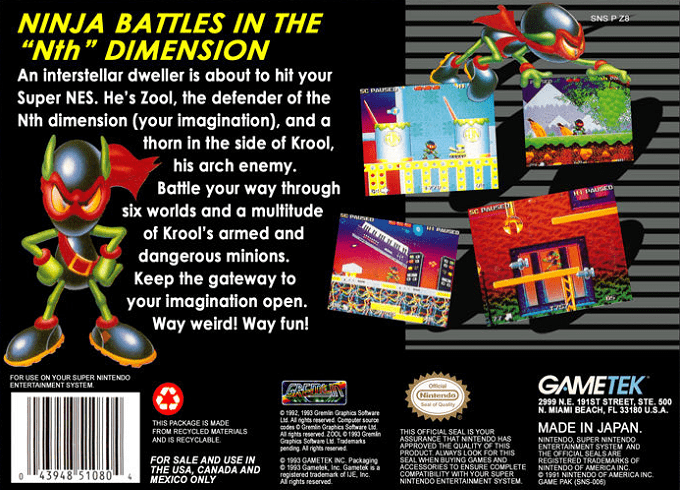
Zool: Ninja of the "Nth" Dimension for Super Nintendo is a fast, side-scrolling action platform game from Gremlin Graphics, released for the SNES during 1994. It brings the studio's colourful Amiga character to Nintendo's 16-bit console as Zool, a compact, insect-like ninja from the far-off Nth Dimension. His journey to earn his ninja status turns into a dash through an exaggerated world of sweets, toys, machinery, and other surreal hazards. Although Zool began life on home computers in 1992, this is a purpose-built console conversion rather than a simple duplicate of the original release.
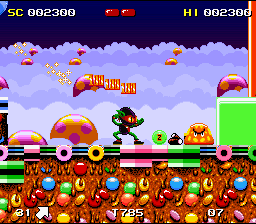
The basic goal is to guide Zool through themed stages, survive their traps and enemies, and reach the exits that lead deeper into the adventure. Zool can run at high speed, leap between platforms, fire projectiles, and use walls to keep moving through vertical or enclosed areas. The pace encourages players to scan ahead instead of simply holding right: enemies can arrive from awkward directions, platforms may be placed at different heights, and a rushed jump can send Zool into danger. Options let players tailor the challenge with choices including difficulty, game speed, continues, and music selection.
Collectibles and temporary abilities give the Super Nintendo game more to manage than a straightforward race to the finish. Pickups can restore health, provide defensive protection, clear threatening enemies with a smart-bomb effect, or improve Zool's jumping ability. One of the more unusual aids is a shadow-like duplicate that repeats Zool's actions after a delay, effectively adding another stream of fire while demanding that the player keep both figures in mind. These power-ups make exploration worthwhile, particularly when a dangerous route offers a useful advantage for the next encounter.
Zool's setting is deliberately playful rather than traditionally martial. Its worlds turn familiar ideas into oversized obstacle courses, with confectionery, musical motifs, industrial scenery, and animated adversaries forming the backdrop to the ninja theme. Progress is divided into short stretches within larger worlds, and the game mixes ordinary platforming with secrets and diversions. Hidden routes and small bonus-style activities reward curiosity, while the end-of-world confrontations give the journey clear milestones. It is a single-player game built around momentum, route learning, and repeated attempts at demanding sections.
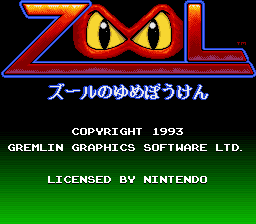
The SNES edition is especially notable because Gremlin did not preserve every Amiga layout unchanged. Its stages are structured differently, its backgrounds were reworked for the console, and it includes bosses that distinguish it from the original computer game and from the Mega Drive version. Regional releases also varied: the North American cartridge was published by GameTek, while Gremlin handled other territories, and Japan received the Super Famicom release as Zool no Yume Bouken. The character's original Chupa Chups promotional association is part of Zool's wider release history and can be visible in certain regional editions.
Zool arrived in the early-1990s wave of mascot-led platform games, when publishers were looking for characters able to match the energy of the genre's biggest console stars. Gremlin positioned Zool as a rapid, visually busy alternative, and the game later reached many systems in different forms. The SNES release captures that period's appetite for colourful arcade-style platform adventures while retaining the identity of a British computer-game creation. A sequel, Zool 2, followed soon after, but this first adventure remains the introduction to the Ninja of the Nth Dimension and his distinctly strange obstacle-filled universe.
Gallery
Details
- Developer
- Gremlin Graphics Software
- Publisher
- Gremlin Graphics Software
- Genre
- Platformer
- Players
- 1
- Release Date
- January 2, 1994
- System
- SNES