About
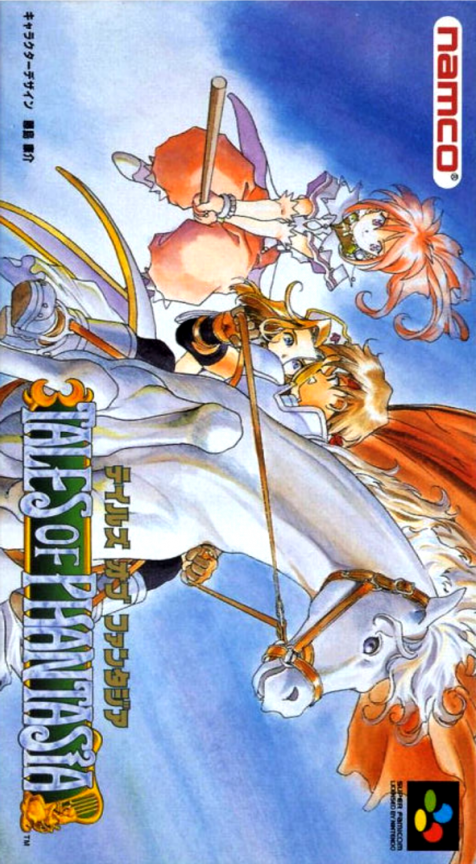
Tales of Phantasia is the original entry in Namco’s long-running Tales role-playing series, released in Japan for the Super Famicom on December 15, 1995. Developed by Wolf Team and published by Namco, this is the 16-bit adventure that established the series’ identity before its later PlayStation, Game Boy Advance, and PlayStation Portable versions. Its setting blends traditional fantasy, magic, ancient technology, and time travel into a journey across the world of Aselia.
The story follows Cress Albane, a young swordsman who leaves his quiet village with his friend Chester for a hunting trip. Their return changes everything: the village has been destroyed, loved ones have been killed, and the pendant Cress carries becomes tied to a much larger threat. Cress soon meets the healer Mint Adenade and learns that the catastrophe is connected to the imprisoned warlord Dhaos. What begins as a personal search for answers becomes a struggle over the fate of the world.
To confront Dhaos, Cress and Mint are sent one hundred years into the past. There they find allies whose talents shape the party: Arche Klein, a half-elf magician, and Claus F. Lester, a scholar who calls upon spirits through summoning. The group travels through towns, forests, ruins, castles, and ancient facilities while gathering the strength and knowledge required to challenge an enemy who cannot be beaten by ordinary means. Time travel is more than a backdrop here; it changes the party’s understanding of history, the conflict, and Dhaos himself.
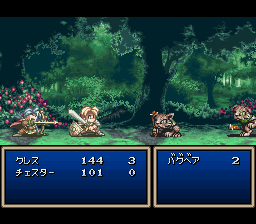
The original Super Famicom version is an action RPG rather than a conventional menu-driven, turn-based RPG. Its Linear Motion Battle System moves combat to a side-view battlefield where Cress fights enemies directly in real time. He can run, jump, attack, and use learned techniques while the screen scrolls across wide encounters. Magic, items, and party commands can be selected from a battle pause menu, and the other companions follow behavior settings or instructions. That fusion of swordplay, character positioning, shortcuts, and supporting magic gave the game a more immediate rhythm than many Japanese RPGs of its era.
Cress is the character controlled directly during the Super Famicom battles, while companions such as Mint, Arche, and Claus contribute through healing, offensive spells, and summons. Success depends on more than repeatedly attacking: close-range timing, guarding space, managing resources, and choosing when to pause for an item or spell all matter. Outside combat, exploration remains central, with dialogue, dungeon puzzles, equipment, inns, shops, and a world map providing the framework for a lengthy fantasy quest. The mix of fast battles and traditional RPG travel is the foundation on which the Tales series built many of its later systems.
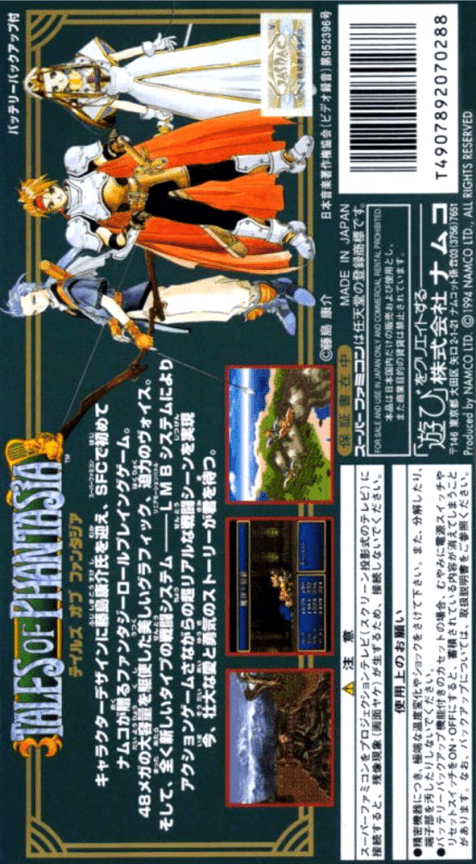
Wolf Team also used the Super Famicom cartridge to give the game an unusually ambitious presentation. Character designs by manga artist Kōsuke Fujishima lend Cress and his companions a recognizable look, while music by Motoi Sakuraba, Shinji Tamura, and Ryota Furuya supports both the adventure and its dramatic turns. The original release includes voice clips in battles and story moments, plus the vocal opening theme “Yume wa Owaranai.” These touches help distinguish the 1995 cartridge as an important late-era Super Famicom production, not merely a rough prototype for its successors.
Later editions should not be confused with this original version. The Japan-only PlayStation remake from 1998 reworked the presentation with an animated opening, redrawn visuals, re-recorded audio, and changes to the battle system; it also made the ninja Suzu Fujibayashi an optional playable party member, whereas she is not playable in the Super Famicom release. The Game Boy Advance edition arrived in Japan in 2003 and was later released in English in North America and Europe in 2006, making that version the first official English-language release rather than an English release of the 1995 cartridge.
Further remakes and ports continued to revise the game. Tales of Phantasia: Full Voice Edition for PSP added full story voice work, and the later Tales of Phantasia X brought additional battle refinements. Those editions may offer different content and performance, but Tales of Phantasia on Super Famicom remains the starting point: the original Wolf Team and Namco vision of Cress’s journey, Aselia’s time-spanning conflict, and the first Linear Motion battles in the Tales series.
Gallery
Details
- Developer
- Wolf Team
- Publisher
- Namco
- Genre
- JRPG
- Players
- 1-2
- Release Date
- December 15, 1995
- System
- SNES