About
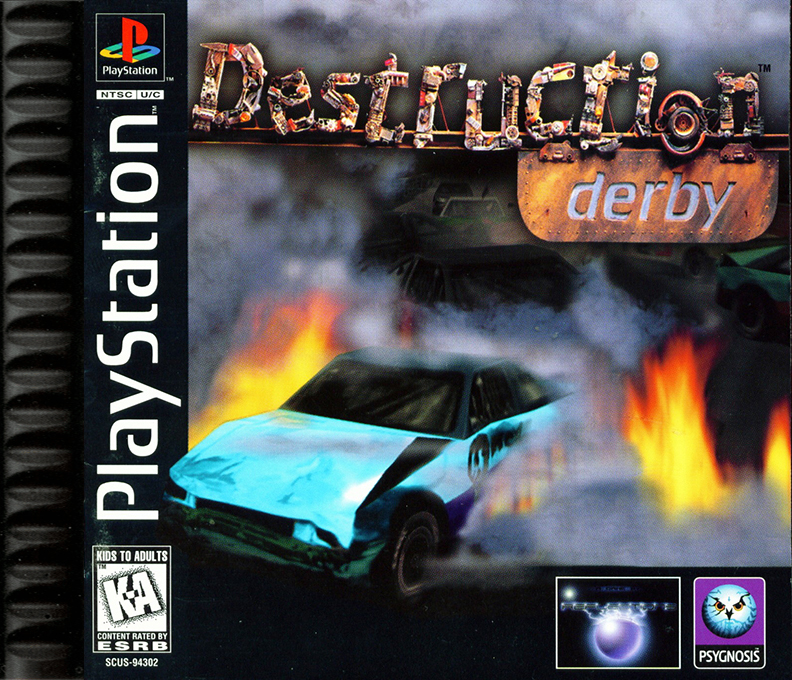
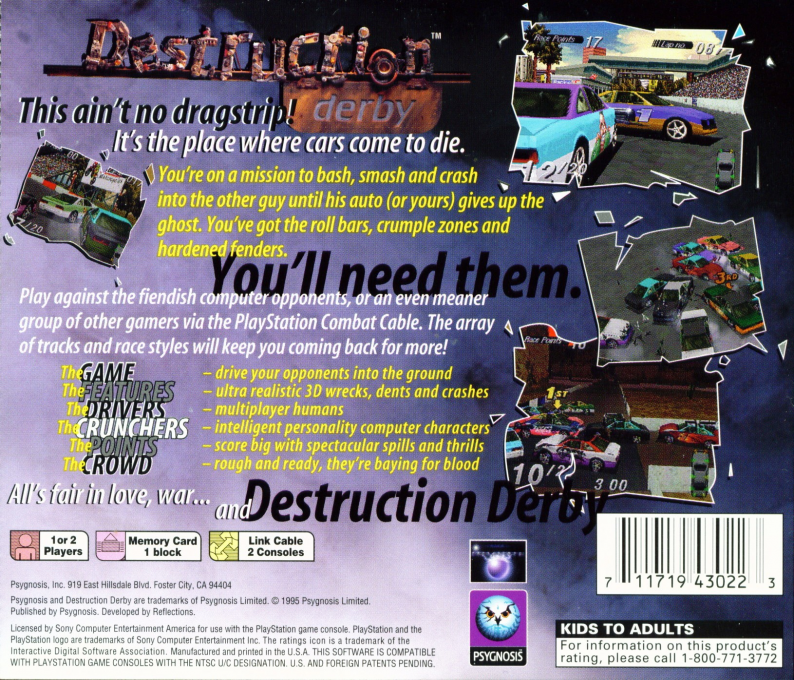
Destruction Derby for PlayStation is a 1995 vehicular-combat racing game from Reflections Interactive and Psygnosis. Released in Europe in October and in North America that November, it turns the rough-and-tumble motorsport of demolition derby into an early 3D PlayStation contest where finishing a race is only part of the job. Drivers enter battered stock-car-style machines and choose whether to pursue clean laps, calculated collisions, or a mixture of both. The central idea is simple but demanding: a car that inflicts damage can earn points, yet every careless impact also threatens the player’s own chances of staying mobile.
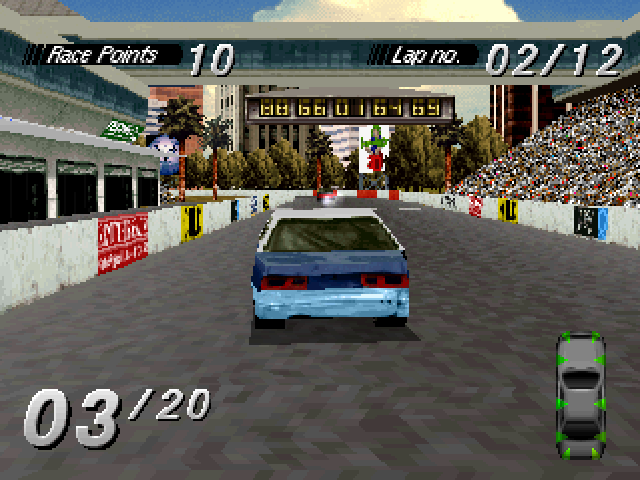
The game is built around contact between a large field of cars. On circuits, opponents crowd the road, attempt overtakes and create opportunities for shunts, spins and wall impacts. Collisions are not merely visual decoration. The direction and force of a hit affect the condition of the vehicles, and damage can reduce steering control and top speed. A serious blow to the front risks harming the radiator; an overheating engine can leave a once-competitive car stranded. That makes the best attacks situational rather than automatic: a rear-end hit, a nudge near a corner or a move that sends a rival into a barrier can be more useful than simply driving headlong into traffic.
Destruction Derby offers four styles of play with different priorities. Wreckin’ Racing combines lap racing with damage scoring, asking players to balance their finishing position against the value of their collisions. Stock Car Racing removes the wrecking points and focuses on crossing the line first, although the other drivers are still very much obstacles. Time Trial is a solo race against the clock. The mode that gives the game its name takes place in the Bowl, a dedicated open arena where surviving and wrecking rival cars become the focus instead of following a conventional circuit.
The PlayStation controls keep the car handling direct and suited to the console’s original digital pad. The directional buttons steer, Cross accelerates, Triangle brakes and Square selects reverse, while the shoulder buttons can change the camera view. Reversing is not just a recovery tool: it can help a driver avoid a damaging frontal collision, line up an opponent, or turn the car around after a spin. The manual’s advice also emphasizes timing, positioning and protecting the vulnerable front of the vehicle, so a player who reads the traffic can often last longer than one who treats every encounter as a full-speed charge.
A selection of cars and courses supports the championship progression, with further tracks becoming available as the player advances. The races keep the pack close enough for the action to develop quickly, and the collision-focused events encourage drivers to watch for damaged rivals as well as the next bend. Computer-controlled opponents provide the single-player competition. PlayStation owners could also use system-link play for two players with compatible hardware, extending the same tactical push-and-shove racing beyond the solo modes.
Destruction Derby arrived during the first PlayStation’s formative period, when developers were experimenting with how many moving 3D objects the new hardware could convincingly show at once. Reflections designed the game around dense traffic and visible vehicle damage, giving crashes a mechanical consequence as well as a spectacle. Its straightforward racing structure therefore differs from a pure driving simulation: grip, braking and positioning matter, but the game openly invites a driver to use another car as part of the strategy. Advertisements around several tracks also reflect Psygnosis’s mid-1990s catalogue, placing the game firmly within that publisher’s PlayStation era.
The original PlayStation release established the Destruction Derby series and was followed by Destruction Derby 2 in 1996, while the first game also appeared on DOS and later reached Sega Saturn. Those versions are separate releases, but the PS1 edition remains the foundation for the series’ blend of circuit racing and demolition competition. For players exploring 1990s PlayStation racing games, Destruction Derby stands out for making damage, survival and race position work together: a win can depend on driving quickly, choosing when to attack and ensuring the player’s own engine remains running long enough to collect the result.
Gallery
Details
- Developer
- Reflections Interactive
- Publisher
- Psygnosis
- Genre
- Racing & Driving
- Players
- 1-2
- Release Date
- November 16, 1995
- System
- PS1