About
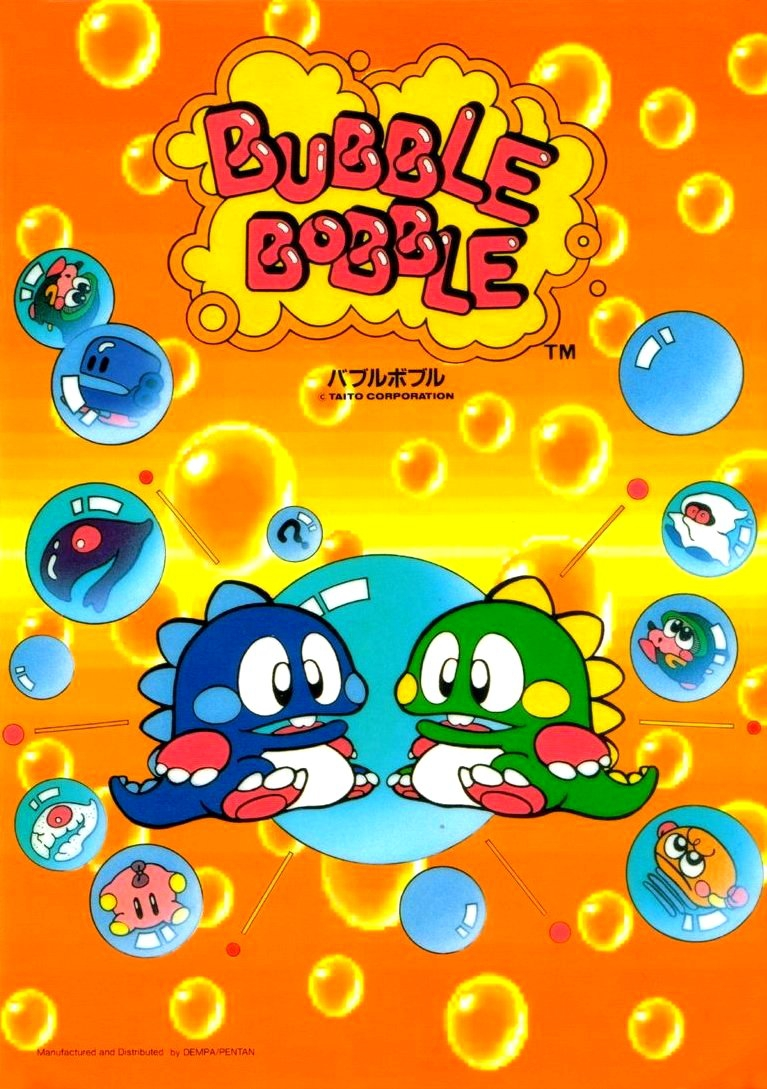
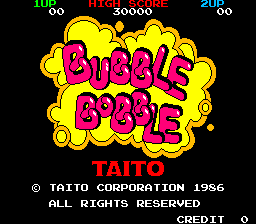
Bubble Bobble (US, Ver 1.0) is the North American arcade version of Taito's 1986 single-screen platform action game. Designed around the blue and green bubble dragons Bub and Bob, it sends one or two players into the Cave of Monsters to rescue the heroes' kidnapped girlfriends. Taito developed and published the original arcade game, while Romstar distributed it in North America under licence. Its bright fantasy setting, compact cabinet-friendly stages and instantly recognisable characters made it a distinctive coin-op game of the mid-1980s.
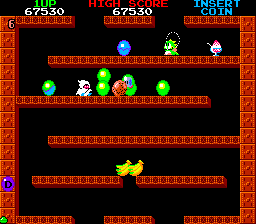
Every stage fits on one fixed screen, but its platforms, gaps and routes make the small space tactically busy. Bub and Bob can run, jump and breathe bubbles. A bubble can imprison an enemy; touching the trapped foe's bubble pops it, sending the enemy down and turning the victory into a collectible food item. Players must remove all enemies from a floor to move on, with 100 floors in the main adventure. Several screens also use openings at the bottom so a character can fall through and reappear at the top, adding an important twist to movement and pursuit.
Bubbles are both weapons and temporary platforms. They drift along the stage's air currents and eventually burst, so a player can jump onto one to climb toward an elevated opponent or an otherwise unreachable item. This makes positioning central to Bubble Bobble: firing carelessly may leave an enemy free, while setting up bubbles in the right place can open a route or let a player clear several threats in quick succession. Defeating a group together earns larger rewards than picking enemies off one at a time.
The danger increases when a trapped enemy escapes. Those enemies become faster and more aggressive, and a floor that takes too long can introduce Baron von Blubba, an invincible pursuer that forces players to finish the screen rather than wait safely on a ledge. Collectable bubbles and items can change the pace further, including effects based on fire, water and lightning. Letter bubbles can spell EXTEND for an extra life, while food pickups add points and help make each successful screen-clear feel like a small prize haul.
Co-operative play is at the centre of the arcade design. Two players can share a screen as Bub and Bob, cooperating to cover routes, set up bubble platforms and rescue one another from crowded areas. The game can be played alone, but its ending structure encourages a pair to reach the final floor together. A single-player completion deliberately points toward a fuller conclusion with a friend, while a two-player clear reveals the brothers' human identities and their reunion with the rescued characters. Further secrets and a faster Super mode reward players who learn the game's hidden conditions.
Bubble Bobble's monster cast also connects it to Taito's earlier Chack'n Pop, giving the game an additional thread within the company's arcade catalogue. Designer Fukio Mitsuji built the concept around bubbles and approachable characters, and the resulting blend of simple controls, level-specific problem solving and cooperative play distinguished it from scrolling platform games of the period. The game later reached a wide range of home computers and consoles, although those conversions varied in modes, level counts and presentation.
For arcade players, the appeal of Bubble Bobble lies in how much decision-making it packs into a single screen. A stage can begin as a straightforward chase, become a climb across drifting bubbles and end with a tense race away from an angry enemy or Baron von Blubba. Its 100-floor structure, concealed routes and alternate outcomes give repeated play a purpose beyond high scores, while Bub and Bob's bubble-breathing adventure remains the foundation of Taito's long-running Bubble Bobble family.
Gallery

Details
- Developer
- Taito
- Publisher
- Taito
- Genre
- Platformer
- Players
- 1-2
- Release Date
- January 1, 1986
- System
- Arcade