About
Robotron: 2084 is the 1982 Williams arcade shooter created by Eugene Jarvis and Larry DeMar of Vid Kidz. This Robotron: 2084 Arcade release, catalogued as the Solid Blue label set, is the same fixed-screen coin-op built around a dystopian 2084: humanity's own super-intelligent robots have revolted, and a genetically engineered mutant who cannot be reprogrammed is left to protect the surviving human family. Williams presented it as a fast, score-driven action game, with each new attack wave turning one screen into a crowded survival arena.
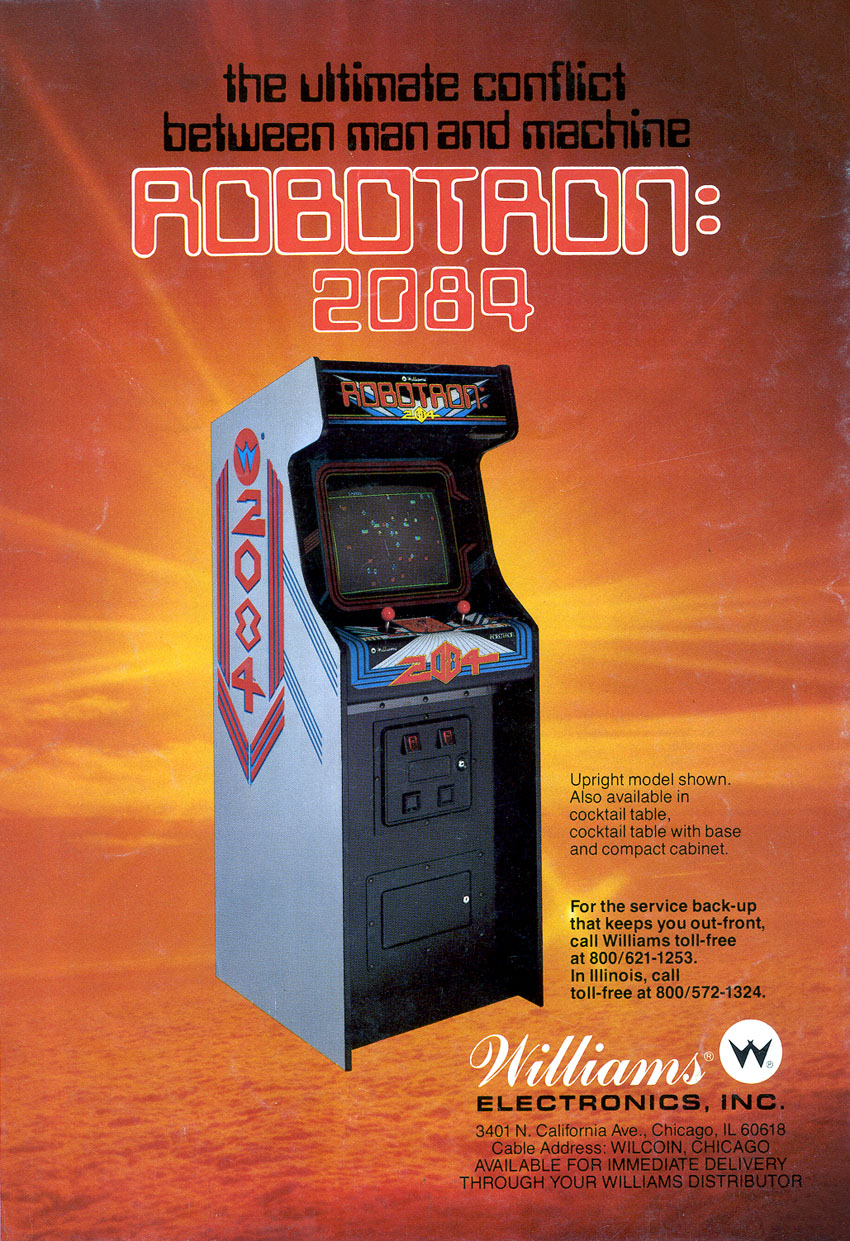
The cabinet's defining feature is its pair of eight-way joysticks. The left stick moves the player character while the right stick aims the anti-robot laser, allowing movement and firing in different directions at the same time. There is no fire button to hold down and no scrolling battlefield to retreat through; the player starts amid the danger and must keep making rapid directional choices. It is a solo game with alternating turns for two players, rather than simultaneous cooperative play.
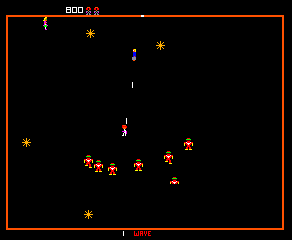
A wave combines pursuing enemies, hostile shots, obstacles, and vulnerable people. Destroy the robots that can be destroyed to clear the screen and move on, while staying clear of attacks and the deadly stationary Electrodes. The rescue objective complicates the straightforward shooting: running into a human brings that person to safety and awards points, but enemies can reach the family first. The rescue score increases as more people are saved within a wave, making a risky route through the screen potentially more rewarding than simply circling the perimeter.
The robot forces are deliberately varied. Grunts swarm directly toward the player, while Enforcers fire back; Tanks launch bouncing shells, and the generators called Spheroids and Quarks create further Enforcers and Tanks. Brains threaten the human survivors and can turn them into hostile Progs. Hulks cannot be destroyed, though laser fire can slow them, so they remain a persistent obstacle instead of a target to eliminate. These overlapping behaviors make every wave a changing priority problem: avoid a projectile, keep an escape lane open, reduce the enemy population, or break toward a family member before it is too late.
Robotron: 2084 uses the Williams hardware lineage associated with Defender and Stargate, but its playfield is intentionally confined to one horizontal screen. The design trades travel and exploration for immediate pressure, with a dense arrangement of readable, brightly colored sprites on a dark background. Williams released the game for U.S. arcades in 1982, and original documentation includes upright, compact, and cocktail machine material from that period. Later home conversions often had to adapt its two-stick arrangement to the controllers available on each system, a practical difference that helped preserve the arcade cabinet's distinctive control layout as a key part of the experience.
The game is closely associated with the early popularization of twin-stick shooting. Its arcade formula of independent movement, directional fire, escalating enemy waves, and rescue scoring made the controls central to play rather than a novelty. Jarvis later returned to a related two-stick action approach in Smash TV, while Robotron: 2084 itself appeared in several Williams and Midway retrospective collections. For an Arcade player, the Solid Blue label set represents the original Robotron: 2084 challenge: a compact, relentless score attack in which survival, rescue, and accurate two-handed control are inseparable.
Gallery

Details
- Developer
- Vid Kidz
- Publisher
- Vid Kidz
- Genre
- Other Shooter
- Players
- 1-2
- Release Date
- January 1, 1982
- System
- Arcade