About
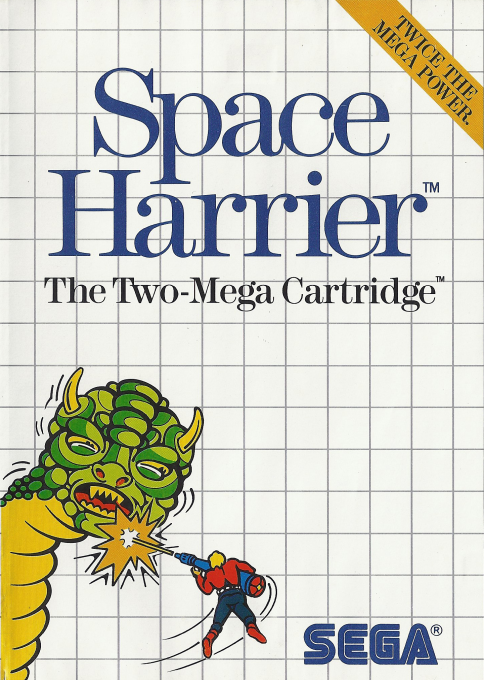
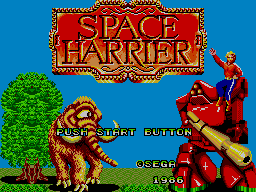
Space Harrier for Sega Master System is Sega's 1986 home conversion of the high-speed arcade shooter first released in 1985. Developed and published by Sega, it puts the player behind Harrier, a jet-propelled hero carrying a large laser cannon through a colorful, fantastical war zone. The Master System release was an ambitious early showcase for Sega's 8-bit console: it translated an arcade game known for its huge moving sprites and flight controls into a cartridge while retaining the original's rapid forward motion, unusual enemy designs, and one-player action.
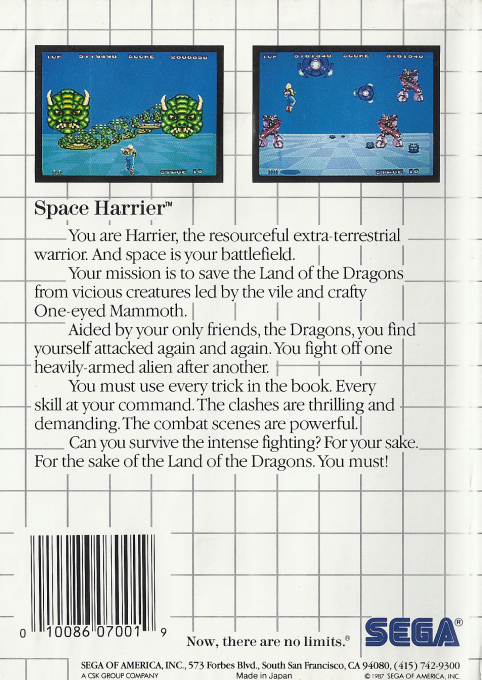
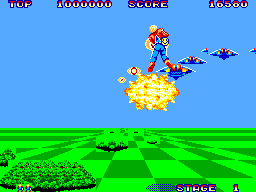
The basic goal is direct but demanding. Harrier is propelled continuously into the distance, and the player steers left, right, up, and down to keep clear of enemy fire, charging creatures, and solid scenery. A fire button sends repeated laser shots toward targets in front of him. Movement is not about choosing a route through a map; survival depends on reading the incoming threats, making quick positioning decisions, and shooting enough enemies to keep the screen manageable. Trees, pillars, and other landscape obstacles are hazards in their own right, so a player must pay attention to the ground as well as the air.
Its setting separates Space Harrier from more conventional military or outer-space shooters. The adventure begins in a strange land of dragons threatened by invading creatures, with a succession of brightly colored environments and a roster that includes beasts, flying machines, giant heads, dragons, and alien forms. Each regular area works as a self-contained stage of the chase, usually building toward a large boss encounter. The Master System game preserves the arcade journey's eighteen stages and also includes two peaceful bonus rides on Uriah, the dragonlike creature, where Harrier can crash through obstacles for points without facing ordinary enemy attacks.
The Master System version is not simply a straight arcade dump. Sega rebuilt the experience around the console's directional pad rather than the coin-op's analog flight stick, and the system could not reproduce every backdrop or the arcade board's dense scaling effects. Its stages therefore use a simpler visual presentation, with the checkerboard ground remaining central to the sense of speed. Sega also framed the home release with a more explicit quest to save the Land of the Dragons, whereas the arcade game offered little narrative beyond its surreal Fantasy Zone setting and closing message.
This conversion adds a distinct conclusion after the familiar stage sequence. Once the player has overcome the major enemies revisited in the late-game rush, the Master System release introduces Haya Oh, a two-headed fire dragon created for this version. Defeating it produces an ending sequence rather than returning immediately to the title presentation. That final confrontation gave the cartridge its own identity and later appeared in several related versions, making it a notable difference for players comparing the Master System game with Sega's original cabinet.
Space Harrier's arcade roots remain visible in every run. The game is built around an immediate loop of forward momentum, evasive movement, and relentless shooting instead of exploration or equipment management, which makes its rules easy to grasp but its later stages difficult to master. The Master System port arrived during the console's 1986 lineup and represented one of the earliest home versions of a celebrated Sega arcade production. It was followed by other interpretations and by the Master System-exclusive Space Harrier 3-D, but this 1986 release remains the original 8-bit console take on Harrier's flight through Sega's bizarre dragon-filled world.
Gallery
Details
- Developer
- SEGA
- Publisher
- SEGA
- Genre
- Third-Person Shooter
- Players
- 1
- Release Date
- January 1, 1986
- System
- Master System