About
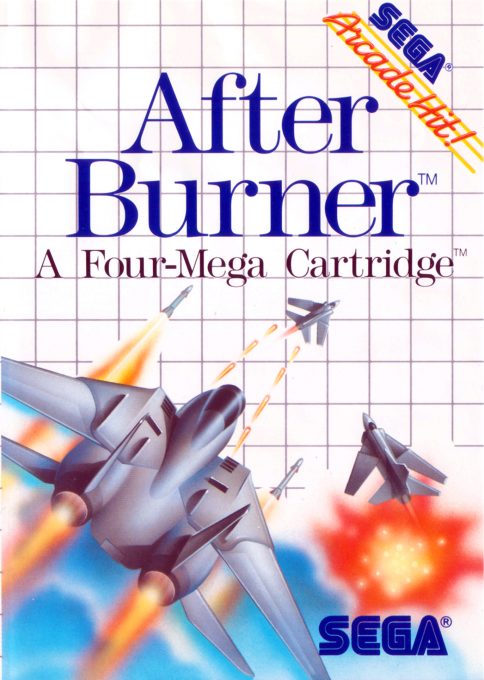
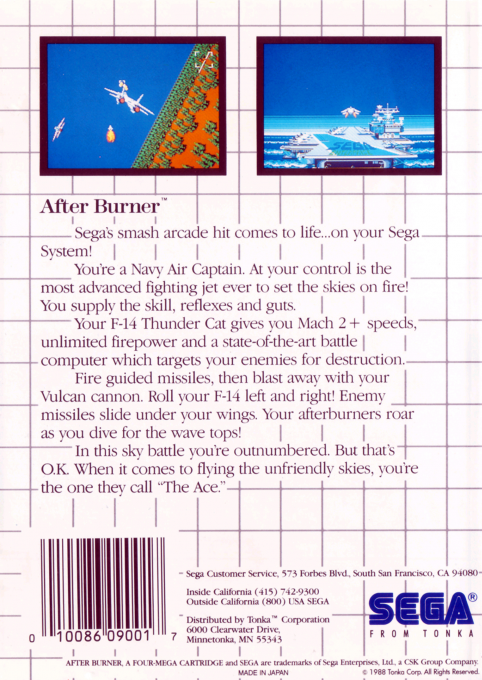
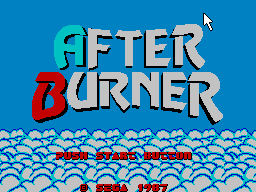
After Burner for the Sega Master System is Sega's 8-bit home conversion of its 1987 arcade air-combat hit. Released in Japan in 1987 and in North America and Europe during 1988, it puts a single player in the cockpit of an F-14 Tomcat for a fast, deliberately arcade-style sequence of hostile skies, sea-level runs, and enemy formations. Sega developed and published this Master System edition, adapting a game associated with Yu Suzuki's arcade team rather than attempting a realistic flight simulation. The Master System game retains the series' signature behind-the-jet viewpoint, so the aircraft stays in view while the horizon races toward the player.
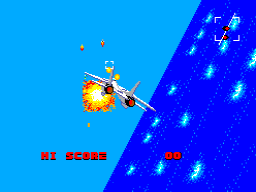
Each mission is a forward-scrolling rail-shooter challenge. The Tomcat continually advances while enemy aircraft, tracer fire, and missiles close in from the distance or cross the screen at speed. The directional pad steers the jet left and right and changes its altitude; quick changes of direction can also produce a roll. Survival depends on reading approaching threats, moving out of firing lines, and keeping targets in the gunsight rather than on managing a cockpit full of simulation controls. This makes After Burner Master System immediately understandable, but its dense attacks and limited reaction time give its short control scheme a demanding rhythm.
The aircraft has two complementary weapons. A rapid Vulcan cannon handles continuous fire, while heat-seeking missiles are used when the targeting reticle finds an opponent. Unlike the arcade game, where missile supply is limited, the Master System conversion gives the player unlimited missiles as well as unlimited cannon fire. That change shifts the pressure toward aim, positioning, and evasion. Aerial refuelling encounters still interrupt the dogfights: lining up with the tanker and making the connection provides a bonus, even though the console version does not make fuel or missile stock a resource to conserve.
After Burner is structured as 18 stages of escalating enemy waves. Standard stretches ask the player to clear formations while flying above changing terrain, and the game periodically introduces a large Flying Fortress confrontation. These encounters ask the player to target and destroy multiple parts of the enemy craft while avoiding its attacks, giving the otherwise continuous chase a more focused objective. The campaign is single-player, score-driven, and built around repeated attempts, with the spectacle of the original's high-speed flight route compressed to cartridge scale rather than replicated as a motion-cabinet experience.
The Master System release belongs to the first wave of home versions that carried Sega's arcade style onto its own console hardware. It preserves the original After Burner premise—an F-14 in an overwhelming, fictional air war—but is distinct from the later After Burner II conversions, which added throttle control and other arcade revisions. For players exploring the Master System library, it is a notable example of Sega translating a large 1987 arcade production into an 8-bit, one-player shooter: the presentation is necessarily simplified, while the essential pattern of locking on, firing, banking away, and facing the next formation remains central to the experience.
Gallery
Details
- Developer
- SEGA
- Publisher
- SEGA
- Genre
- Third-Person Shooter, Flight Simulator
- Players
- 1
- Release Date
- January 1, 1988
- System
- Master System