About
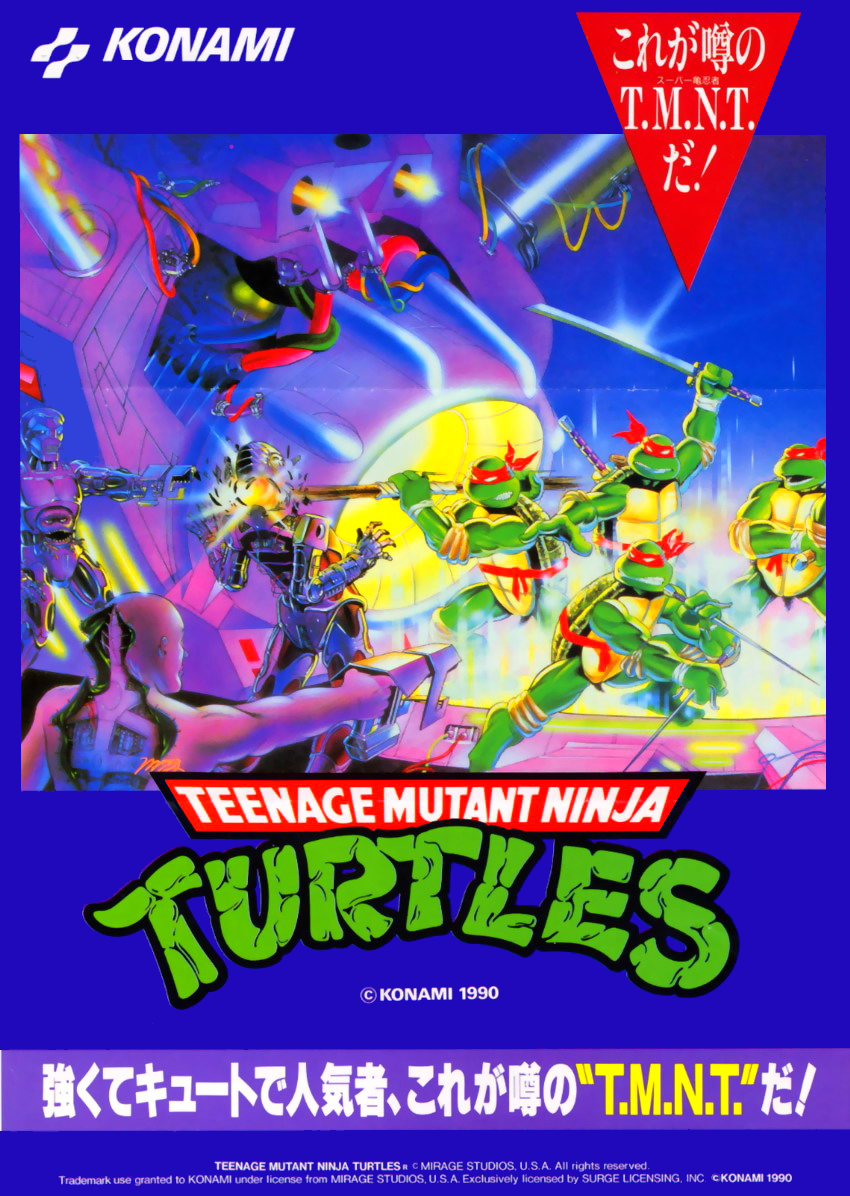
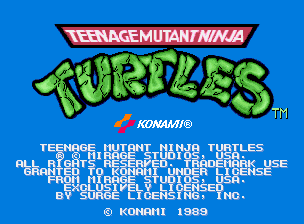
Teenage Mutant Ninja Turtles for arcade is Konami’s 1989 scrolling beat ’em up based on the 1987 animated series. This Oceania two-player version belongs to the original arcade release, rather than the later NES conversion sometimes called Teenage Mutant Ninja Turtles II: The Arcade Game. Konami developed and published the coin-op during the height of the Turtles’ late-1980s popularity, adapting Leonardo, Michelangelo, Donatello, and Raphael into a fast-moving cooperative game for arcades.
The story begins with Shredder’s forces abducting April O’Neil and Master Splinter. One or two players choose a Turtle and pursue the Foot Clan through a sequence of New York City locations and increasingly fantastical enemy territory. The campaign follows the cartoon’s broad setup instead of trying to retell a comic-book storyline, using familiar allies, villains, and dramatic scene changes to give each stage a clear destination. The final aim is to reach Shredder after freeing the Turtles’ friends and overcoming his lieutenants.
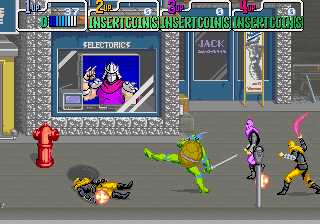
Teenage Mutant Ninja Turtles arcade gameplay uses an eight-way joystick and two buttons: one for attacking with a Turtle’s signature weapon and one for jumping. The basic rhythm is direct and readable—move through a scrolling area, clear groups of opponents, and meet a boss at the end—but positioning matters when the screen fills with enemies. Players can combine jump and attack for a special move, toss certain foes, and knock adversaries into walls or scenery. Breakable or hazardous objects such as street fixtures and explosive containers can turn crowded encounters to the heroes’ advantage.
Each Turtle has a different combat feel. Donatello’s bo staff reaches farther but his attacks are slower, while Michelangelo and Raphael trade that reach for quicker strikes with their nunchaku and sai. Leonardo occupies a middle ground between speed and range. In a dedicated four-player cabinet, each control position corresponds to a Turtle; the two-player conversion represented by this Oceania listing instead allows the available players to make their selections. That variation keeps the same arcade adventure while making it practical for a smaller cabinet layout.
Most opposition comes from color-coded Foot Soldiers whose weapons and behavior distinguish their threats. Some rush the players, some attack from a distance, and others can hold a Turtle in place, creating danger when other enemies are nearby. The boss roster draws heavily from the animated series, including Bebop, Rocksteady, Baxter Stockman, Granitor, General Traag, Krang, and Shredder. Their appearances provide recognizable set pieces without changing the game’s essential cooperative brawling structure.
The presentation was built to make a licensed cartoon world legible on an arcade floor. Large character sprites, city backdrops, spoken clips, and a version of the television theme reinforce the show’s tone between exchanges of punches and flying Foot Soldiers. Konami’s game was released under different names in some territories: Japan received Teenage Mutant Ninja Turtles: Super Kame Ninja, while the franchise was renamed Teenage Mutant Hero Turtles in the United Kingdom. The Oceania release retained the Teenage Mutant Ninja Turtles name.
The 1989 arcade game later reached home hardware, but those editions should not be confused with this two-player Oceania arcade revision. The Western NES adaptation added material and used the subtitle The Arcade Game to distinguish it from the earlier NES title, while several computer versions followed under the Hero Turtles name in Europe. Konami returned to the arcade formula with Teenage Mutant Ninja Turtles: Turtles in Time in 1991. The original remains a defining early example of a cartoon license shaped around simultaneous arcade play, distinctive character weapons, and a straightforward rescue mission.
Gallery

Details
- Developer
- Konami
- Publisher
- Konami
- Genre
- Beat 'em Up
- Players
- 1-4
- Release Date
- January 1, 1989
- System
- Arcade