About
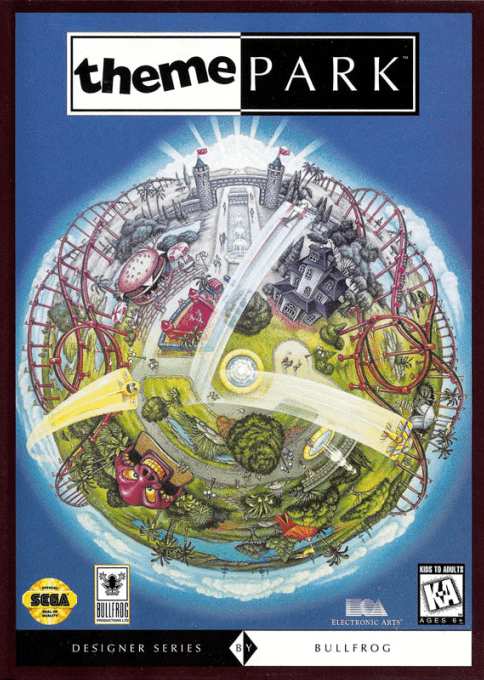
Theme Park for the Sega Genesis/Mega Drive is Bullfrog Productions' 1995 amusement-park construction and management simulation, published by Electronic Arts. Adapted from Bullfrog's 1994 computer game, it puts the player in charge of a new park with a plot of land, starting capital, and the long-term aim of building a business prosperous enough to expand into new locations. Rather than following a fixed story, the game turns the daily decisions behind a busy attraction into its subject: make a park inviting, keep its guests moving and spending, and balance the books while the calendar advances.
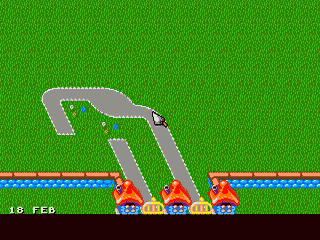
Construction begins with the layout. Players place paths, queues, rides, shops, facilities, landscaping, and water features, arranging them so visitors can reach what they want without creating a confused or inconvenient park. Attractions range from small fairground-style diversions to larger investments, and certain rides require the player to lay out their courses. A coaster or water attraction is therefore not merely an item selected from a menu; its route becomes part of the park's design. Trees, lakes, and other scenery give the grounds a more developed appearance, while toilets and refreshment outlets help serve the crowds drawn through the entrance.
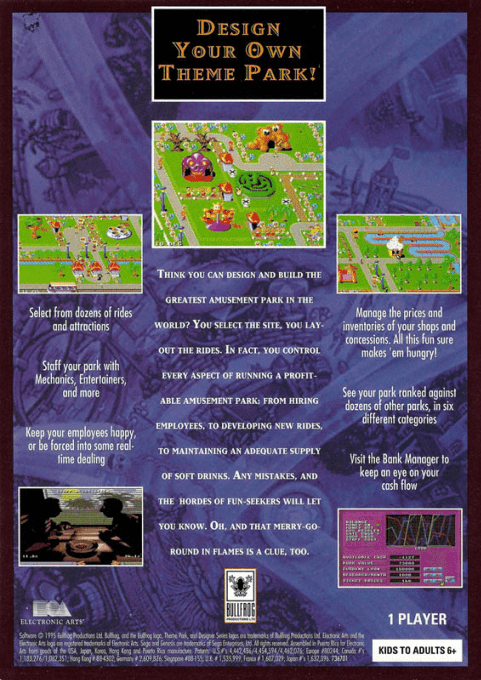
The management layer makes those building choices matter. Admission can be priced, and the park earns further income through food, drinks, souvenirs, and other attractions. Shop products can be adjusted in unusual detail, including settings connected to ingredients such as sugar, salt, or caffeine. The result is a simulation that asks players to consider both what visitors will buy and how much revenue each decision can generate. New rides and improvements are not all available at once: research is funded and directed to unlock additions and improve parts of the operation, so growth depends on planning as well as immediate spending.
A park also needs people behind the scenes. Theme Park lets the player hire staff including handymen, mechanics, security personnel, and entertainers. Their work affects the visible state of the grounds and attractions: untidy paths, failing rides, and disorder can undermine a park that looked successful on paper. Wages, stock supplies, and other costs add another layer to the financial side, while the difficulty setting determines how much of that business simulation the player must handle. At less demanding settings, the emphasis can remain on building an appealing park; at the deeper end, research, negotiation, and operational details require more attention.
Progression reaches beyond a single site. Strong performance increases the value of the business and enables the player to sell a park and start another in a different part of the world. Those locations bring their own conditions, including differing land, weather, and economic factors; the Genesis/Mega Drive and Super NES releases also use location-specific environments such as desert and glacier settings. This structure gives the game a campaign-like sense of advancement without abandoning the freedom to decide where rides, services, and scenery belong. Performance is assessed over the in-game years, encouraging a sustainable operation instead of a park built only for a quick profit.
The Genesis/Mega Drive version brings a controller-driven take on a detailed PC-style simulation to Sega's 16-bit console. It is a single-player game, and its interface condenses a broad set of building and business choices into menus and park views rather than relying on a mouse. Some features vary among Theme Park ports; for example, the Mega Drive release does not include the PC version's zoning feature. Its central identity remains intact, however: a colourful Bullfrog simulation where the roller coasters, shops, staff, queues, and finances all belong to one connected park. Theme Park later became the first entry in Bullfrog's Theme series, followed by Theme Park World and Theme Park Inc.
Gallery
Details
- Developer
- Bullfrog
- Publisher
- Electronic Arts
- Genre
- Management Simulation
- Players
- 1
- Release Date
- May 2, 1995
- System
- Genesis/Megadrive