About
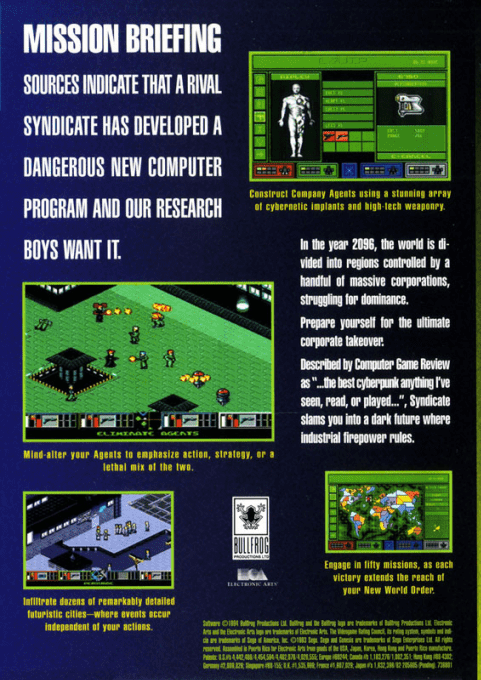
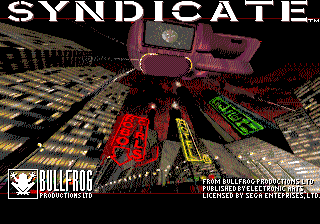
Syndicate for the Sega Genesis, known as the Mega Drive outside North America, brings Bullfrog Productions' dystopian real-time tactics game to 16-bit console players. Published by Electronic Arts in 1994, this version casts the player as the executive of a ruthless corporation in a future where multinational syndicates have displaced conventional governments. From a management screen and a global map, the campaign sends a small squad of cybernetically altered agents into city-based operations as the company competes for control of territory around the world.
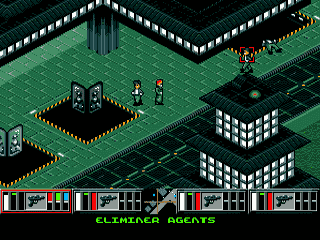
Each operation unfolds from an angled, isometric viewpoint and takes place in real time. Players direct one to four agents through dense streets populated by civilians, guards, police, vehicles, and competing operatives. Missions call for more than simply reaching an exit: objectives can involve eliminating a rival, recovering an item, rescuing or abducting a target, converting a person to the corporation's side, or overcoming enemy agents. Careful positioning, keeping the squad together, and choosing when to press ahead all matter, because a crowded map can rapidly become dangerous once combat begins.
The Genesis Syndicate revolves around preparing a team for those assignments. Before deployment, agents can be equipped with weapons and useful devices, and their cybernetic capabilities can be developed as the campaign advances. Pistols and shotguns suit basic confrontations, while later equipment broadens the options available for difficult jobs. The Persuadertron is one of the game's defining tools: rather than simply attacking, it can make susceptible people follow the squad. Recruited civilians may become a moving escort or provide extra help in a tense encounter, giving missions an unusual alternative to direct force.
Between missions, the strategic layer connects every successful operation to the wider campaign. Conquered regions supply income, which can be directed toward research, equipment, replacements, and further agent improvements. Taxation creates a trade-off: higher revenue helps fund the organization, but pushing a territory too far can provoke unrest and require the player to regain control. That loop makes the game more than a sequence of action stages; the condition of the player's growing corporate empire affects how well prepared its agents will be for the next assignment.
Although it shares its cyberpunk premise and basic structure with Bullfrog's earlier computer game, Syndicate on Genesis is a console-specific adaptation rather than a straight copy. It uses a redesigned set of levels and altered presentation for Nintendo and Sega hardware, while retaining the mix of strategic planning and immediate squad action. The pad-based interface also changes how commands are issued compared with the mouse-driven computer editions, asking players to handle selection, movement, equipment, and targeting through the Genesis controller during fast-moving missions.
The setting supplies the campaign with its cold corporate tone. Syndicates wage their private wars while the public lives under the influence of powerful companies, and the agents are expendable instruments of that conflict. Missions move from one territory to the next as the player expands a personal organization against rival groups. The contrast between the clean planning screens, urban operations, and the ability to influence bystanders helps define the game’s identity: it is a tactical action game where manipulation, money, research, and territorial control sit alongside firefights.
As the first entry in the Syndicate series, the Genesis release preserves the core idea that made Bullfrog's game distinctive in the early 1990s: command a customizable cyborg team while running the organization that sends it into the field. Its single-player campaign combines short, objective-driven missions with longer-term economic and research decisions, and its 16-bit redesign gives Sega Genesis and Mega Drive owners their own version of the corporate-conquest fantasy. Later games and reworkings would revisit the name, but this release remains rooted in the original isometric strategy concept.
Gallery

Details
- Developer
- Bullfrog
- Publisher
- Electronic Arts
- Genre
- Turn-Based Strategy
- Players
- 1
- Release Date
- January 1, 1994
- System
- Genesis/Megadrive