About
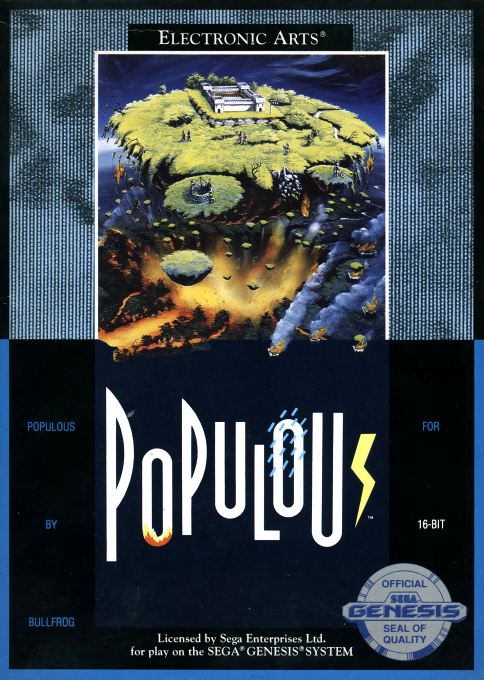
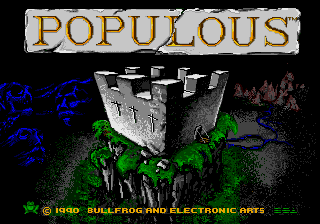
Populous for the Sega Genesis, released in North America in 1990, brings Bullfrog Productions' landmark strategy concept to the console in a single-player cartridge published by Electronic Arts. Designed by Peter Molyneux's British studio, this is the original Populous: a real-time contest between two rival deities rather than the later Populous II or Populous: The Beginning. Each stage places the player's followers and an opposing tribe on an isometric landscape. The goal is to build enough strength to erase the other god's people, then move on through a long sequence of worlds. Its combination of settlement growth, terrain management, and supernatural intervention made Populous an unusually ambitious fit for the Genesis library.
The first task in every Populous battle is practical rather than destructive. Followers need level ground before they can settle, so the player raises hills and lowers ridges to make usable plots. Once a tribe has room to construct homes, its population grows and its worship increases the pool of divine power used for later actions. The shape of the land therefore becomes a resource: a broad, flat space can support a larger settlement, while a poorly planned map can strand people or leave a community exposed. Success comes from balancing expansion with interference, since the rival deity is developing its own territory at the same time.
As power accumulates, Populous expands the player's influence beyond simple landscaping. Its miracle commands can reshape the conflict with earthquakes, swamps, volcanoes, and floods, each capable of changing where a population can live or directly threatening people and buildings. A leader can also be strengthened and turned into a knight, giving the tribe an aggressive force that heads into enemy territory. The climactic Armageddon power gathers the two sides for a final confrontation, so it is most useful after careful preparation has created an advantage. The game continually turns a peaceful-looking building exercise into a race to decide when construction, defense, mobility, or an attack will have the greatest effect.
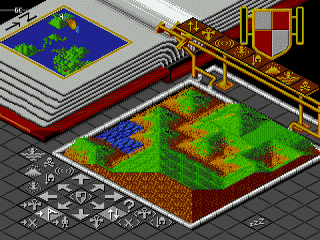
The Genesis version presents this contest through the series' recognizable tabletop-like interface: the main isometric world shares the screen with an overview map, status displays, and command icons. It was designed for one player, and the console adaptation translates a game rooted in mouse operation to the standard three-button Genesis pad. The direction pad moves the cursor across the map, while the A and C buttons provide direct raising and lowering of terrain. Commands and map information allow the player to survey a wider battlefield, follow important units, and choose powers as they become available. The result is a deliberately paced strategy game in which pausing to read the terrain can be as important as acting quickly.
This Genesis/Mega Drive edition preserves the central structure of the original computer release: a campaign of more than 500 passworded stages set across different landscape types, including grassland, snow, marsh, and desert environments. Climate and geography are more than decoration because they affect how easily followers can find and develop territory. The North American Genesis cartridge appeared after Populous had begun on home computers in 1989; Sega published the Japanese Mega Drive release in 1991. Later computer expansions introduced additional novelty landscapes, but they are not part of this early Genesis conversion. That distinction matters when exploring the game's many versions, as Populous was adapted for a remarkably wide range of machines.
Populous is widely associated with the rise of the "god game," a label used for strategy games that give the player indirect control over a society and direct authority over its world. Bullfrog followed it with Powermonger and then Populous II: Trials of the Olympian Gods, while the original's approach to terrain, population, and escalating powers remained its own compelling formula. On Sega Genesis, the game stands apart from the system's faster action staples by asking the player to observe a living map, nurture a small community, and turn an entire landscape into the weapon that wins the war between gods.
Gallery

Details
- Developer
- Bullfrog
- Publisher
- Electronic Arts
- Genre
- Turn-Based Strategy
- Players
- 1
- Release Date
- January 1, 1990
- System
- Genesis/Megadrive