About
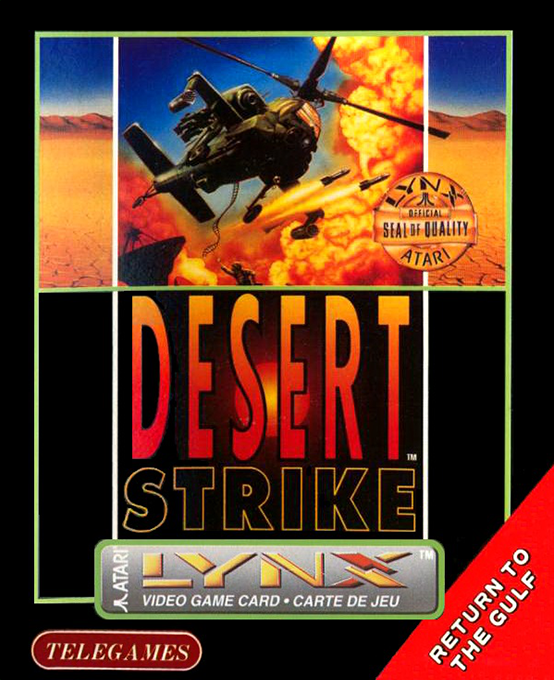
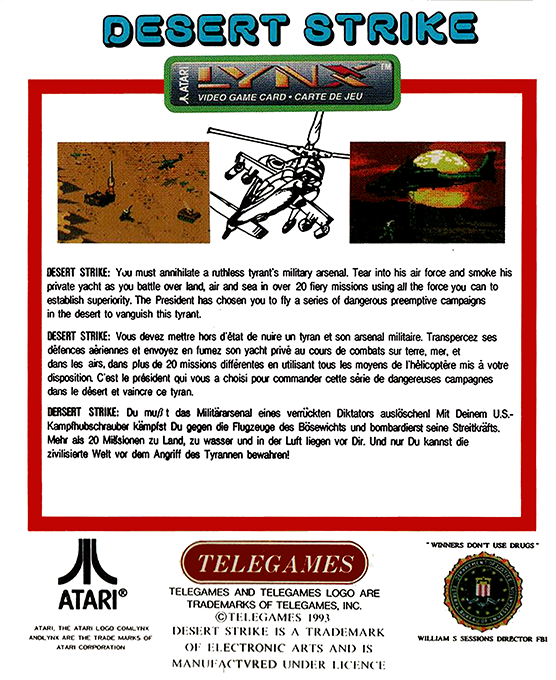
Desert Strike for Atari Lynx brings the helicopter action and mission planning of Electronic Arts' 1992 Strike series to Atari's color handheld. Developed for the Lynx by Teque London and published by Telegames in 1993, this version adapts Desert Strike: Return to the Gulf, the first entry in a long-running action series. The campaign casts the player as an American Apache helicopter pilot dispatched to stop General Kilbaba, a dictator who has seized a fictional Persian Gulf emirate and is building a military threat against its neighbors.
Rather than treating every encounter as a straightforward shooting gallery, Desert Strike combines combat with resource management and route planning. Each operation unfolds over a broad, overhead battlefield that can be explored in several directions. The helicopter carries a machine gun, rockets, and more powerful missiles, but ammunition is finite; fuel and armor are limited as well. Fuel drums and ammunition crates scattered across the map become part of the tactical problem, as the pilot must judge how far to travel, what targets to attack first, and when to head back toward a safer area.
The four campaigns are divided into linked objectives. Missions can ask the player to eliminate airfields, missile launchers, weapon facilities, or other installations, while rescue work and the capture of enemy personnel add different demands. People picked up by the Apache must be transported to designated landing zones, and the passenger load can also help restore the helicopter's armor. Enemy resistance includes ground troops, armored vehicles, tanks, and anti-aircraft defenses, so positioning and weapon choice matter as much as reflexes. Losing all armor or running out of fuel costs a helicopter, making a careful approach essential.
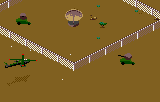
On the Lynx, the Apache is viewed from above at a three-quarters angle, with the directional controls used for movement and separate buttons firing the available weapons. The handheld conversion retains the series' pause-screen mission information and offers a choice of co-pilot/gunner that affects performance. The portable format necessarily presents the battlefield on a smaller display than the home-computer and console editions, but it preserves the central balance of flying, shooting, reconnaissance, and supply collection. Passwords issued after campaigns allow progress to be resumed rather than requiring the full operation to be replayed in one sitting.
The premise was shaped by the political atmosphere surrounding the Gulf War, though the game places its conflict in a fictional setting and uses invented names. Its story moves through escalating threats involving captured personnel, chemical and biological weapons, oil infrastructure, nuclear material, and the pursuit of Kilbaba himself. That topical setting gives the missions a connected sense of urgency: objectives are not merely stage-clear targets, but parts of a campaign intended to weaken the dictator's forces before their plans can be carried out.
Desert Strike established the formula later expanded by Jungle Strike, Urban Strike, Soviet Strike, and Nuclear Strike. The Lynx edition is the only game from the original trilogy of 16-bit Strike sequels to reach Atari's handheld, making it a distinct version within the series' history. Its blend of isometric helicopter combat and deliberate mission management stands apart from more linear shooters of its era, delivering a portable campaign in which conserving supplies and choosing a route can be just as important as firing at the next enemy target.
Gallery
Details
- Developer
- Teque
- Publisher
- Telegames
- Genre
- Shoot 'em Up
- Players
- 1
- Release Date
- January 1, 1992
- System
- Lynx