About
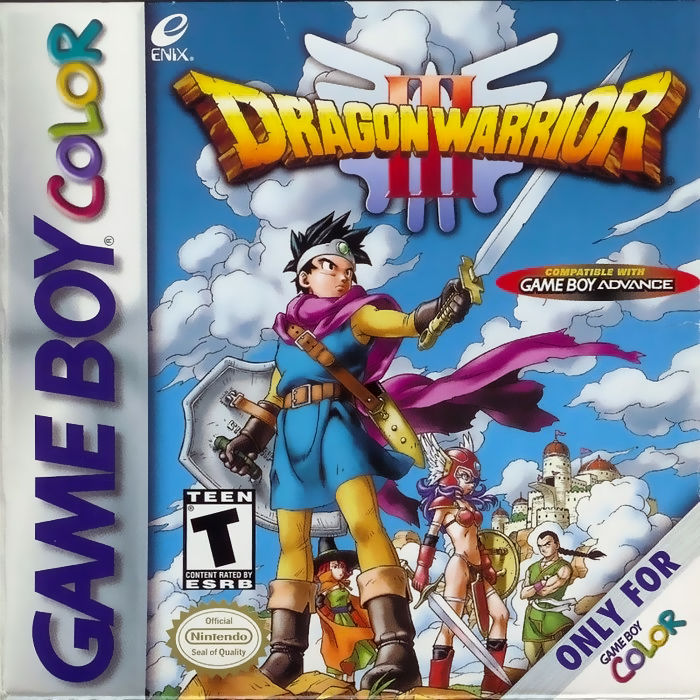
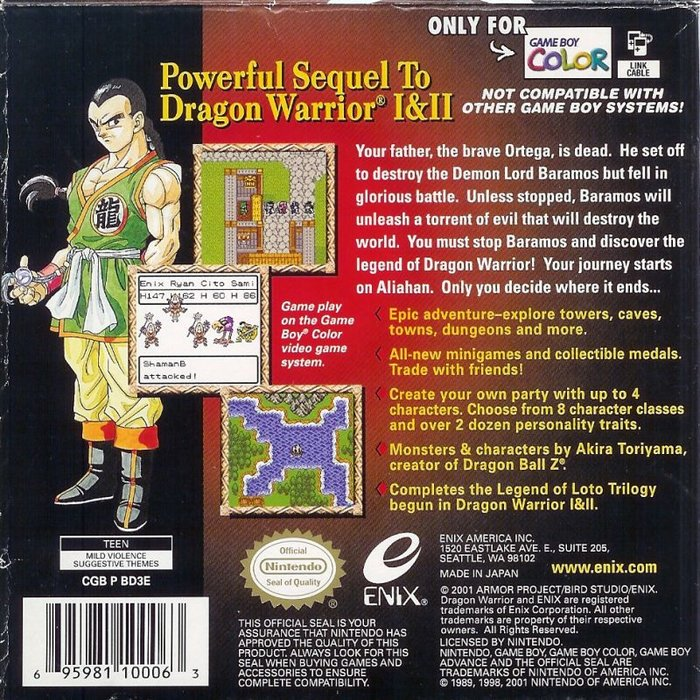
Dragon Warrior III for Game Boy Color is Enix America's 2001 North American release of the enhanced remake of the 1988 Japanese role-playing game Dragon Quest III. It brings the long quest of Aliahan's young Hero to Nintendo's color handheld under the Dragon Warrior name, building on the earlier Super Famicom remake rather than simply reproducing the NES game. The story begins when the Hero, child of the celebrated warrior Ortega, is called upon to continue a mission Ortega could not finish: stopping the archfiend Baramos from bringing ruin to the world. Although it is the third game released in its series, this adventure takes place before the first two Dragon Warrior stories and establishes the legend associated with Loto in this English version.
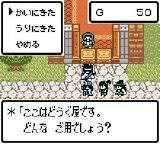
Play proceeds through a large top-down fantasy world of towns, castles, caves, towers, seas, and hostile wilderness. The Hero speaks with local residents, gathers equipment and key items, boards a ship, and gradually opens new routes while turn-based battles provide experience, gold, and monster encounters. Commands are selected from menus for attacks, spells, items, tactics, and other actions, so the challenge comes from preparing a group for the threats ahead as well as choosing moves in battle. The day-and-night cycle changes the atmosphere of travel and can affect the availability of people, shops, and events, giving the world a rhythm beyond its dungeon expeditions.
Rather than giving the player a fixed cast of story companions, Dragon Warrior III lets the Hero recruit adventurers at the tavern and build a party of up to four active members. The Hero remains in the Hero vocation, while recruits can begin as roles such as Warrior, Fighter, Cleric, Mage, Merchant, Gadabout, or the remake-added Thief. At Alltrades Abbey, qualifying companions can change vocation, restarting their experience progression while retaining learned spells. This makes it possible to shape a party around direct combat, healing, magic, speed, or more unusual combinations. A personality system also influences how characters' attributes grow, and the remake's opening and character-creation choices feed into that layer of party planning.
The main journey sends the party from Aliahan across regions modeled in part on real-world geography. Progress includes finding keys, resolving local troubles, earning a vessel, and collecting six magical orbs needed to summon the bird Ramia and reach Baramos's mountain-ringed stronghold. Defeating Baramos is not the final answer to the crisis: the adventure then reveals a deeper enemy, Zoma, and carries the party to Alefgard, the land linked to the earlier Dragon Warrior games. This structure lets the game shift from a father's unfinished quest into an origin story for the trilogy's central heroic legacy.
The Game Boy Color edition packages the revised graphics, expanded translation, battle animation, item conveniences, Mini Medals, and Pachisi board-game courses introduced by the Super Famicom remake for a portable system. It also adds features particular to this version, including collectible Monster Medals dropped by defeated foes. Two players can trade those medals through a Game Link Cable, and the collection is tied to further optional dungeon exploration. Postgame content, additional monsters and equipment, and the Thief vocation distinguish this release from the older North American NES cartridge while keeping its single-player campaign at the center.
Dragon Warrior III on Game Boy Color is therefore a handheld adaptation of a foundational Dragon Quest adventure, not a sequel set after the original American releases. Its scenario was created by Yuji Horii, with character artwork by Akira Toriyama and music by Koichi Sugiyama, and its remake framework preserves the series' mix of open travel, custom party building, and escalating discoveries. For players tracing the early Dragon Warrior trilogy on Game Boy Color, its renamed Loto legend and added collectible systems make this version a distinct chapter alongside Dragon Warrior I & II rather than merely a change of hardware.
Gallery
Details
- Developer
- Enix
- Publisher
- Enix
- Genre
- JRPG
- Players
- 1
- Release Date
- July 18, 2001
- System
- GBC