About
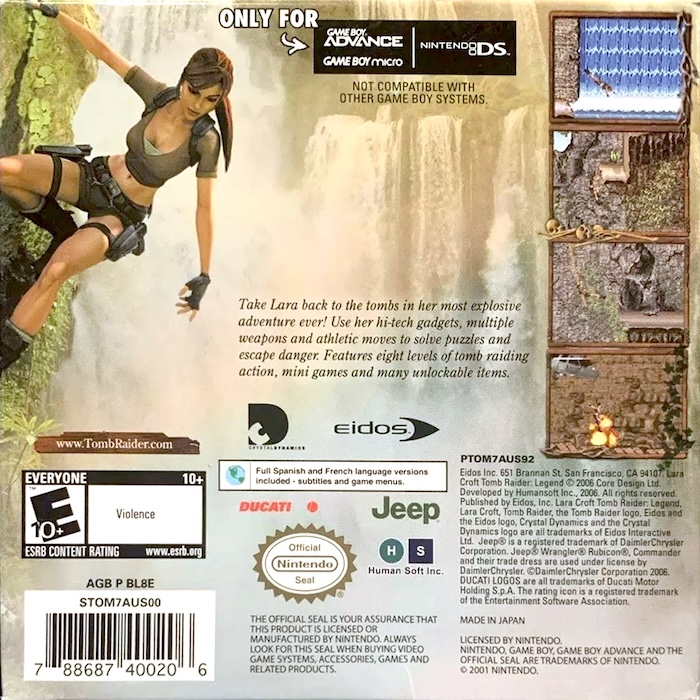
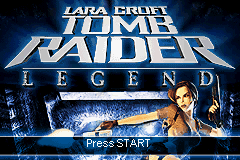
Released for Game Boy Advance in 2006, Tomb Raider: Legend is a handheld adaptation developed by Human Soft and published by Eidos Interactive. It brings Lara Croft's seventh main-series adventure to Nintendo's 32-bit portable, following the same broad narrative as the contemporary console game while rebuilding the experience around the GBA's strengths.
Lara’s expedition begins with her search for answers about the disappearance of her mother, Amelia, after a Himalayan plane crash years earlier. A clue in Bolivia points her toward fragments of a powerful ancient sword, and the pursuit carries her through ruins and hostile territory in Peru, Japan, Ghana, Kazakhstan, England and Nepal. The adventure ultimately ties the artifact to the legend of Excalibur and to Lara’s unresolved family mystery.
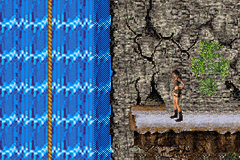
Rather than attempting the original game’s third-person 3D format, this version presents Lara’s journey as a fully 2D side-scrolling platform adventure. Sprite-based characters and scrolling backdrops frame a sequence of large, linear stages, while static illustrated scenes and text relay the story between missions. The result shares locations and plot beats with Legend elsewhere, but has its own tailored level design and visual presentation.
Traversal is built around Lara’s acrobatics. She runs, crouches, rolls, jumps, grabs ledges, climbs, shimmies, swings from ropes and horizontal bars, and uses the magnetic grapple to cross gaps or pull on designated objects. Progress regularly depends on reading the terrain, timing a leap, and finding a route upward through a screen of platforms, hazards and handholds.
Environmental puzzles break up the platforming. Lara can move heavy objects, operate switches and use gunfire or the grapple on parts of the scenery to open paths or trigger effects. Swimming sections add an air meter, while falls, traps and enemy attacks reduce health; health packs restore it, and checkpoints limit how much ground is lost after a failure.
Combat keeps Lara’s twin pistols at the center of encounters with wildlife and armed foes. She can draw and fire with the A button, run-and-shoot while moving, and collect alternate weapons or grenades from defeated enemies. The action also lets players turn the environment to their advantage by shooting or pulling objects that can damage nearby opponents.
The GBA controls make its platforming and combat workable on a compact button layout: the Control Pad handles movement, B performs jumps, A fires or activates context-sensitive actions, L operates the grapple, and R accesses or holsters weapons. Motorcycle sequences use R to accelerate, B to brake or reverse, the Control Pad to steer, and A to shoot, providing faster set pieces between the on-foot exploration.
It differs sharply from both the DS and home-console editions. The GBA game is strictly 2D, whereas the DS version mixes 2D sprites with angled 3D environments and adds touchscreen and microphone features; the console releases retain the full 3D, third-person design. This portable adaptation still preserves the series’ familiar blend of climbing, gunfights, traps and puzzle solving, but in a more direct side-scrolling form.
Gallery

Details
- Developer
- Human Soft
- Publisher
- Eidos Interactive
- Genre
- Action-Adventure
- Players
- 1
- Release Date
- November 14, 2006
- System
- GBA