About
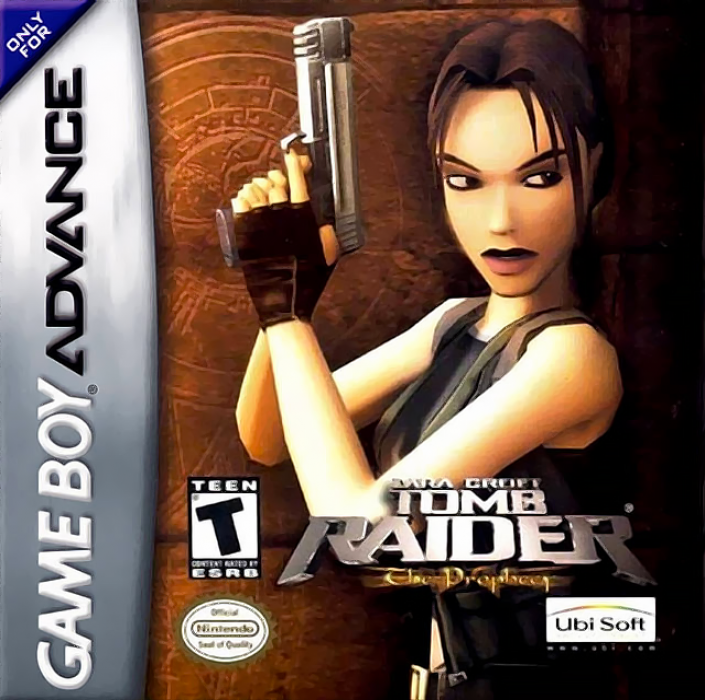
Lara Croft Tomb Raider: The Prophecy for Game Boy Advance is a 2002 single-player action-adventure built specifically for Nintendo's handheld by Ubi Soft Milan and published by Ubi Soft under licence from Eidos Interactive. Rather than adapting one of Lara Croft's larger console expeditions, this cartridge tells its own story. An ancient manuscript warns of a destructive occult force, drawing the archaeologist into a race to locate legendary stones before their power can be used for catastrophe.
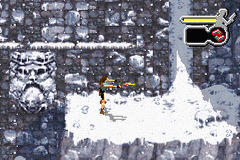
The Prophecy makes a major change from the side-scrolling Game Boy Color Tomb Raider games that preceded it. Its stages are viewed from a high, angled isometric perspective, with Lara moving through environments that suggest depth, ledges and layered routes. The viewpoint turns exploration into a matter of reading each chamber carefully: a path may continue around a wall, above a drop, across a narrow platform or through a passage revealed only after an obstacle has been dealt with.
Lara retains an athletic toolkit tailored to the Game Boy Advance controls. The directional pad guides her around hazards and along ledges, while the jump command is used for leaps and for reaching climbable surfaces. Context-sensitive actions let her grab, pull herself upward and negotiate edges. Sprinting and weapon handling are assigned to the shoulder buttons, keeping movement and combat close at hand as the player searches temples, ruins and other perilous locations.
Progress is driven by navigation, switches, keys, traps and combat encounters. Players look for routes through sealed areas, trigger mechanisms that alter the environment and collect useful items while managing danger from hostile creatures and human opponents. Lara begins with her familiar dual pistols and can find more powerful firearms, including Uzis and Golden Guns. Combat uses an automatic targeting approach suited to the overhead view, allowing the player to concentrate on positioning while keeping enemies in range.
The adventure's plot sends Lara between sites connected to the prophecy and its threatened magical legacy. Her investigation brings her into conflict with the Teg-du-Bhorez, a cult pursuing the same power, and gives the journey a clear treasure-hunt structure: uncover clues, survive the next set of ruins and prevent the opposing force from completing its objective. The mixture of solitary exploration, environmental puzzles and bursts of shooting preserves the central Tomb Raider idea in a compact portable form.
Lara Croft Tomb Raider: The Prophecy is also notable within the series as the first Tomb Raider game designed for Game Boy Advance and as a different technical answer to its earlier handheld relatives. Character movement, enemies and the camera presentation were arranged to evoke a three-dimensional adventure on the system, while the game uses passwords instead of battery-backed saves to resume progress. Released in North America in November 2002, it stands as a self-contained Lara Croft expedition from the period when the series was extending its formula across dedicated handheld hardware.
Gallery


Details
- Developer
- Ubisoft
- Publisher
- Ubisoft
- Genre
- Action-Adventure
- Players
- 1
- Release Date
- November 12, 2002
- System
- GBA