About
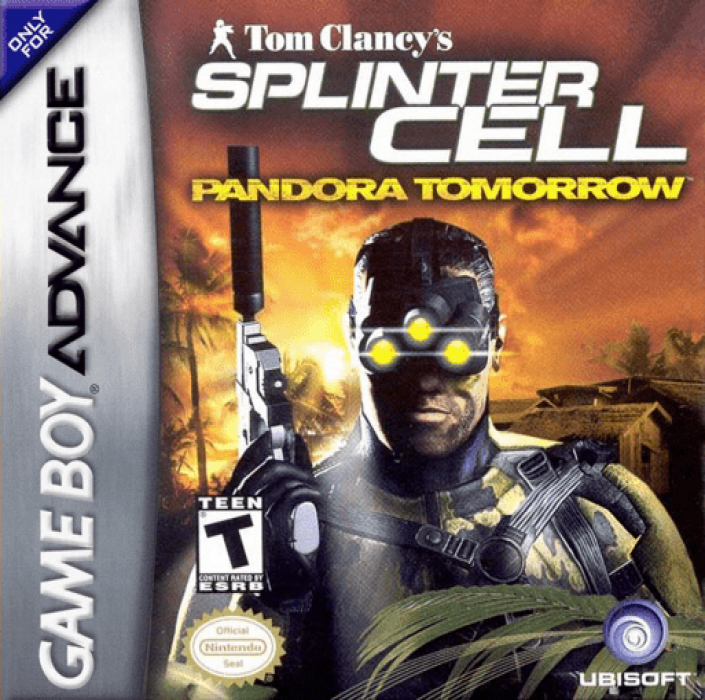
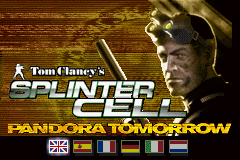
Tom Clancy's Splinter Cell: Pandora Tomorrow for Game Boy Advance is Ubisoft's 2004 portable stealth-action sequel, starring NSA operative Sam Fisher. Released in North America in March 2004, it adapts the second Splinter Cell story for Nintendo's 32-bit handheld as a 2D side-scrolling mission game rather than a scaled-down version of the PC and console releases. Ubisoft developed and published this GBA edition, which follows Fisher as Third Echelon sends him into an international crisis involving an Indonesian terrorist network and the threat behind the name Pandora Tomorrow.
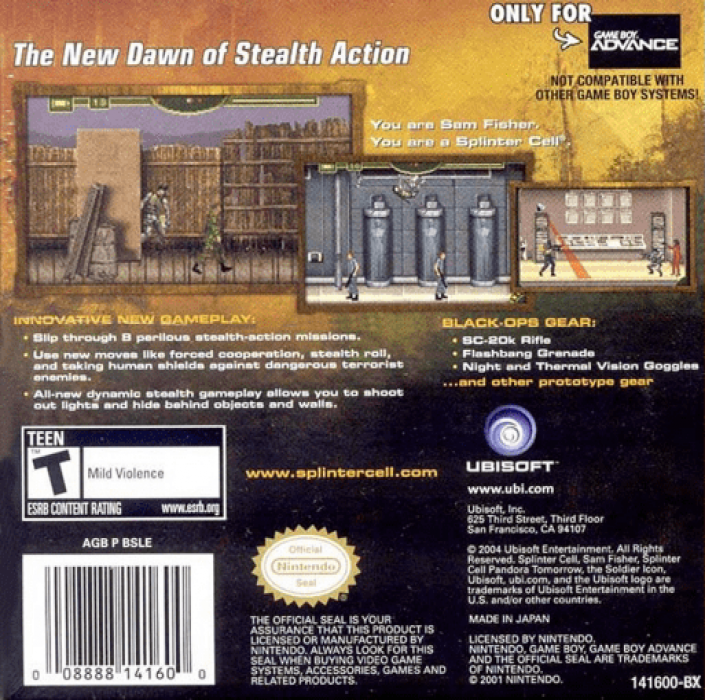
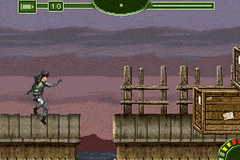
The campaign is built around nine missions and 22 objectives. Fisher infiltrates guarded sites, locates intelligence, rescues targets, bypasses security, and works toward each assignment's extraction point. The side-on viewpoint changes how the series' espionage ideas play: players read platforms, patrol routes, doors, pipes, cover, and pools of darkness across compact 2D environments. Progress depends on reaching a mission's required goals, and individual areas can impose strict conditions, making observation and a careful approach more useful than rushing ahead.
Stealth remains the centre of Tom Clancy's Splinter Cell: Pandora Tomorrow on GBA. Sam can crouch, sneak, roll, climb pipes, hang from overhead surfaces, and press against walls to reduce his exposure. Darkness and solid scenery offer places to hide, while binoculars let players look ahead beyond the current screen. An on-screen radar marks patrolling guards, but it does not reveal which way they are facing, so timing still matters. Guards can discover downed allies, encouraging players to move bodies out of sight when the situation allows.
Fisher's equipment gives the handheld version several ways to deal with obstacles. Night vision and thermal vision are available to help with low-light conditions and surveillance. His SC20K can handle guards and disable cameras; its alternate fire launches flashbang grenades to disorient nearby enemies. Fisher can also approach from behind and use a chokehold, then make a captured guard operate a retinal scanner in certain situations. These options sit alongside close combat and the pistol, but missions may restrict lethal tactics, reinforcing the series' emphasis on disciplined infiltration rather than indiscriminate combat.
The game also converts specialist spy work into short interactive challenges. Lock picking, rooftop rappelling, and similar tasks are represented through minigames, with 14 of these challenges tied to objectives across the campaign. Three Silent Scope activities—Camera Shoot, Sniper, and Laser Mic—provide distinct gadget-focused scenarios. This structure lets the cartridge include familiar Splinter Cell tools and mission variety without trying to reproduce the original releases' fully 3D spaces.
Pandora Tomorrow is the second entry in the Tom Clancy's Splinter Cell series, following the first game and preceding 2005's Chaos Theory. Its Game Boy Advance version is a separate portable interpretation: it shares Sam Fisher and the broader Pandora Tomorrow conflict with its contemporaries, but it uses its own side-scrolling design, mission layout, and GBA-focused mechanics. Unlike the console editions' notable online modes, this handheld release is a single-player experience. For Game Boy Advance players, it presents the series' signature surveillance, gadgets, and covert problem-solving through a purpose-built 2D format.
Gallery
Details
- Developer
- Ubisoft
- Publisher
- Ubisoft
- Genre
- Other Adventure
- Players
- 1
- Release Date
- March 24, 2004
- System
- GBA