About
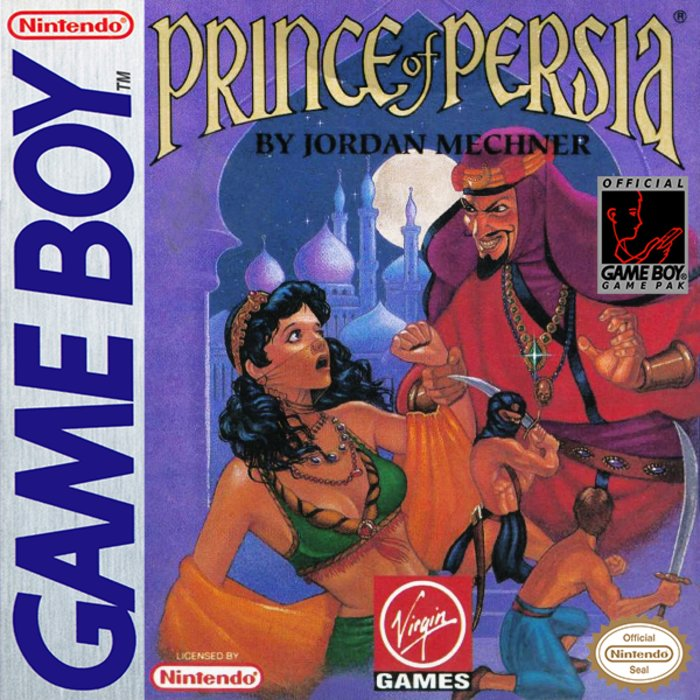
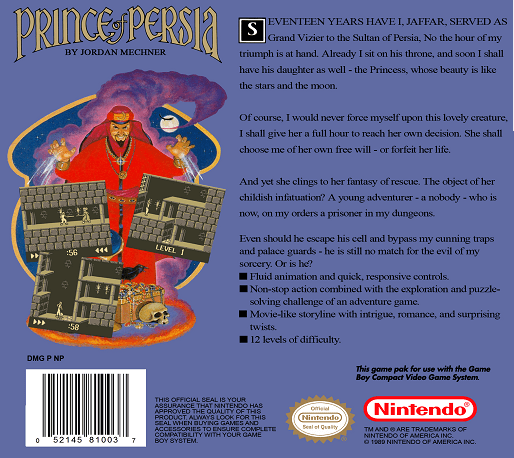
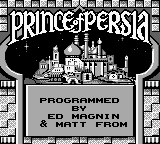
Prince of Persia for Game Boy is the 1992 handheld conversion of Jordan Mechner and Brøderbund’s 1989 cinematic platform adventure. Virgin Games, also billed as Virgin Interactive, published the North American cartridge in January 1992; NCS released it in Japan later that year and Mindscape handled Europe. The port retains the central tale of a nameless adventurer imprisoned by the Grand Vizier Jaffar while the Sultan is away at war. Jaffar has given the Princess an hour to accept marriage or die, so the rescue is governed by the same real-time deadline that drives the game’s action.
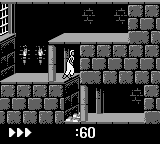
The objective is not to accumulate points but to escape the dungeon and reach the Princess before the sixty-minute clock expires. The adventure is built around twelve levels of linked, fixed-screen rooms, with each exit leading to another chamber of the palace or its underground prison. A wrong turn, a missed switch, or an overly cautious route costs precious seconds. Death sends the Prince back to the beginning of the current level, while passwords issued after completed stages make it possible to resume a later attempt with the remaining time and health recorded.
Platforming depends on momentum and deliberate positioning rather than instant arcade movement. The Prince runs, makes standing or running jumps, crouches, climbs up ledges, climbs down to hang, and can grab a lip after a jump or fall. Loose floors, spike traps, slicing gates, pressure plates, deep drops, and poisoned potions turn individual rooms into small spatial problems. Progress often means finding the switch that opens a distant door, judging a leap from exactly the right takeoff point, or deciding whether a detour for a life-extending potion is worth the time.
The Game Boy controls preserve that careful rhythm with a compact but unusual layout. The Control Pad handles running, crouching, climbing, and a vertical jump; A makes the Prince leap forward in the direction he faces, while B produces a single cautious step. Those measured steps are essential near false floors, pits, and spikes, and either action button can be used to catch a ledge. Start begins or pauses play and Select controls the music. The deliberate animation gives every command a commitment, so a safe-looking jump can still fail if the player begins it a fraction too early.
Sword fights punctuate the exploration once the Prince finds his weapon. A guard causes the sword to draw automatically, changing the same buttons from movement aids into combat commands: A attacks and B or Up blocks. Fencing is a matter of reading distance and timing a parry before returning a thrust; rushing a guard can quickly deplete the Prince’s limited health. Small red potions restore a health unit, large red potions permanently increase maximum health, and blue potions are harmful, so observation matters as much as reflexes.
On the original Game Boy, the conversion compresses the experience into the system’s four-shade monochrome display. The rooms are scaled to fit the handheld screen instead of using the scrolling compromises seen in some console versions, but the absence of colour makes dungeon and palace locations look more alike than on richer ports. Its audio and sound effects were adapted for the Game Boy hardware, while the striking rotoscoped movement remains the feature that carries across the smaller machine.
This is the original black-and-white Game Boy version, not the later 1999 Game Boy Color reissue. It keeps the core twelve-level campaign and its familiar guards, traps, shadow encounter, and showdown with Jaffar, but it does not have the colour presentation or the short training stage added for Game Boy Color. It also lacks the expanded stages, extra enemies, and broader audiovisual upgrades found in versions such as the Super NES release. As a result, the cartridge is best understood as a compact, faithful take on the original structure, with its tension coming from exact movement and an hour that never stops counting down.
Gallery
Details
- Developer
- Brøderbund Software
- Publisher
- Virgin
- Genre
- Platformer
- Players
- 1
- Release Date
- January 1, 1992
- System
- GB