About
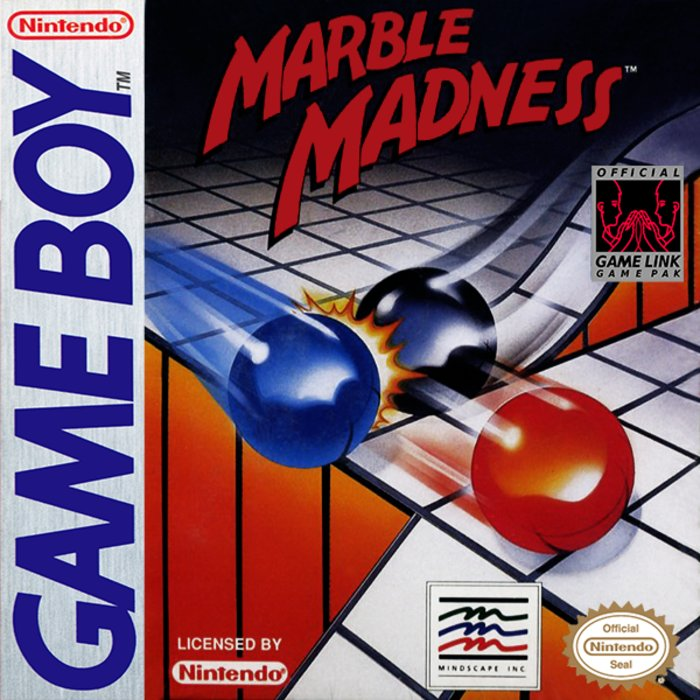
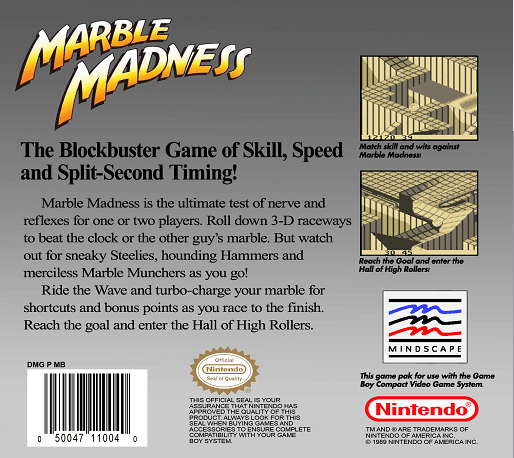
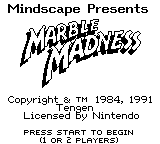
Marble Madness for Game Boy is a 1991 handheld adaptation of Atari Games’ arcade marble-racing game, developed by Tengen and published by Mindscape. It translates the original’s tilted, three-dimensional-looking courses to Nintendo’s monochrome portable system, asking players to guide a rolling marble from the start of each maze to its Goal Line before the clock expires. The premise is immediate, but the changing angles, narrow paths, drops, and roaming hazards make every run a contest of route knowledge and precise steering.
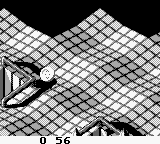
The single-player game is built around five timed levels. A course is not simply a straight race: it is an isometric obstacle course where the apparent direction on screen can differ from the direction requested on the Game Boy Control Pad. Before starting, players can choose a 45-degree or 90-degree steering arrangement, allowing them to select the response that feels most comfortable for the course perspective. The marble has no conventional jumping or attacking moves; success comes from keeping it on the track, correcting momentum before a ledge, and finding the quickest path to the finish.
Speed is an important tactical resource in this Game Boy version. Either A or B gives the marble a turbocharged burst, which can help it clear a tricky section, get away from danger, or reach a shortcut in time. It also increases the risk of carrying too much speed toward an edge. A fall or enemy encounter removes the current marble and costs precious seconds while another appears, and running out of time ends the game. The supply of marbles is unlimited, so the real limitation is always the countdown rather than a fixed stock of lives.
The courses add personality through their traps, detours, and score opportunities. Marble Munchers threaten to consume an unwary racer, while the Steelie is a pursuing rival marble that can be avoided or knocked from a ledge for bonus points. The manual also points players toward shortcuts, including a wave on the third level, and the opening level contains a turbo-assisted route to a tic-tac-toe grid with extra points. Time left after a completed stage carries into the next one from levels two through five, making efficient navigation valuable both for the score and for the extra breathing room it provides later.
Marble Madness also supports head-to-head play through the Game Boy Game Link Cable. Each player needs a Game Boy and a copy of the cartridge; Player One uses white marbles and Player Two uses black ones as they race toward each Goal Line. That competitive option preserves a defining idea of the arcade game while fitting the hardware’s link-play format. Rather than reproduce the arcade cabinet’s trackball, this edition reshapes its distinctive rolling challenge around the handheld’s directional controls, with configurable steering and turbo bursts giving the Game Boy release its own approach to the classic timed maze race.
Gallery
Details
- Developer
- Tengen
- Publisher
- Mindscape
- Genre
- Maze
- Players
- 1
- Release Date
- May 2, 1991
- System
- GB